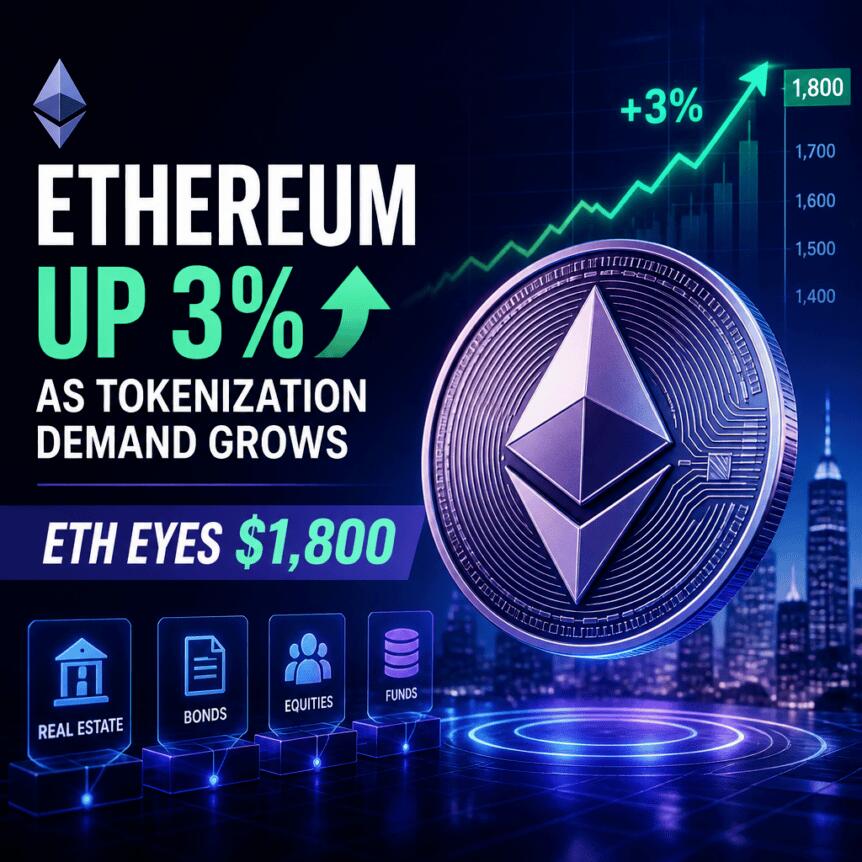
Ether (ETH) rose roughly 3% from Thursday to Friday, briefly lifting it above broader market performance as activity around tokenization and fresh ecosystem flows gained attention. The latest
Ether (ETH) rose roughly 3% from Thursday to Friday, briefly lifting it above broader market performance as activity around tokenization and fresh ecosystem flows gained attention. The latest narrative has been fueled by Robinhood Chain’s early success and continued corporate treasury-style accumulation, but several onchain and derivatives indicators still point to a more cautious backdrop—leaving traders to ask whether ETH can realistically revisit the $1,700 area or whether the bounce fades near resistance around $1,800.
Key takeaways
- Robinhood Chain’s launch has added measurable ETH demand via bridging, reinforcing the tokenization-and-layer-2 growth thesis.
- Rwa.xyz data places Ethereum at 47% market share in tokenized real-world assets, underscoring its continuing role in RWA issuance.
- Ethereum’s onchain fundamentals look muted: weekly DApp revenue and active addresses are both down versus earlier in 2026, according to DefiLlama.
- Perpetual futures funding has cooled, suggesting bullish leverage demand is weaker than it was at the start of the move.
- Corporate-style accumulation by BitMine remains a support factor, but it doesn’t automatically translate into a sustained break above $1,800.
Robinhood Chain and RWA momentum lift sentiment
A major driver behind the renewed optimism is the layer-2 network Robinhood Chain, which has been rolling out with ETH as its native gas token. During its first week, the network recorded $106 million in bridge deposits, according to coverage referenced in the article. This kind of “bridge in” activity matters because it converts ETH from a speculative asset into operational fuel for a growing execution environment—an angle that tends to resonate with investors focused on utilization rather than just headlines.
The ecosystem story is also reinforced by the TradFi presence behind the project. Robinhood offers tokenized stock products to customers across 120 countries, which strengthens the case for an EVM-compatible pipeline where tokenized assets can be issued, traded, and settled with less friction than siloed systems.
Ethereum’s share of tokenized assets remains dominant
Beyond Robinhood Chain, tokenization continues to serve as the clearest thematic tailwind for Ethereum. According to Rwa.xyz data cited in the source, Ethereum accounts for 47% of the RWA tokenization market. The same dataset highlights major non-stablecoin offerings such as SKY’s Tether Gold (XAUT), Ondo US Dollar Yield (USDY), and Franklin Templeton’s government bonds (iBENJI).
The article also points to tokenized stocks as key growth pockets, including Strategy’s PP variable (STRCx) on xStocks and Circle’s CRCLon from Ondo. For investors, the practical takeaway is that Ethereum’s advantage here is not just price—it’s infrastructure density. When RWA products cluster on one chain, liquidity and tooling tend to compound, making it harder for alternative ecosystems to fully replicate the same rails.
“TVL vs. market cap” looks supportive—but usage metrics are cooling
One of the most bullish signals discussed comes from Lisk research head Leon Waidmann, who said in comments referenced by the source that Ethereum’s total value locked (TVL) reached $260 billion—surpassing ETH’s market cap of about $210 billion. The argument presented is that this mismatch suggests ETH may be underpriced relative to network utilization, and the article frames it as a distortion compared with the 2022 bear market.
However, the counterweight is that TVL alone doesn’t guarantee demand for new users or new trading activity. The source highlights that Ethereum’s decentralized application performance has weakened during 2026’s broader downturn. Per DefiLlama figures cited, Ethereum DApps generated about $11 million in weekly revenue, down from $20 million in the first quarter of 2026. The decline is reflected in user activity as well: active addresses fell to 3.2 million from 5.4 million earlier in 2026.
Examples of specific dApps mentioned include Sky at $3.1 million in weekly revenue, Titan Builder at $2.4 million, and Chalink at $1.1 million—useful datapoints because they show where value generation remains concentrated, even as the overall trend softens.
Derivatives and funding data signal weaker conviction
Even with fundamentals that may look comparatively strong on a valuation basis, market structure is sending caution flags. The article notes that ETH’s perpetual futures annualized funding rate dropped to around 3% on Saturday, below a 6% neutral threshold used to gauge bullish positioning demand. It also contrasts this with peak funding levels around 12% seen earlier in the week, implying that the surge in leverage enthusiasm didn’t sustain.
In practice, cooling funding rates can mean fewer aggressive long positions entering the system. While price can still rise on spot inflows, sustained breakouts typically require derivatives confirmation—either through continued positive funding (for trend-chasing longs) or, in some setups, through reduced funding as price consolidates rather than sharply reversing.
BitMine accumulation adds a potential floor—yet doesn’t settle the $1,700 question
Another reason bulls have more support than pure chart narratives is corporate-style ETH accumulation. The source references Arkham Intelligence, which flagged an ETH withdrawal of 20,500 tokens worth about $36 million from Galaxy Digital to a new wallet on Thursday. The article connects this pattern to previous “BitMine Immersion” purchases and states that BitMine added 198,370 ETH over the past 30 days.
As further context, the article cites that BitMine now holds $10.3 billion in reserves. That matters for traders because large, recurring reserve accumulation can dampen downside volatility—particularly when the market is otherwise relying on speculative momentum. Still, the source argues that the combination of strong tokenization themes and weak onchain/derivatives conditions does not, by itself, justify assuming an automatic retest of $1,700.
That tension is the core of the current setup: tokenization and L2 catalysts can drive short-term inflows, but weakening DApp revenue and declining active addresses suggest the broader usage engine is not fully re-accelerating. Meanwhile, derivatives cooling suggests that a rally may be more “supported” than “confirmed.”
Going forward, traders should watch whether ETH can clear and hold above the $1,800 area with improving utilization signals—especially active addresses and DApp revenue—as well as whether perpetual funding turns back up from its weaker levels. If onchain stagnation persists while derivatives confidence remains muted, any move toward $1,700 may depend more on external flows and reserve accumulation than on organic network demand.
This article was originally published as Ethereum Up 3% as Tokenization Demand Grows; ETH Eyes $1,800 on Crypto Breaking News – your trusted source for crypto news, Bitcoin news, and blockchain updates.