What is established: daily trading volume in Ethereum fell to $4.63 billion on Sunday, after $19.53 billion on Saturday. Our assessment follows further down: a market that moves this little s
What is established: daily trading volume in Ethereum fell to $4.63 billion on Sunday, after $19.53 billion on Saturday. Our assessment follows further down: a market that moves this little supply loses its depth first and its direction only later.
The price itself stood at $2,256 on Sunday evening, almost exactly where it was on Saturday evening. What makes the day interesting is therefore not the price move but what was missing behind it: volume. For anyone who wants to buy, sell or hold a leveraged position over the coming days, that is the more important number.
Ethereum price on Sunday evening: $2,256 with a $23.51 daily range
Ethereum traded at $2,256.27 on Sunday, November 1, at around 11:40 pm German time. That is 0.03 percent below the level 24 hours earlier, in effect unchanged. The daily high was $2,275.34 and the daily low $2,251.83. The gap between the two is $23.51, or 1.04 percent of the price. The figures come from the market overview on CoinGecko.
For context: on the two previous days Ethereum was still moving in ranges of several percent, because the Binance hack and the market slide that followed had shaken the entire market. By Sunday nothing of that was left. Ethereum's market capitalisation stands at $275.67 billion.
A daily range of one percent is unusually tight for Ethereum. In October the price lost 16.47 percent, from $2,684.71 on October 1 to $2,242.50 on October 31. Bitcoin got away with a 7.60 percent loss in the same month, from $83,576 to $77,223. After a month like that, a quiet Sunday is a pause rather than relief.
$4.63 billion in volume: Ethereum's thinnest trading day since August 17
Ethereum volume totalled $4.63 billion on Sunday. On Saturday, October 31, it was $19.53 billion, and on Friday $18.76 billion. The drop from Saturday amounts to 76.3 percent. The average of the seven days before Sunday was $11.18 billion.
We went through the daily volumes of the past 90 days to check. The last day with less Ethereum volume was August 17, with $3.31 billion. Before that, only August 16 with $2.84 billion, August 10 with $4.02 billion and August 9 with $3.40 billion came in lower. All of the other 85 days brought more volume than this Sunday. cryptoticker.io compiled this analysis itself on November 1, 2026.
There are 76 days between August 17 and November 1. During that time Ethereum traded both above $2,770 and below $1,860. So the market has seen movement, just not on this weekend.
Part of the explanation is the calendar. November 1 fell on a Sunday and on the first of the month at the same time, the monthly futures expiry on October 30 was already behind the market, and the big dates of the new week are still ahead. On top of that, one of the largest trading venues is only gradually releasing withdrawals again after the attack of October 29, which ties up capital that would otherwise move between exchanges.
Volume to market cap: 1.68 percent for Ethereum, 4.22 percent for Bitcoin
The absolute volume figure says little on its own, because Bitcoin has more volume simply by virtue of its size. The turnover ratio is more telling: daily volume divided by market capitalisation. It measures what share of the outstanding value changes hands in a day.
For Ethereum, that ratio stood at 1.68 percent on Sunday: $4.63 billion in volume on $275.67 billion in market value. Bitcoin came in at 4.22 percent on the same day, namely $65.91 billion in volume on $1,561.83 billion in market value. Relative to its size, Bitcoin traded two and a half times as actively as Ethereum this Sunday.
That is the real news of the day. What matters is the ratio: anyone moving a larger amount of Ethereum on a day like this meets a much thinner book than in Bitcoin, and that costs money before the price has even moved.
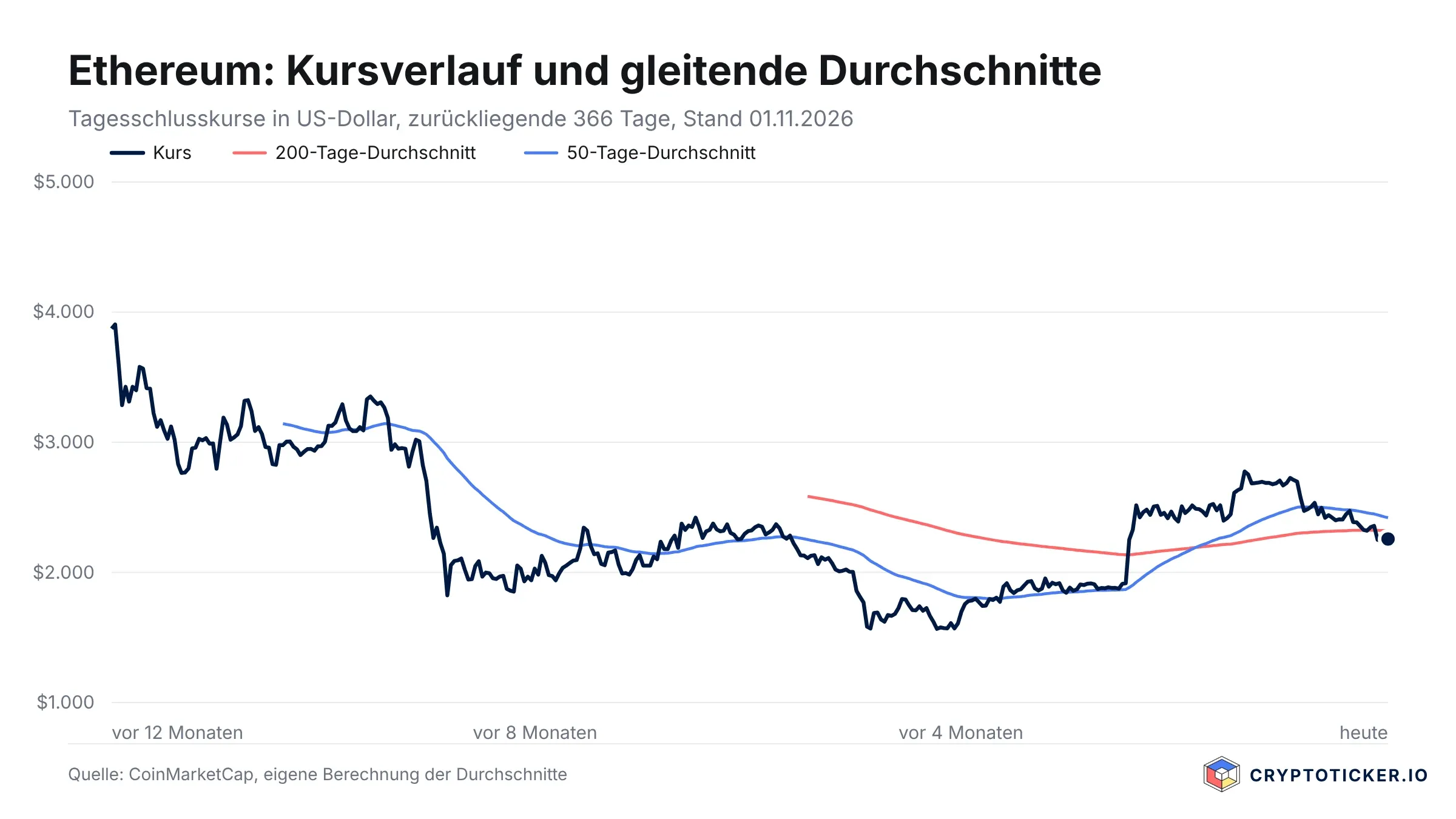
The one-year chart shows why the two moving averages now sit so close together: Ethereum has been oscillating around them for weeks.
The 200-day line at $2,321 and the 50-day average at $2,420
For the key levels of the day, we analysed the daily closing prices of the past 366 days. The 200-day average stands at $2,321.28, the 50-day average at $2,419.94. At $2,256, Ethereum is below both lines, $64.67 below the longer one and $163.33 below the shorter one.
This position is not new. Ethereum slipped below the 200-day line on October 26 and has not reclaimed it from above on any trading day since. What has changed is the distance: on October 26 it was a few dollars, now it is almost $65. The line has thus turned from a support into a resistance that first has to be overcome again.
On the downside, Sunday's daily low of $2,251.83 is the first level, followed by the month-end close of October 31 at $2,242.50. Below that begins the zone in which Ethereum last traded for an extended period in August. The low of the year is $1,566.01, the high $3,905.34.
With daily volume of $4.63 billion, none of these levels said anything this Sunday about whether it will hold. A level is only confirmed by volume. What breaks or holds on a thin Sunday tells you little about Monday.
ETH/BTC at 0.029: the ratio sits at a three-month low
The ratio of Ethereum to Bitcoin, known in the industry as ETH/BTC, shows how many bitcoin one ether costs. It is the most widely used gauge of whether capital within the crypto market is flowing towards Ethereum or towards Bitcoin.
On Sunday, ETH/BTC stood at 0.029. The low of the past 90 days dates from October 30, at 0.0289. Over the last eight days the values ranged between 0.0289 and 0.0291, so the ratio has been practically flat at its three-month low for a week. After the October slump, Ethereum has recovered none of its lag against Bitcoin.
Two points belong alongside this. Measured over the full 90 days, the two are close together, with Ethereum up 21.42 percent and Bitcoin up 22.49 percent. The gap therefore opened up in October, not over the whole quarter. And it came in a month in which, according to our analysis of DeFi deposits from November 1, 6.7 percent of the ETH locked in applications was withdrawn.
Thin order book: how a market order moves the price when volume dries up
An order book is the list of all open buy and sell orders on an exchange, sorted by price. Anyone placing a market order buys or sells without a price limit and fills as many entries on the other side as the size requires.
In a high-volume market those entries sit close together, and a mid-sized order runs through only a few price levels. If volume falls to a quarter, the orders that sit in the book only briefly, those of the automated traders, disappear first. What remains are wider gaps between the levels. The same order then runs through more levels and achieves a worse average price. The difference between the expected and the achieved price is called slippage.
The same applies in both directions and explains why quiet days are deceptive. A single larger sale can trigger a price swing in a thin book that would have been lost in the noise the day before. For leveraged positions this is the critical point: liquidations are based on the market price, not on the volume that produced it.
So anyone holding a leveraged position over the weekend carries a different risk on Sunday than on Wednesday, even though price and leverage are unchanged. The risk sits in the book, not in the chart.

One notch back instead of turned all the way up: in a thin book, order size decides what price you end up with.
Limit instead of market: what an order costs in a thin book
The volume drought has a very practical consequence for anyone who wants to buy or sell Ethereum in these days. A limit order states the price you are willing to pay at most or receive at least. It is only executed if the market gets there, so it cannot force a worse price on you.
Three points count now: the order size relative to the depth of the book, the spread between the best bid and the best ask, and fees. Many platforms charge a lower fee for a limit order that rests in the book than for a market order that takes liquidity immediately. In thin market conditions, both effects add up in the same direction. Which platform charges what is set out in our comparison of crypto exchanges.
The second point concerns splitting orders. Instead of placing an order in one go, the same amount can be spread across several smaller orders. In a book that refills after every fill, that is the more reliable route to an average price close to the quoted one. The cost is more effort and, with some providers, paying the minimum fee several times.
The one-year rule under German tax law: 2026 losses lapse after twelve months
For investors in Germany, the October slump has a side that has nothing to do with the chart. German law treats crypto as other assets, and gains and losses from sales count as private disposal transactions under Section 23 of the German Income Tax Act. The key factor there is the one-year period between purchase and sale.
If you sell within a year of buying, the gain is taxable at your personal income tax rate, not at the flat withholding tax. In return, a loss from the same period can be offset, but only against gains from other private disposal transactions, not against wages or interest. After one year the gain is tax-free, and that is precisely why the loss is then worthless for tax purposes.
For positions bought in 2026 that are in the red, this creates a deadline that nobody extends: once the twelve-month mark is passed, the option of setting this loss against other crypto gains disappears. On top of that comes the exemption limit of 1,000 euros per calendar year, which has applied since the 2024 assessment period; if it is exceeded, the entire gain becomes taxable, not just the part above it.
How lawmakers will handle the one-year period going forward is open. We track the current state of the debate on our page on the reform of the crypto holding period. Anyone who has not documented purchase dates, quantities and acquisition costs without gaps will not get far with offsetting in any case; the programs that handle this are shown in our comparison of crypto tax tools.
Staking yield and the delayed Glamsterdam upgrade
Besides price and volume, Ethereum has two factors that run independently of day-to-day trading. The first is staking: anyone who locks ETH in the network helps secure the blockchain and receives a yield in ETH in return. As we reported on October 28, that yield stood at 2.63 percent a year, below what dollar investments were paying at the same time.
This matters for the volume question, because staked ETH cannot be traded freely. The more ETH is locked in the network, the smaller the share that sits on exchanges at all, and the faster the books thin out on quiet days. If you are considering staking, weigh lock-up periods and provider risk against the yield; the terms are listed in our comparison of staking providers.
The second factor is technical development. The Glamsterdam upgrade, which had been planned as the network's next major development step, has been postponed according to our report of October 31. For the price, this initially means only that there is no date around which expectations could gather. That explains part of the calm in which Ethereum is currently trading.
Our view: a volume drought without a price break
In the editorial team's view, November 1 is not a directional day for Ethereum but a liquidity finding. Three numbers support that: $4.63 billion in volume against $19.53 billion the day before, a turnover ratio of 1.68 percent against 4.22 percent for Bitcoin, and a daily range of $23.51. A market that trades both narrowly and quietly has not yet redistributed its positions after October.
Against this, low Sunday volumes are seasonally normal. Of the four days with lower volume, two fell on a Sunday, August 9 and August 16, and the other two on the Monday after. A single day therefore does not prove a structural drying-up. The finding only becomes robust if volume also stays well below the weekly average of $11.18 billion on Monday and Tuesday. That is exactly what we will be watching over the coming days.
What we do not derive from these numbers is a price direction. A thin book amplifies moves in both directions and says nothing about which one is coming. Crypto assets can lose their entire value.
Ethereum at $2,256: without volume, the $2,321 line stays out of reach
The situation in three steps:
- Choose the order type before you trade. With daily volume of $4.63 billion, the limit order is the cheaper route, and larger amounts should be split up. Which exchange charges which fee is shown in the exchange comparison.
- Look up the purchase date of every position. For investors in Germany, anything bought in 2026 and in the red has a twelve-month deadline, after which the loss can no longer be offset for tax purposes. The documentation is provided by crypto tax tools.
- Adjust leverage to the book, not to the chart. Liquidations follow the market price, and in a thin book it moves on smaller amounts. If you prefer yield instead, the terms are in the staking comparison.
The next meaningful reading is Monday's volume. If it stays below $10 billion, Sunday was no outlier.
(As of November 1, 2026. This article is not investment advice. Prices and fee structures change; check the terms with the provider before you buy.)