

Altcoins4 min read
This XRP Rich List Tells A Story
Crypto enthusiast Julia has called attention to the distribution of XRP holdings across the XRP Ledger, pointing to data that shows how much of the cryptocurrency sits in relatively few accou
A euro stablecoin is a crypto token designed to be worth one euro at all times and redeemable for one euro at face value whenever you want. In the European Union, these tokens have been e-mon
A euro stablecoin is a crypto token designed to be worth one euro at all times and redeemable for one euro at face value whenever you want. In the European Union, these tokens have been e-money tokens under the MiCA regulation since June 30, 2024, and only banks and e-money institutions may issue them. On November 21, 2026, euro stablecoins worth €747 million were in circulation according to DefiLlama, 3.4 times as much as when the MiCA rules took effect. Measured against the whole stablecoin market, that is still small: for every euro held in euro stablecoins, there are about 350 dollars in dollar stablecoins. The largest euro stablecoin is Circle's EURC with around 460 million tokens, followed by Société Générale's EURCV.
For you as an investor in the EU, what matters most is whether a stablecoin is licensed here. Tether (USDT), the world's largest stablecoin, has no MiCA authorisation. How much its safety buffer has shrunk in this week's crash is shown in our fact check of the crash warnings, and the figures as of September 30 are in our analysis of Tether's quarterly report. Exchanges with a MiCA licence are expected to end their services involving non-compliant stablecoins by January 8, 2027. If you want to hold euros on a blockchain, the path therefore leads to e-money tokens. The good news: these tokens are tightly regulated, and you can check for yourself in a few minutes whether yours is one of them.
Legally, a euro stablecoin is an e-money token, or EMT. You hold a claim against the issuer to redeem it for one euro at any time, and the issuer must invest the money it receives safely. It is still not a bank deposit.
Regulation (EU) 2023/1114 on markets in crypto-assets, known as MiCA or MiCAR, defines an e-money token in Article 3(1)(7) as a crypto-asset that "purports to maintain a stable value by referencing the value of one official currency". If a token references several currencies, gold or a basket, it is an asset-referenced token instead, with separate and stricter rules. The euro stablecoin is therefore the simplest case: one currency, one token.
Four obligations follow for every euro stablecoin in the EU:
The redemption right applies against the issuer, not against the exchange. On a trading platform you pay the market price, which can deviate in a thin market: on Bitstamp, one EURC traded between €0.9895 and €0.9997 in the 24 hours to Sunday, 00:14 UTC, on volume of just over 2,000 EURC. How to spot a real break of the peg is explained in our guide to stablecoin depegs. One point is often overlooked: deposit guarantee schemes covering €100,000 apply to bank deposits, not to electronic money. Our article on the euro stablecoin from 37 banks explains why.
When an e-money token becomes large, the European Banking Authority (EBA) steps in as well. A token is significant if it crosses three of several thresholds, including more than 10 million holders, a value above €5 billion or more than 2.5 million transactions a day (Articles 43 and 56). On October 14, 2026, the EBA classified USD Coin (USDC) as the first significant e-money token, according to its press release, and since November 12 it supervises Circle's reserve, own funds and liquidity directly, as our article on EBA supervision of USDC shows. No euro stablecoin comes close: EURC reaches less than a tenth of the value threshold.
Ten euro stablecoins listed in the ESMA register, sorted by supply. The table combines two sources: issuer, supervisor and date from ESMA's list of e-money token white papers, supply and number of blockchains from DefiLlama, both as of November 21 and 22, 2026.
Token Issuer Supervisor White paper in ESMA register Supply Blockchains EURC Circle Internet Financial Europe SAS ACPR, France July 1, 2024 €458.3m 14 EURCV Société Générale-Forge ACPR, France July 1, 2024 €170.4m 4 EURI Banking Circle S.A. (Eurite) CSSF, Luxembourg August 28, 2024 €28.5m 2 EURe Monerium ehf Central Bank of Iceland January 9, 2026 €25.2m 9 EUROP Salvus (Schuman) ACPR, France November 22, 2024 €13.4m 6 EURR (StablR) StablR Ltd MFSA, Malta November 14, 2025 €12.7m 2 EURQ Quantoz Payments B.V. DNB, Netherlands March 24, 2025 €5.3m 4 EURR (Revolut) Bridge Building S.A. CSSF, Luxembourg July 23, 2026 €1.7m 2 EURAU AllUnity GmbH BaFin, Germany June 20, 2025 €0.3m 5 EURqi Qivalis B.V. DNB, Netherlands October 21, 2026 no supply recorded yet none yetEURC (formerly Euro Coin) comes from Circle, the issuer of USDC. In the EU it is issued by Circle Internet Financial Europe SAS in Paris and supervised by the French ACPR; its white paper has been in the register since the first day of MiCA. According to Circle, 459.7 million EURC were in circulation on November 22 at 00:13 UTC, and the company publishes its reserves on its transparency page. EURC runs on 14 blockchains, including Ethereum, Base, Solana and Stellar.
EURCV from Société Générale-Forge, the crypto subsidiary of the French bank, is the second-largest euro stablecoin and runs on Ethereum, Solana, Stellar and the XRP Ledger. On July 1, 2024, only 0.8 million EURCV were in circulation; on November 21, 2026, there were 170.4 million. How the bank brought the token to the XRP Ledger is covered in our report on Société Générale's euro stablecoin on the XRPL.
The only German issuer in the register is AllUnity GmbH from Frankfurt, authorised by BaFin. Its euro token EURAU had only €0.3 million in circulation on November 21, though. Revolut has been in the register with EURR since July 2026, via the Luxembourg company Bridge Building S.A.; our article on Revolut's EURR stablecoin explains the details. EURqi is new: the bank consortium Qivalis, backed by 37 banks from 15 countries according to the company, submitted its white paper to the Dutch central bank on October 21, 2026, one week after its authorisation as an e-money institution. DefiLlama does not yet record any supply for the token.
Two earlier euro stablecoins are missing from the register and have shrunk since MiCA: Stasis Euro (EURS) from €44.4 million to €6.9 million, and Tether's EURT, last recorded by DefiLlama in May 2026 at €4.2 million. The full list of stablecoins with their MiCA status, including dollar tokens, is in our stablecoin comparison.
 Illustrative image, AI-generated
On November 21, 2026, euro stablecoins worth €747 million were in circulation. On July 1, 2024, the first day of the MiCA rules for e-money tokens, the figure was €221 million. That is 3.4 times as much. Dollar stablecoins grew only 1.8-fold over the same period, from $160.4 billion to $282.5 billion. Even so, the euro's share of the stablecoin market is just 0.29%.
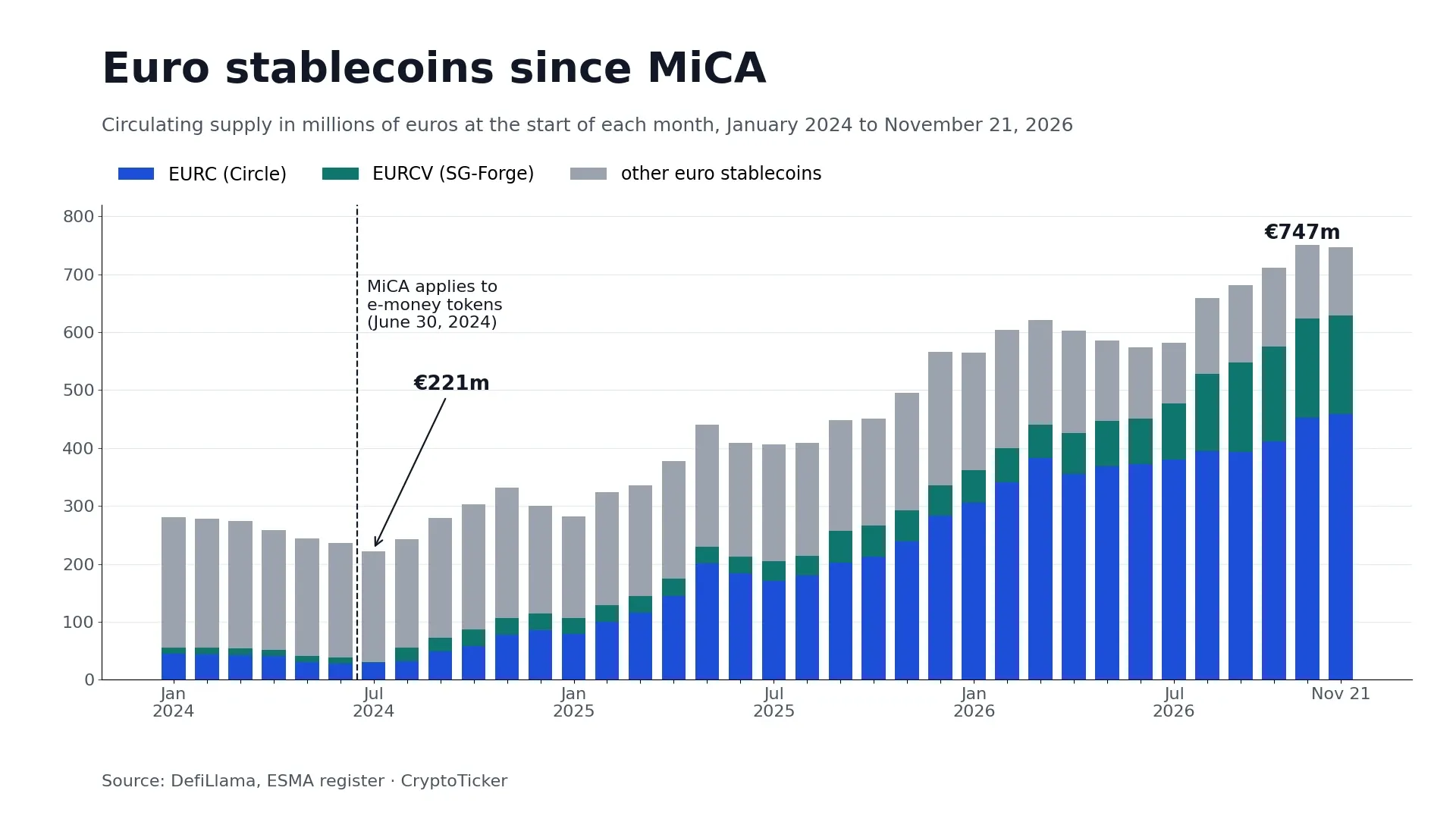 Supply of all euro stablecoins at the start of each month, split into EURC, EURCV and other tokens. Source: DefiLlama, as of November 21, 2026
The chart shows what lies behind the growth. Before MiCA, the market consisted mainly of tokens that have no authorisation today, such as Stasis' EURS and Tether's EURT. Back then, EURC and EURCV together made up 14% of supply. On November 21, 2026, they made up 84%, because EURC grew from €29.7 million to €458.3 million and EURCV from €0.8 million to €170.4 million. MiCA did not choke the market, it rebuilt it: away from unsupervised tokens and toward two issuers licensed in France.
During the November crypto crash, the difference also showed in supply. From November 1 to November 21, dollar stablecoin supply shrank by 4.7% to $282.5 billion, while euro stablecoin supply fell by only 0.4% to €747 million. Falling supply means tokens are being redeemed and burned, usually because investors are moving out of the crypto market and into bank money.
A comparison helps with the scale: for every euro in euro stablecoins there are 347 dollars in dollar stablecoins, converted at the rate DefiLlama uses for euro tokens. The ECB reference rate on November 20 was $1.0990 per euro. Even USDC, the dollar token from the same issuer as EURC, has more than a hundred times as much supply. How large the individual dollar stablecoins are and which of them are licensed in the EU is shown in our stablecoin list with MiCA status.
Whether a euro stablecoin may be offered in the EU is recorded in the interim MiCA register of the European Securities and Markets Authority (ESMA). On November 22, 2026, its list of e-money tokens contained 51 white paper entries from 26 issuers in 14 countries. At least 18 different euro tokens are among them, alongside tokens in dollars, Swiss francs, pounds, kronor, złoty and lei.
Most entries come from the Netherlands (11) and France (8), followed by Germany with 6 entries, all from AllUnity, Luxembourg (5), and Finland and Malta (4 each). The number of entries is not the number of tokens: some issuers file a separate white paper for each new version. The EBA counted 45 notified e-money tokens in the EU on October 14. In August, our analysis of the MiCA register of stablecoin issuers still counted 23 issuers and 43 white papers.
There is a wide gap between the register and the market. Of the at least 18 euro tokens in the register, only six had more than €10 million in circulation on November 21. Many issuers have their licence but hardly any users, and some tokens, such as Qivalis' EURqi, are not in circulation at all yet.
You can check a euro stablecoin in three steps:
For euro stablecoins, programmable means that a program on the blockchain can move them according to fixed rules, without a bank triggering the payment. The money itself remains freely usable. The distinction matters, because the term is used for two different things in the debate.
In its questions and answers on the digital euro, the ECB describes programmable money as digital money that is used for a predefined purpose, like a voucher that is only valid with certain merchants or until a certain date. Programmable payments are something else: you set a condition yourself, for example that a payment is only released on delivery.
Euro stablecoins on public blockchains can do exactly this second kind of payment. Because EURC or EURCV exist as tokens on Ethereum, Solana or the XRP Ledger, a smart contract can manage them. Three examples of what that looks like:
The flip side: the issuer has code in hand as well. The contracts of USDC and EURC include a blocking function that lets Circle freeze individual addresses, for example on the order of an authority. How such freezes work at Tether and how to check your own address is explained in our guide to the USDT blacklist.
For the digital euro, the ECB has already answered the question: it would never be programmable money, but conditional payments should be possible. Our assessment: for investors, the programmability of euro stablecoins is mainly a tool for crypto exchanges and decentralised finance today. Hardly anyone pays with them in everyday life. For banks and companies that settle tokenised bonds and funds, however, it is the real reason behind projects such as EURCV and EURqi.
On a screen, a euro in your current account, an EURC in your wallet and a future digital euro look the same. Legally, they are three different claims against three different debtors, and that decides what happens to your money if something goes wrong.
Feature Bank deposit Euro stablecoin (e-money token) Digital euro Debtor your bank the issuer, such as Circle or Société Générale-Forge the Eurosystem, i.e. the ECB and national central banks Protection deposit guarantee up to €100,000 reserve, at least 30% in separate bank accounts central bank money, planned as legal tender Interest possible prohibited (Article 50 MiCA) none planned Where to use banking network, SEPA public blockchains, around the clock checkout, online shops, phone to phone Available now now, €747 million in circulation 2029 at the earliestThe digital euro is not a stablecoin but digital cash issued by the central bank. The ECB states on its progress page that it could be issued in 2029 if EU lawmakers adopt the regulation in the course of 2026. That looks tight: according to the European Parliament's legislative train, negotiations between Parliament and Council are ongoing, and the negotiating teams had met five times by the end of October. The timeline and how much you would be allowed to hold are covered in our guides to the digital euro and its holding limit. Why central banks are testing both forms of money side by side is explained in our article on the difference between the digital euro and stablecoins.
For you as an investor, this means: a euro stablecoin is the only one of the three forms of euro that you can hold on a blockchain, send to a wallet and trade around the clock on a crypto exchange today. In return, it lacks the protection of the deposit guarantee.
 Illustrative image, AI-generated
Among stablecoins, e-money tokens with a MiCA licence are the most tightly regulated choice for retail investors in the EU, but they are not free of risk. Their safety depends on four points: the issuer and its reserve, price stability on the exchange, technology and storage, and what you do with them in DeFi.
So what does a euro stablecoin offer? It is the alternative to dollar stablecoins for anyone who thinks in euros: you can park profits after a sale without leaving the crypto market, carry no exchange rate risk between euro and dollar, and send money to other wallets and exchanges around the clock. Anyone who wants interest or deposit protection still needs a bank account for that.
The easiest way to buy EURC is on a crypto exchange with a MiCA licence, directly against euros. On November 22, 2026, the public market data of the exchanges showed a EURC/euro trading pair at these three providers, among others, all authorised as crypto-asset service providers in the ESMA register:
On Coinbase, you trade EURC on the exchange against USDC; the MiCA licence of Coinbase Luxembourg S.A. dates from June 20, 2025, with details in our Coinbase review. Fees, withdrawal options and licences of all major providers are compared side by side in our crypto exchange comparison.
Check three things before you buy:
MiCA has worked, measured against its own goal. The rules did not slow the euro stablecoin market, they brought order to it: 84% of supply now comes from two issuers supervised in France, with a redemption right, a secured reserve and a white paper. Unlicensed tokens have almost disappeared. Anyone who wants to park euros on a blockchain, for example during a crash like this week's, now has a legally sound choice.
That does not mean the euro has won. €747 million against $282.5 billion means the crypto market thinks in dollars, even in Europe. Only a euro stablecoin that customers of European banks use as a matter of course could change that. This is exactly what Qivalis is aiming for with 37 banks; whether its EURqi token takes on that role will only become clear once it is in circulation. Until then, EURC is the standard, and for investors in the EU one simple rule applies: check the ESMA register first, then buy.