Federal prosecutors are seeking to recover approximately $65,000 in cryptocurrency linked to an Ohio resident who allegedly lost nearly $200,000 in retirement savings to a fake financial advi
Federal prosecutors are seeking to recover approximately $65,000 in cryptocurrency linked to an Ohio resident who allegedly lost nearly $200,000 in retirement savings to a fake financial adviser.
According to a Nov. 13 Justice Department announcement, the scam began with an unsolicited phone call from an individual who identified himself as "Jake Williams."
The caller claimed to be a financial adviser and cryptocurrency trading expert, eventually persuading the victim to move retirement savings through a bank into a Coinbase account that he vouched was legitimate.
Related: Apple rises 26 places on the Roundtable 100
Prosecutors allege the caller then obtained remote access to the victim's laptop and transferred cryptocurrency into wallets under his control.
To maintain the deception, the caller displayed a wallet supposedly containing $860,000, including investment profits.
But when the victim attempted to withdraw money, the caller claimed the Internal Revenue Service had frozen the account because the victim's accountant had not filed taxes since 2021.
Investigators identified approximately 60 fraudulent transfers between Dec. 17, 2025, and March 31, 2026, totaling $198,232.92 tied to the scammer's accounts.
Authorities subsequently traced $65,028.09 in USDC, a dollar-pegged stablecoin, to an Ethereum address. Circle, the stablecoin's issuer, blocklisted the funds after being served a May 20 federal seizure warrant.
From the archives | Watch the video below to learn what stablecoins are and how they work
What is a stablecoin? Explained (3:33)
A Nov. 9 civil forfeiture complaint seeks legal ownership of those assets. Prosecutors said they would seek to return the stolen funds to the victim if successful. No funds have yet been returned.
The FBI said it has received additional complaints from other individuals who lost funds in similar schemes involving someone named "Jake."
Cryptocurrency fraud continues to drain investor savings
The case comes amid broader cryptocurrency crime investigations.
On Nov. 12, the Justice Department announced that more than $2.7 billion linked to the North Korea-attributedBinance hack had been frozen, including over $1.2 billion authorized for seizure or restraint.
Binance's hack is unrelated to the Ohio investment scam.
Popular on TheStreet Roundtable:
According to the FBI's 2025 Internet Crime Report, cryptocurrency investment fraud generated 61,559 complaints and $7.228 billion in reported losses.
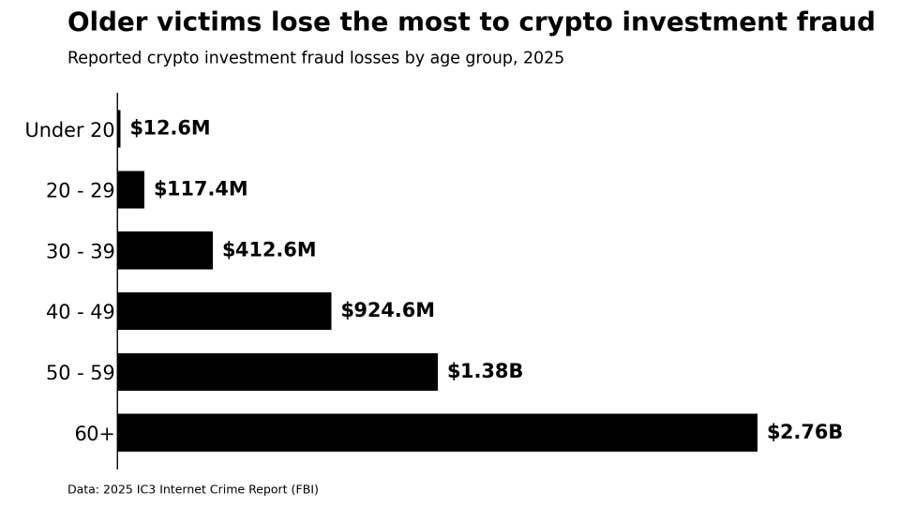
People aged 60 and older reported $2.764 billion in losses across 13,685 complaints, the highest figures among the listed age groups.
Crypto investment fraud losses reported to the IC3 in 2025, by age group.
Across all crime types, victims aged 60 and older reported more than $7.7 billion in losses in 2025, with investment schemes the biggest drain at over $3.5 billion, according to the FBI.
The FBI warns that scammers often exploit trust by promising investment profits, displaying fictitious balances and inventing withdrawal restrictions.
Precautions cryptocurrency investors can take
The FBI and securities regulators recommend several measures to reduce investment fraud risks:
- Verify advisers: Check registrations and disciplinary records through Investor.gov or FINRA BrokerCheck.
- Protect account access: Never give unsolicited callers remote access to financial accounts. Seek independent advice before moving retirement savings.
- Question displayed profits: Verify platforms independently and confirm that funds can actually be withdrawn.
- Watch for additional demands: Refuse suspicious tax or withdrawal-fee requests, including upfront payments for supposed recovery services.
- Report suspected fraud: Contact the bank or exchange immediately and file a report at IC3.gov, preserving messages, wallet addresses, transaction records and payment details.
Prompt reporting can assist investigators, although recovering stolen funds is not guaranteed.
Related: Traders open $9.1 million in Nvidia shorts as CEO admits to affair