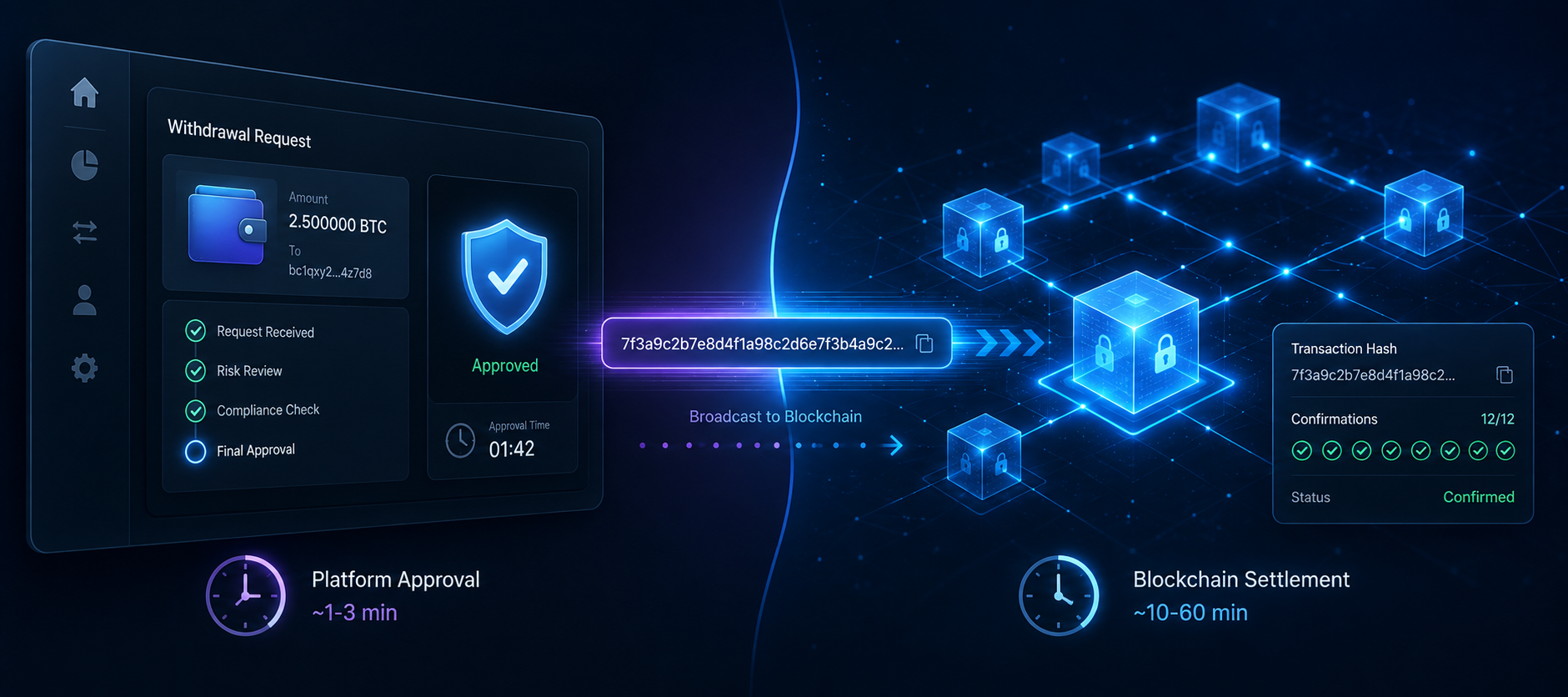
Crypto payments are often sold with one simple promise: speed. A blockchain may confirm transactions in seconds or minutes. Yet users can still wait hours—or longer—for a withdrawal to reach
Crypto payments are often sold with one simple promise: speed.
A blockchain may confirm transactions in seconds or minutes. Yet users can still wait hours—or longer—for a withdrawal to reach their wallet.
The apparent contradiction has a simple explanation. A crypto withdrawal does not run on one clock. It runs on two.
The first clock belongs to the platform. The second belongs to the blockchain. Only the second is controlled by network speed.
One Withdrawal, Two Separate Clocks
When a user clicks “withdraw,” no blockchain transaction necessarily exists yet. The platform first receives an internal request to release funds from the account balance.
This begins the operator approval clock.
The platform may check the account, payment history, destination wallet, withdrawal limits, bonus activity, location, or unusual behavior. It may also request identity documents or proof that the wallet belongs to the user.
The blockchain settlement clock begins only after the platform creates and broadcasts the transaction.
At that point, the payment must enter the network, be included in a block, and receive the required confirmations.
StageControlled mainly byCommon causes of delayInternal approvalPlatform operatorAccount review, KYC, bonus checks, limits, payout queueBlockchain settlementNetwork and transaction settingsCongestion, fees, block inclusion, confirmations
A fast blockchain can shorten the second stage. It cannot force an operator to complete the first stage quickly.
The Transaction Hash Is the Key Divider
The most useful question during a delayed withdrawal is not, “How fast is this blockchain?”
It is: Has the transaction been broadcast?
Once a transaction is broadcast, the platform should normally be able to provide a transaction hash, also called a transaction ID. The hash lets the user inspect the payment on a block explorer and see whether it is pending, confirmed, failed, or sent on the wrong network.
Without a transaction hash, the payment may still be inside the platform’s approval process. Some services batch transactions or update their interface slowly, so the absence of a hash is not absolute proof.
Still, a withdrawal marked “pending” without an on-chain record is usually not being delayed by miners or validators yet.
This distinction is central to The Coin Republic’s seven-check analysis of crypto casino withdrawals, which separates operator approval from blockchain settlement instead of treating “crypto speed” as one measurement.
What the Blockchain Actually Does
Once the platform broadcasts the transaction, the network takes over.
Bitcoin payments first appear as unconfirmed. They gain confirmations after miners include them in blocks and more blocks are added.
The official Bitcoin developer documentation explains that higher confirmation counts provide stronger protection against double spending. High-value payments may therefore require more confirmations before acceptance.
Ethereum uses a different consensus process, but the same separation applies.
According to the Ethereum transaction lifecycle, a submitted transaction enters a pool and must be selected by a validator for inclusion in a block. The block later moves toward justification and finalization.
This is blockchain settlement. It is visible and measurable after broadcast.
Before broadcast, there is no network transaction to accelerate.
Why “Instant Crypto Withdrawals” Can Mislead
The word “instant” is often used without explaining when the timer starts.
It may describe:
- automated approval for eligible accounts;
- the time between approval and broadcast;
- the expected speed of the selected network;
- the first confirmation rather than final settlement;
- only withdrawals below an internal review threshold.
These are different promises.
A platform can use a fast network and still maintain a manual payout queue. It can approve routine withdrawals automatically while reviewing larger amounts.
It can also broadcast stablecoin payments quickly after approval but spend hours checking bonus activity beforehand.
That does not automatically prove misconduct. Security, fraud-prevention, and compliance checks can be legitimate. The problem is poor disclosure.
Users should be able to find clear answers to four questions:
- How long does internal approval normally take?
- What can trigger a manual review?
- When will a transaction hash become available?
- How many network confirmations are required?
If a platform advertises only blockchain speed, it is describing the part of the process it controls least.
KYC Happens Before the Blockchain Clock
Verification is another reason why a fast network may not produce a fast payout.
A user may register and deposit without documents, then face checks after requesting a larger withdrawal, changing wallets, accessing the account from a new location, or triggering a compliance review.
KYC itself is not automatically a warning sign.
The Financial Action Task Force’s virtual-asset standards call for covered service providers to apply measures such as customer due diligence, record keeping, and suspicious-transaction reporting.
The important issue is predictability.
A fair process should explain which documents may be requested, what can trigger a review, and whether funds remain unavailable during verification.
Repeated requests for new documents without a clear reason create a different risk profile from a defined, one-time check.
None of these checks can be solved by choosing a faster blockchain.
Bonus Rules Can Delay an Otherwise Simple Payment
Promotional balances add another layer.
Before approving a withdrawal, a platform may check whether wagering requirements were completed, whether restricted products were used, whether a maximum bet was exceeded, or whether a maximum cashout applies.
To the user, this may look like a payment delay. Inside the platform, it is a terms review that happens before the transaction is created.
A small cash deposit without a bonus therefore provides a cleaner withdrawal test. It removes several dispute points and reveals the normal approval process more clearly.
A successful small withdrawal does not guarantee that a larger one will follow the same path. Higher amounts may trigger additional checks.
Still, the test provides more useful evidence than a homepage claim about network speed.
How to Measure a Crypto Withdrawal Properly
Users should record separate timestamps for each stage:
- when the request was submitted;
- when its status changed to approved;
- when a transaction hash appeared;
- when the first confirmation arrived;
- when the funds became usable;
- whether support explained any delay clearly.
Imagine a withdrawal submitted at 10:00. The platform approves it at 15:00 and broadcasts it at 15:02. The blockchain confirms it at 15:05.
Calling that a five-minute withdrawal would be misleading.
The network stage took three minutes, but the user waited five hours and five minutes in total.
The reverse can also happen. A platform may approve a payment in two minutes, while congestion or a low fee delays confirmation.
In that case, the operator was fast and the network stage was slow.
Both outcomes matter, but they have different causes.
The Better Standard Is Predictability
The best crypto payment experience is not necessarily built on the fastest chain. It is the one where users can understand what is happening at every stage.
A reliable platform should separate:
- internal processing;
- verification or security reviews;
- transaction broadcast;
- network confirmation;
- final wallet receipt.
It should also provide a transaction hash promptly after broadcast and explain unusual delays in specific terms.
Blockchain technology can make settlement faster and more transparent. It cannot remove operator control over account balances, withdrawal approval, bonus enforcement, or compliance reviews.
That is why network speed is only half the story.
Before trusting any “instant withdrawal” claim, check when the blockchain clock actually starts.
This article is for general educational purposes. It does not constitute financial or gambling advice.