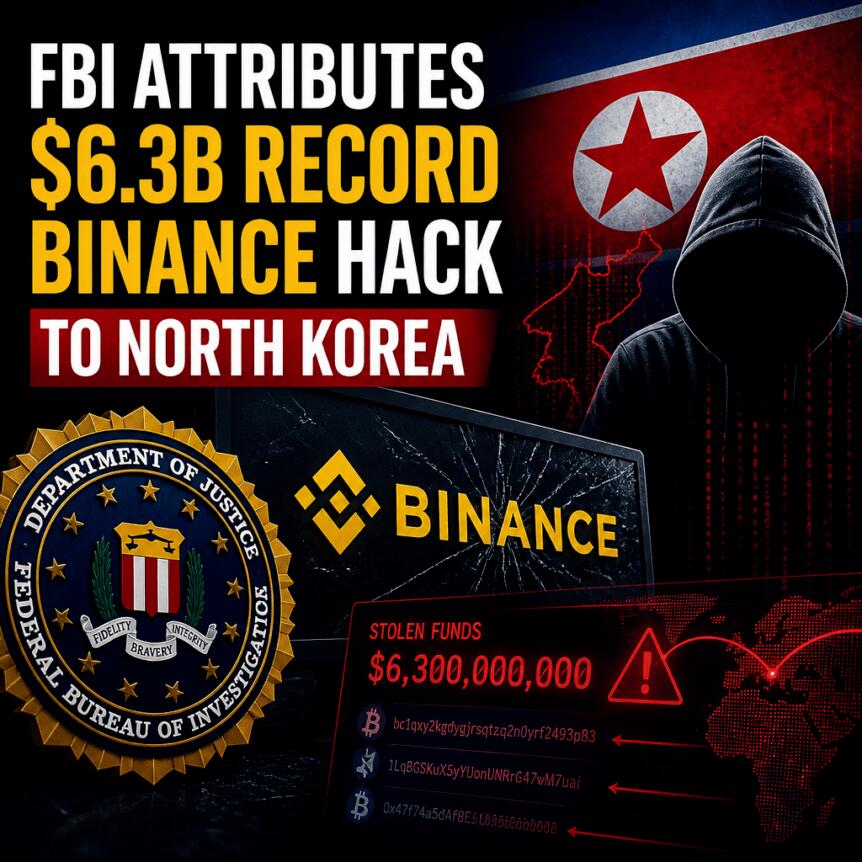
The FBI has linked North Korea to the theft of roughly $6.3 billion in digital assets from cryptocurrency exchange Binance, according to a Saturday statement. The agency said the campaign is
The FBI has linked North Korea to the theft of roughly $6.3 billion in digital assets from cryptocurrency exchange Binance, according to a Saturday statement. The agency said the campaign is carried out by North Korean malicious cyber actors it labels “TraderTraitor,” a name that reflects how the group has been most recently observed moving stolen funds—largely into Ether—before progressing to further laundering stages.
In its alert, the FBI urged a wide range of private-sector participants in crypto infrastructure to disrupt the laundering workflow by blocking transactions tied to addresses associated with TraderTraitor activity. The notice also signals that investigators expect more complex movement of funds through DeFi routes and instant swap services as the stolen assets are integrated into the broader ecosystem.
Key takeaways
- The FBI attributes the Binance theft of about $6.3 billion in digital assets to North Korea-linked cyber activity known as “TraderTraitor.”
- Investigators say the group has recently converted stolen assets mostly into Ether, setting up follow-on laundering steps.
- The FBI expects further conversion using DeFi protocols and instant swap services as funds advance through higher-risk stages.
- Crypto service providers and infrastructure operators are urged to block transactions involving TraderTraitor-linked addresses listed in the FBI release.
- Earlier reporting and research cited in the statement point to an ongoing pattern of DPRK-linked theft used to support state priorities.
FBI’s “TraderTraitor” warning and why it matters
The FBI’s alert is focused on operational disruption: it is not merely describing the intrusion, but outlining what it believes happens after funds are stolen. The agency says it has most recently observed TraderTraitor converting the assets it obtains “mostly into Ether (ETH),” suggesting that Ether is being used as a key liquidity and conversion bridge in the attackers’ process.
That matters for market participants because post-theft behavior can determine what defenders should monitor. If stolen funds are being consolidated into a liquid asset first and then redistributed, blocking or monitoring at that conversion layer can reduce the likelihood that assets quickly become difficult to trace. The FBI also expects additional movement via DeFi and instant swaps, which are often used to restructure funds rapidly and obscure transaction trails.
To counter that, the FBI urged organizations including THORNode operators, RPC node operators, instant exchanges, DeFi services, and blockchain analytics firms to prevent transactions involving addresses associated with TraderTraitor actors. The agency states that a full address list is provided in the underlying news release.
From theft to laundering: DeFi and swaps in the spotlight
The FBI’s wording underscores that laundering is expected to intensify after initial conversions. According to the statement, the attackers are moving “to more advanced laundering stages,” and the agency specifically calls out DeFi and instant swap services as likely tools used to further convert and reposition stolen value.
For investors and ecosystem builders, this highlights a recurring risk pattern: crypto theft does not end at the moment funds are stolen. The defensive challenge becomes keeping up with how quickly adversaries can adapt—especially when they can route assets through infrastructure components that may not always share a common monitoring standard.
The FBI’s call for blocking transactions tied to known addresses aims to close that gap by creating immediate friction for the attackers’ next steps. Even if attackers can search for alternate routes, preventing movement through identified endpoints can slow the process and reduce the attackers’ ability to extract value before controls take effect.
Broader context: research on North Korea’s crypto role
The Binance theft case fits into a wider set of findings referenced in the coverage. Cointelegraph earlier reported that North Korea-linked hackers accounted for about 60% of the value lost to crypto hacks in 2025, with proceeds reportedly used to support the regime’s nuclear and ballistic missile programs—an example of how digital asset theft can function as a source of hard-to-interdict financing.
Those figures align with analysis attributed in this reporting to a CertiK study. CertiK’s findings, as cited, attributed more than $2 billion of an estimated $3.4 billion in 2025 crypto security losses to groups tied to North Korea across 79 incidents out of 656 incidents documented that year.
While North Korea does not publish credible budget figures, independent research by MilitarySpend is referenced regarding defense spending capacity. MilitarySpend reportedly estimates that North Korea’s annual defense spending—based on purchasing-power-adjusted GDP estimates—could be as high as $6 billion, though the figure is described as uncertain. The analysis adds that revenue from arms transfers involving Russia, along with cryptocurrency theft, can contribute to funding for weapons programs, including development linked to WMD capabilities.
Further context cited here suggests that between 2016 and early 2026, North Korea-linked actors stole an estimated $6.75 billion in cryptocurrency across 263 documented incidents, according to CertiK and findings by onchain researcher Taylor Monahan. CertiK’s analysis is described as concluding that North Korea has “industrialized” crypto theft into a core state revenue mechanism.
What to watch after the FBI alert
With the FBI expecting stolen funds to keep moving through DeFi and instant swap services, the next critical developments are likely to center on how quickly infrastructure providers implement the address-based controls outlined in the notice—and whether attackers attempt to shift to new routes once known endpoints are blocked. Readers should also watch for additional public updates that refine the attribution set or expand the scope of targeted addresses as investigators track the next laundering steps.
This article was originally published as FBI Attributes $6.3B Record Binance Hack to North Korea on Crypto Breaking News – your trusted source for crypto news, Bitcoin news, and blockchain updates.