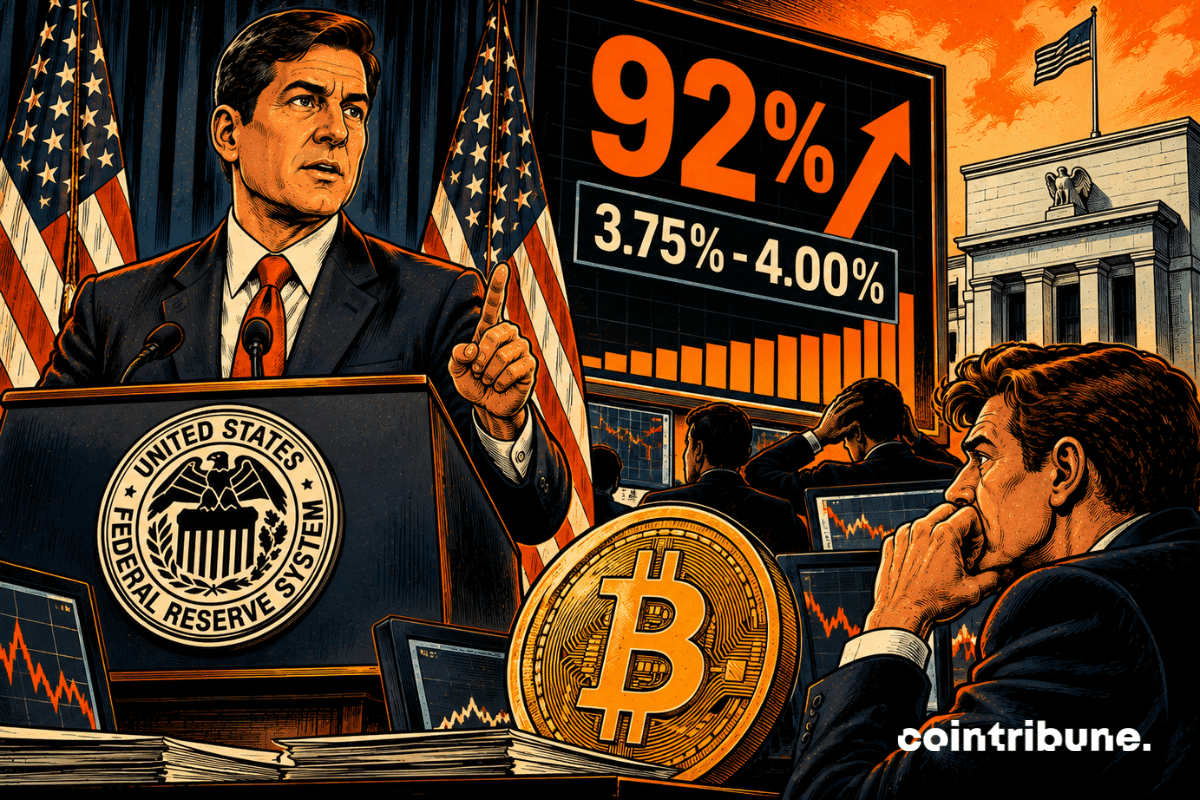
A few hours before the decision, the market has almost already checked the “hike” box. The contracts tracked by CME FedWatch give a 92.3% chance of a 25 basis point increase. The FED would th
A few hours before the decision, the market has almost already checked the “hike” box. The contracts tracked by CME FedWatch give a 92.3% chance of a 25 basis point increase. The FED would therefore surprise more by not moving. However, the evening is not just about this quarter point. Investors want to see the projections, count the dissenting votes, and listen to Kevin Warsh. Stock markets, gold, and bitcoin especially need to know what could come next.
In brief
- Markets estimate a 92.3% probability of a 25 basis point hike, but will mainly watch the Fed’s monetary projections.
- U.S. inflation reaches 3.4%, while employment holds up and expensive oil seriously complicates Kevin Warsh’s monetary equation.
- Wall Street could react more to the dot plot and bond yields than to a rate hike already largely priced in.
- Below $4,350, gold awaits Warsh’s indications, torn between pressure from high rates and the search for safe havens.
- $75,800 bitcoin approaches the meeting weakened by liquidations, ETF outflows, and the procedural failure of the CLARITY Act in the Senate.
Warsh faces his first real test on rates
Let’s go back a month. Before Jackson Hole, the probability of a hike hovered around 36%. Kevin Warsh explained there that inflation had not “improved enough.” A few statistics later, the doubt almost evaporated.
The path to September better tells the change than any formula. In June, the FED left its range at 3.50%–3.75%. Same decision in July, this time with three members in favor of a 25 basis point increase. The disagreement therefore existed before the markets massively lined up behind the hike scenario.
This Wednesday, a range of 3.75%–4.00% constitutes the dominant scenario. At 8 pm Paris time will be released the statement, economic projections, and the dot plot. Warsh will speak thirty minutes later.
That’s when the screens will become interesting again. A largely anticipated hike informs about today; the dot plot points talk about tomorrow. Another hike in December would change the reading. A calmer trajectory too. After weeks of watching the same number climb, traders will finally be able to look elsewhere.
Inflation, oil and jobs leave the Fed little room for comfort
Prices provide a good part of the answer. In August, U.S. inflation rose 0.4% monthly and 3.4% yearly. Excluding food and energy, it advances 0.3% monthly. The Fed’s target remains set at 2%.
Then there is energy. Crude passed $100 again in the sources studied, amid disruptions around the Strait of Hormuz. When oil prices rise, transport, production, and household budgets eventually feel it.
Secure your cryptos with LedgerThis link uses an affiliate program.Employment offers little respite to those favoring a pause. The U.S. created 162,000 jobs in August and unemployment stands at 4.1%. Meanwhile, the ten-year Treasury yield hovers around 5%.
The central bank thus lands on an uneasy economy: inflation too high, employment resilient, long-term rates already tight. Raising rates can weigh on credit. Doing nothing, with markets nearly certain of the opposite, would provoke another shock. The setting is enough; no need to add lightning.
Could Wall Street actually welcome a rate hike?
Tuesday, equities were hardly in the mood to celebrate. Oil had gained more ground and investors reduced exposure to several consumer-related sectors. However, a rate hike does not automatically condemn Wall Street to a bad session.
The reason lies with bonds. If the Fed convinces investors it regains control over inflation, pressure on long yields could ease. Scott Ladner, Chief Investment Officer at Horizon, describes this unusual setup:
It’s the signaling effect and the net impact on the long end of the curve that could ultimately benefit the equity markets.
The story is less smiling. Canaccord Genuity examined six tightening cycle starts over more than thirty years: the S&P 500 lost 3.4% on average in the following month. An average does not write Wednesday’s session. It just reminds why investors watch stocks, the dollar, and Treasuries.
This time, the quarter point has already traveled far in prices.
Gold hovers below $4,350 with all eyes on warsh
Gold moves with two opposing winds. Wednesday morning, the yellow metal remains below $4,350 an ounce. The dollar gave up some ground after reaching a two-week high, which supports gold. High bond yields tell the opposite story.
When bonds yield more, holding a non-yielding asset becomes relatively less attractive. The Fed can increase this pressure if its projections outline several more hikes. But gold retains another clientele: those seeking refuge when geopolitical or economic tensions rise.
Technical levels give some benchmarks. FXStreet places a first resistance around $4,413, then a stronger zone around $4,520. On the downside, $4,326 serves as the first support, before the 50-day moving average near $4,280.
Even a 25 basis point hike can produce different reactions depending on the accompanying speech. For traders, no need to guess too early. The metal awaits the statement, then Warsh. He too wants to know what’s next.
Bitcoin at $75,867: Is $70,000 the next battleground?
Bitcoin arrives with some bruises. Its price fell below $76,000, the lowest since August 21. Tuesday, more than $545 million in long positions were liquidated. Spot ETFs recorded $462.73 million of outflows last week, after $3.52 billion inflows in August.
Added to this nervousness is Washington. The Senate did not advance the CLARITY Act on September 15: 49 votes against 50, while 60 were needed. The crypto market thus loses a regulatory event closely watched by investors.
Bill Merz, from U.S. Bank Asset Management, urges to distinguish expected decision and surprise:
We probably should not expect a significant immediate impact from a rate hike on stocks, since it is already priced in.
For bitcoin, the key number is $70,000. This zone aligns with old prices and the 200-day moving average. A close below, with persistent ETF outflows, would give more room to sellers. Not a prophecy: simply the next place where buyers and sellers might meet in numbers.
- The BTC price at the time of writing is $75,867, after passing below $76,000.
- CME FedWatch rates the probability of a 25 basis point hike at this meeting at 92.3%.
- U.S. inflation reached 3.4% year-on-year in August, while its core component rose 0.3% monthly.
- The U.S. economy created 162,000 jobs in August and the unemployment rate stands at 4.1%.
- The ten-year Treasury yield hovers around 5%, already weighing on financial conditions.
At $75,860, bitcoin still holds a margin before the $70,000 zone mentioned by technical analysts. Tonight, the first move might come from the Fed’s statement; what follows may depend more on projections and Warsh. If the Fed outlines further hikes, risky assets will have to absorb the message. If the tone proves less harsh, bitcoin could catch a breath. The market itself will revise its certainties in a few minutes.