The Federal Reserve published the record of its 27–28 October meeting at 2:00 p.m. EST on 18 November, and the document carries a split inside it. Ten members agreed to keep the federal funds

The Federal Reserve published the record of its 27–28 October meeting at 2:00 p.m. EST on 18 November, and the document carries a split inside it. Ten members agreed to keep the federal funds target range at 3-3/4 to 4 percent. Two voted against the decision, and not for the reason the rate-cut argument assumes: they wanted a quarter-point increase that day.
“Two members voted against the decision to maintain the target range for the federal funds rate, preferring an increase of 25 basis points in the target range at this meeting,” the minutes released on 18 November read.
That sentence answers the question traders carried into this week’s selloff. A December increase is not a tail risk in the committee’s own words. It is the working assumption around which the meeting was organised, and the meeting after it is scheduled for 8–9 December.
Almost all of them said so in plain language: “almost all participants judged that, under their baseline outlooks for inflation and the labor market, further action to raise the target range for the federal funds rate—broadly consistent with the September Summary of Economic Projections—would likely be appropriate, in order to ensure a timely return of inflation to the 2 percent objective.”
Three weeks after the October statement, the difference between a hold and a pause is the whole argument. A hold means the committee stopped. A pause means it has not finished, and the minutes describe the second.
The Inflation Print That Turned a Hold Into a Split
The staff’s own estimate explains why two members broke ranks. “The staff estimated that price inflation—as measured by the 12-month change in the price index for total personal consumption expenditures (PCE)—rose to 3.6 percent in September, boosted by a rapid increase in consumer energy prices.” Core PCE, which excludes energy and many food prices, “edged up to 3.1 percent” in the same month.
Both readings sat above their year-earlier levels, and the minutes name three sources for that: earlier tariff increases, higher energy inflation, and “upward pressure on consumer goods prices that was associated with the AI buildout.”
That third item is where the document stops being a routine policy record. The central bank’s inflation diagnosis now includes the capital-spending boom in artificial intelligence as a goods-price channel, not merely an asset-price story. Fiscal and monetary policy both enter the same argument about data-center construction, power prices and hardware supply, and so does the trade that financed much of it.
The committee’s internal caution is worth quoting in full, because it is the reason officials are unwilling to call the job done: the staff viewed “the possibility that longer-run inflation expectations could have become unanchored after five years’ worth of elevated inflation as a salient risk.”
The AI Buildout Has Become a Credit Story
The market review inside the minutes spends more space on AI financing than on any single economic indicator. Two leading AI firms reported revenue growth below investor expectations. A hyperscaler released capital spending plans that required more financing than investors had anticipated. Equity prices in the AI infrastructure segment fell harder than the broad index, and credit spreads widened in both investment-grade and high-yield segments, “with high-yield bonds issued to finance data center construction experiencing an especially notable widening in spreads.”
Bank equity prices fell sharply on concerns about slower loan growth and commercial real estate exposure. Participants drew a policy conclusion from that repricing: they “judged that greater market discipline over highly leveraged projects could temper investment demand.”
That is a conditional argument, and it is the strongest one the doves have. If widening credit spreads and lower AI valuations slow the buildout without the Fed lifting rates, the inflation pressure the staff flagged in goods prices eases on its own. If credit stays open and construction keeps running, the case for a December increase gets stronger, not weaker.
Two Rate Paths, and the Twenty-Five Basis Points Between Them
The minutes record two different expectations for the same policy, and the gap between them is the most useful number in the document. Futures pricing assigned “high probabilities assigned to a 25 basis point hike by year-end and two more by the summer of 2027.” The Open Market Desk’s survey of market expectations was cooler, “with the median participant expecting one rate hike in December and another one in March 2027, followed by a rate cut early in 2028.”
Put those side by side and the arithmetic is simple. The futures curve implies 75 basis points of tightening by mid-2027; the survey median implies 50. Both start from a ceiling of 4.00 percent, so one path arrives at 4.75 percent and the other at 4.50 percent. The difference is a full quarter-point meeting, and it is the difference between a committee that hikes three times and one that hikes twice and then waits.
The survey’s longer-run estimate of the nominal fed funds rate rose to about 3.4 percent, and the minutes attribute the move to a higher estimate of the long-run real rate. If the neutral rate has drifted up, a 4.00 percent ceiling is less restrictive than it was a year ago, which is the argument the two dissenters made.
What a Quarter Point Costs a Leveraged Position
Abstract rate arguments hide their cost. A 25 basis point increase takes the ceiling of the target range from 4.00 percent to 4.25 percent, a 6.25 percent increase in the policy rate itself. On $1 million of floating-rate borrowing, that is $2,500 a year in additional interest, or roughly $208 a month, before any change in spreads.
The full futures path is heavier. Three hikes would lift the ceiling to 4.75 percent, 18.75 percent above today’s level and $7,500 a year more on the same $1 million. That is the number a leveraged crypto book is really trading against, and it competes with an asset that has fallen 13.8 percent in seven days and 22.6 percent in thirty.
Bitcoin’s distance from its record does the rest of the work. At $63,519, the asset needs a 98.5 percent gain to return to the $126,080 high it set on 6 October 2025. Cash at 4 percent needs nothing.
What the Minutes Landed On
Bitcoin traded at $63,504 at 04:58 UTC on 19 November, down 1.3 percent over 24 hours and 49.6 percent below that record, according to CoinGecko data. Ether changed hands at $1,798, Solana at $74.50, XRP at $0.975 and Zcash at $932. The total bitcoin market cap stood near $1.28 trillion.
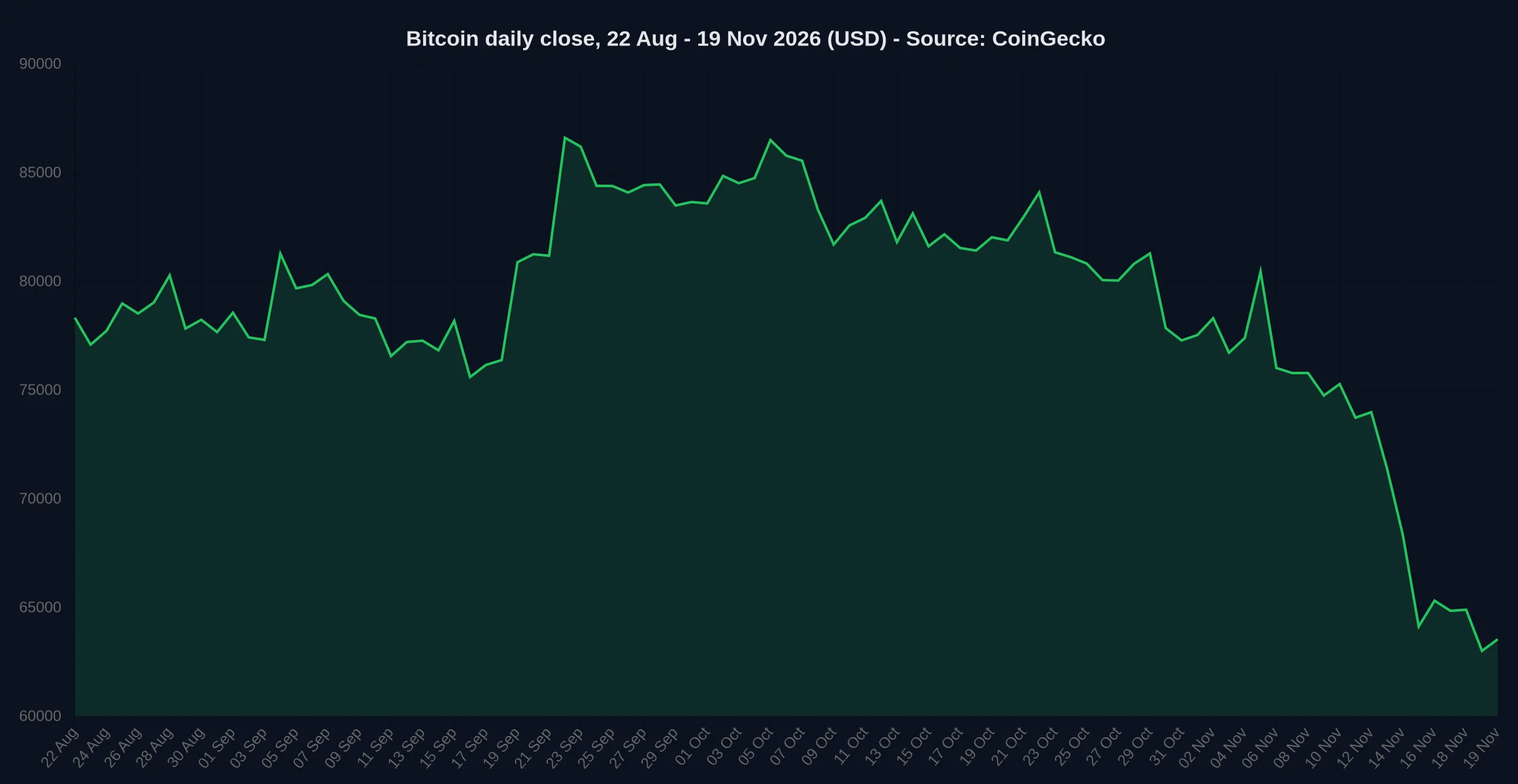
The release itself did not produce a directional break. Bitcoin traded in a $2,796 range across the 24 hours that contained it, between $62,068 and $64,864, and it has recovered from the low end of that band. The 13.8 percent weekly decline was already in place before the minutes were published, and the Crypto Fear and Greed Index printed 10 on 19 November, the third reading of 10 in five days.
That sequencing is the honest way to describe the relationship. The minutes gave the selloff a framework, not a cause. Available evidence does not establish that the document moved the price; it establishes that the price and the document now agree on the same risk.
Proven, Inferred, and the Date That Settles It
What is proven is narrow and specific. Ten members voted to hold at 3-3/4 to 4 percent. Two wanted 25 basis points more and said so in the record. PCE inflation was estimated at 3.6 percent for September, core at 3.1 percent, and almost all participants expected further increases to be appropriate. The next meeting runs 8–9 December.
What is inferred is the size and timing of the move. One passage sets a limit on how mechanical the December decision is: “A couple of participants noted that an increase of more than 25 basis points could warrant consideration at the next meeting if incoming inflation data were unfavorable.” A couple is not a majority, and a 50 basis point step remains a minority view rather than a plan.
Three things would break the December baseline. A November inflation reading that comes in below the September estimate would remove the urgency the two dissenters built their case on. A labor-market deterioration sharp enough to change the employment side of the mandate would do the same, and the minutes already describe a labor market with “low rates of hiring and layoffs” and unusually weak dynamism. So would a credit-market accident severe enough to make the committee’s own “market discipline” argument operative before 9 December.
One absence deserves a line of its own. The document never mentions bitcoin, crypto or stablecoins. The asset class is not part of the committee’s stated deliberations, which means the connection between Fed policy and crypto prices runs entirely through the discount rate on risk, not through any policy the committee has designed for the industry. Readers who treat the minutes as a crypto document are reading a signal where the Fed is describing something else.
The distinction is practical. The October decision set the level; this document set the direction, and the direction runs toward higher rates with two members already voting that way. The Fed’s November financial stability report made a related point from a different angle: the vulnerabilities it named were in the plumbing around crypto, not in the price.
Frequently Asked Questions
Will the Fed raise rates in December 2026?
The October minutes point that way without promising it. Almost all participants judged further increases to be appropriate under their baseline outlooks, and futures markets assign high odds to a quarter-point move by year-end. The decision itself is scheduled for 8–9 December and depends on data released before then.
What did the October FOMC minutes actually say?
That ten members agreed to hold the target range at 3-3/4 to 4 percent and two voted against, preferring a 25 basis point increase at that meeting. The staff estimated September PCE inflation at 3.6 percent and core PCE at 3.1 percent, both above year-earlier levels.
Why did bitcoin fall while the Fed minutes were being published?
Bitcoin was already down 13.8 percent over the preceding seven days before the release. The minutes gave the decline a framework rather than a trigger: the available evidence does not establish that the document caused the move, and the price traded in a $2,796 range across the release window.
Does the Fed discuss crypto in its minutes?
Not in this set. The 27–28 October minutes do not mention bitcoin, crypto or stablecoins. The link between Fed policy and crypto prices runs through risk appetite and the discount rate applied to long-duration assets, not through any crypto-specific policy.
This article reflects the minutes as published on 18 November 2026 and market data as of 04:58 UTC on 19 November 2026. Figures are updated in the source links.
Data: FOMC minutes, October 27–28, 2026, Federal Reserve press release, CoinGecko, Alternative.me Fear and Greed Index.
The post Fed Minutes Put a December Rate Hike Back on the Table, and Two Members Voted for One Now appeared first on BlockchainReporter.