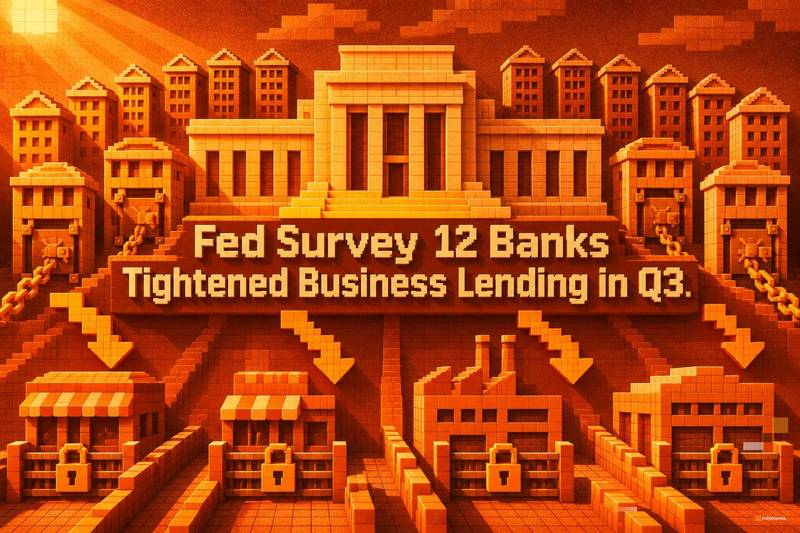
The Federal Reserve's quarterly Senior Loan Officer Opinion Survey found that 12 of 50 responding banks tightened standards for business lending in Q3, while 37 of the same respondents held t
The Federal Reserve's quarterly Senior Loan Officer Opinion Survey found that 12 of 50 responding banks tightened standards for business lending in Q3, while 37 of the same respondents held their standards unchanged. The result, drawn from the Fed's Senior Loan Officer Opinion Survey on Bank Lending Practices, reflects a minority-driven shift in credit posture rather than a broad contraction, and carries relevance for the macro environment that Bitcoin market participants track alongside network fundamentals.
Fed Survey Shows a Modest Tightening in Business Lending
The Federal Reserve's Senior Loan Officer Opinion Survey asked senior loan officers at a panel of domestic and foreign banks to characterize changes in their lending standards and terms during Q3. Of the 50 banks that responded, 12 reported tightening standards applied to business borrowers. The remaining 37 banks reported no change to their standards during the quarter. For related coverage, see Why Is Sui (SUI) Price Down Today?.
The survey result should be read as a snapshot of reported bank behavior, not as a system-wide measure covering every U.S. lending institution. The Fed's SLOOS panel is a rotating sample, and the figures describe what responding officers reported, not aggregate loan volume changes across the full banking sector. Context on this theme: Why Is Ondo (ONDO) Price Down Today?.
WHAT TO KNOW
- 12 of 50 responding banks reported tightening business-lending standards in Q3.
- 37 respondents reported holding standards steady; a clear majority saw no change.
The 12-of-50 figure means roughly one in four responding institutions moved toward stricter criteria for business credit during the quarter. That is a minority signal, not a consensus shift. The Fed's own framing of the SLOOS consistently distinguishes between banks that tightened, held steady, or eased rather than presenting a single directional verdict for the whole system.
What Tighter Business-Lending Standards Can Signal
When a bank tightens lending standards, it typically means the institution has raised the bar for approving business loans, adjusted collateral requirements, reduced credit limits, or imposed more restrictive covenants on borrowers. The practical effect for businesses seeking credit is a narrower window for obtaining financing on favorable terms.
The Q3 data does not indicate what drove individual banks to tighten. The SLOOS captures reported behavior but does not establish a single cause, and the survey carries no verified data on the specific factors cited by those 12 institutions. Any attribution of cause, whether interest-rate sensitivity, credit-loss concerns, or regulatory pressure, would go beyond what the survey evidence supports.
The more important signal from a macro standpoint is what the 37 unchanged respondents imply: the dominant posture among survey participants in Q3 was stability, not contraction. That balance matters for interpreting the tightening subset in context. A reading that overstates the 12-bank figure risks distorting the overall picture the survey presents.
Why Credit Conditions Matter to Bitcoin Market Watchers
Credit conditions in the traditional banking system function as a leading indicator of liquidity in the broader economy. When banks restrict business lending, the downstream effect can be tighter cash flow for companies, reduced investment appetite, and a more cautious approach to riskier assets. Bitcoin, which trades as a macro risk asset in many institutional portfolios, sits within that broader ecosystem of liquidity signals.
Observers watching bank credit conditions alongside Bitcoin are treating the SLOOS data as one input among many. A single quarter showing 12 of 50 banks tightening does not, by itself, constitute a macro tightening event. Investors monitoring whether tighter credit translates into reduced demand for digital assets would need to track multiple quarters of SLOOS data alongside other indicators such as commercial paper rates, corporate bond spreads, and overall M2 dynamics.
The credit environment also affects how traditional financial institutions approach digital asset adjacent products. A Visa survey found that 56% of U.S. consumers want bank-style safeguards for stablecoins, illustrating how expectations built around conventional credit institutions are shaping digital asset policy discussions even as those same institutions adjust their lending posture.
Recent shifts in Bitcoin-adjacent markets illustrate how quickly institutional capital flows can respond to macro signals. BlackRock's IBIT recorded a $405 million outflow, its largest since June, suggesting that institutional positioning in Bitcoin-linked products remains sensitive to macro cross-currents even when network fundamentals hold steady.
On the Bitcoin network itself, hashrate, difficulty adjustment, and mempool conditions reflect miner and user behavior driven by on-chain economics rather than credit officer sentiment. The post-halving supply environment continues to compress new issuance, a structural condition that credit tightening in the traditional banking system does not alter. What bank lending surveys like the SLOOS can affect is the pace at which new capital enters the Bitcoin market from businesses and institutional allocators operating inside the conventional credit system.
Exchange-level reserve data provides a more granular view of how market participants are positioning amid the broader macro backdrop. OKX's proof-of-reserves report showed higher Bitcoin holdings and lower USDT balances, a pattern that may reflect users shifting toward Bitcoin exposure over dollar-denominated holdings, independent of traditional lending signals.
The Fed's Q3 SLOOS result, taken at face value, describes a banking system in which a minority of surveyed institutions tightened business-lending standards while the majority held steady. For Bitcoin market participants, it registers as one macro variable worth tracking across subsequent quarters to determine whether the modest tightening reported by 12 banks becomes a broader trend or remains a contained adjustment within an otherwise stable credit environment.
Additional source references: source document 1.
Disclaimer: This article is for informational purposes only and does not constitute financial or investment advice. Cryptocurrency and digital asset markets carry significant risk. Always do your own research before making decisions.
Bitcoininfonews first published the article titled Fed Survey: 12 Banks Tightened Business Lending in Q3.