America's biggest bank just told investors that the easy-money era isn't coming back, and everyday Americans are already feeling the pressure. That combination raises an uncomfortable questio
America's biggest bank just told investors that the easy-money era isn't coming back, and everyday Americans are already feeling the pressure.
That combination raises an uncomfortable question about a choice most of the country didn't make a decade ago.
In a research note this week, JPMorgan Chase's Joyce Chang and her team laid out what they call the "six D's" reshaping the global economy: deficits, deregulation, de-carbonization, de-population, de-globalization, and de-dollarization.
Two of those forces, in particular, are colliding to push borrowing costs higher for years to come.
"A global breakdown in fiscal discipline is occurring in all corners of the world, and fiscal dominance is eclipsing monetary policy," the JPMorgan team wrote, noting that global public debt has reached $100 trillion.
The IMF put total global debt, spanning governments, companies, and households, at $251 trillion in 2025.
The demographic side of the equation compounds the problem. Advanced economies are aging, birth rates are falling, and the working population available to support a growing retiree base is shrinking.
Related: More Americans over 55 hold crypto than under 25, NCA report finds
JPMorgan flagged Social Security specifically as a flashpoint, noting the program's trust fund is on a depletion countdown of roughly seven years and ten months, at which point benefits would be automatically cut.
"The demographic dividend that characterized the last 40 years is ending," the bank's team concluded, "and we view de-population as an underappreciated risk that will reduce savings and contribute to higher interest rates."
In plain terms, the two things that kept borrowing cheap for three decades, favorable demographics and government fiscal restraint, are both reversing. That has real consequences for anyone borrowing money, from a mortgage to a credit card, for years to come.
The paycheck-to-paycheck reality
Against that backdrop, a new survey from Debt.com offers a strange mix of good and bad news. The share of Americans living paycheck to paycheck dropped sharply this year, falling to 48% in 2026 from a record high of 69% in 2025, according to the company's ninth annual Budgeting Survey of more than 1,000 Americans.
That's an improvement. But Howard Dvorkin, CPA and Chairman of Debt.com, cautioned against reading too much into it.
"We cannot look at 48% and think the battle is won," Dvorkin said. "Nearly half of our country is still one missed paycheck away from a financial crisis."
The survey backs up his caution. 95% of respondents say ongoing economic uncertainty and rising costs make budgeting more important than ever, and retirement has overtaken inflation as the top reason people budget in the first place, the highest that figure has ever been in the survey's history.
In other words, even as the headline number improved, the underlying anxiety hasn't gone anywhere.
Most Popular on TheStreet Roundtable:
What early Bitcoin adoption actually looked like
Against JPMorgan's warning of structurally higher rates for years and nearly half the country still financially stretched, Bitcoin's decade-long run stands out as a genuine counterfactual worth examining, not as advice, but as a real data point about how differently things could have played out for some.
Ten years ago, Bitcoin traded around $280, dismissed by most of the financial mainstream as a fringe experiment. A $1,000 investment then would have bought roughly 3.57 BTC. At Bitcoin's current price of $64,111, that position would be worth approximately $228,877, a return exceeding 22,700%, according to TheStreet Roundtable's own analysis.
The people who actually captured that return, by most accounts, were not the ones checking prices daily; they were the ones who bought and simply held through multiple 50%-80% drawdowns along the way.
Related: SEC commissioner has a blunt warning for crypto vaults and lending
Why most Americans never took that bet
So why didn't more Americans get in early? The data suggests it wasn't ignorance so much as deep, persistent distrust.
A Pew Research Center survey conducted in 2024 found that three-quarters of Americans who had heard of cryptocurrency said they weren't confident it was reliable or safe.
The survey found the number had barely moved: 63% of all U.S. adults still lacked confidence in crypto's safety and reliability, and the share of Americans who had ever used cryptocurrency, just 17%, was statistically unchanged since 2021. That distrust was already well established well before crypto entered the mainstream conversation.
Roughly 78% of American workers reported living paycheck to paycheck, according to a CareerBuilder survey published in August 2017, a level of financial strain far higher than the 48% Debt.com recorded in 2026.
That same January, Bitcoin was trading at just $981.79. A $1,000 investment made at that point would have bought roughly 1.02 BTC, a position worth approximately $65,300 today, a return of about 6,430%. The financial stress most Americans were living through and the price most were ignoring were, in hindsight, moving in opposite directions.
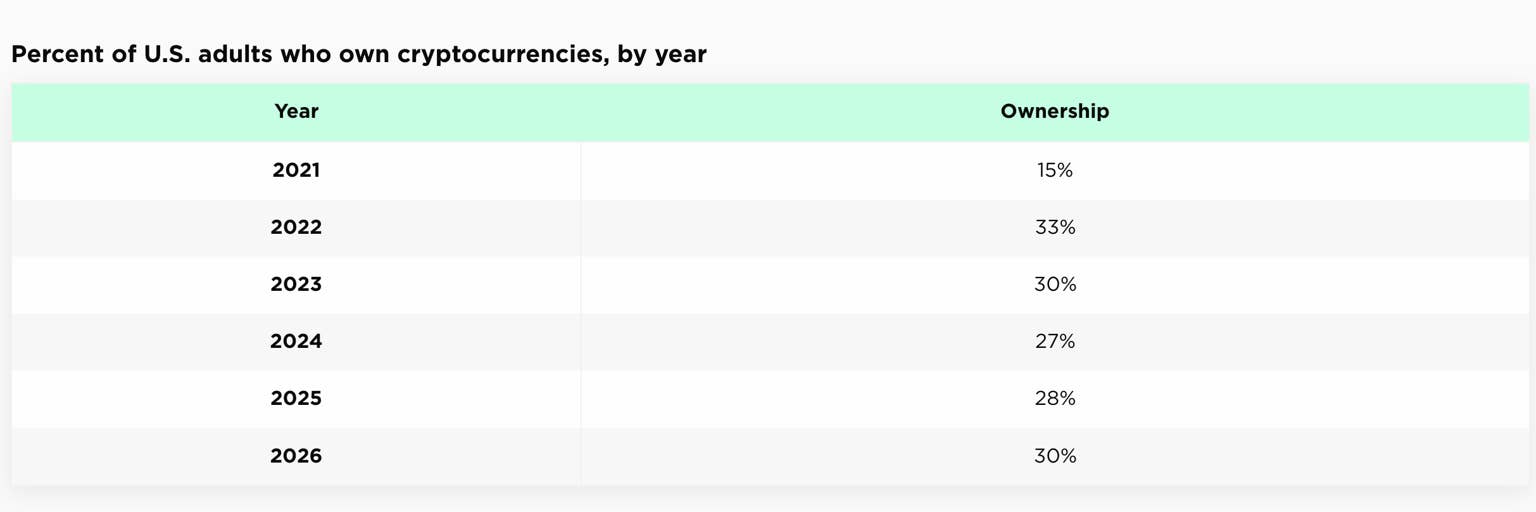
That hesitancy has persisted even as adoption edged up. Security.org's 2026 Cryptocurrency Adoption and Sentiment Report, based on a survey of 992 U.S. adults, found ownership climbing back to 30% this year, still short of the 33% peak reached in 2022 before the crypto winter wiped out over $2 trillion in value.
Trending on TheStreet Roundtable:
Among non-owners, unstable value (37%) and lack of government or bank oversight (16%) remain the top cited concerns, largely unchanged from years earlier. Perhaps most tellingly, 47% of non-owners say they will never buy cryptocurrency at all.
Source:
Security.orgThere's a real irony buried in that number. Among people who bought early, 53% report a net gain on their investment, according to the same Security.org survey. The people most skeptical of crypto's reliability have, on the whole, been proven wrong by the people who actually held it.
None of this is a suggestion that Bitcoin is a fix for the structural pressures JPMorgan describes; a volatile, unregulated asset carries its own very real risks, and past returns say nothing about what comes next.
But the juxtaposition is hard to ignore: a bank warning that the foundations of cheap borrowing are gone for good, a country where half of all workers remain one missed paycheck from crisis, and an asset that multiplied over 200-fold in a decade that most Americans still don't trust enough to touch.
Related: Ex-Trump advisor believes Bitcoin will grind higher after crashing