The Robinhood Chain ecosystem has quickly become one of the most discussed narratives in crypto. While most traders focus on price action, another question is arguably more interesting: Where
The Robinhood Chain ecosystem has quickly become one of the most discussed narratives in crypto. While most traders focus on price action, another question is arguably more interesting:
Where is the capital actually flowing?
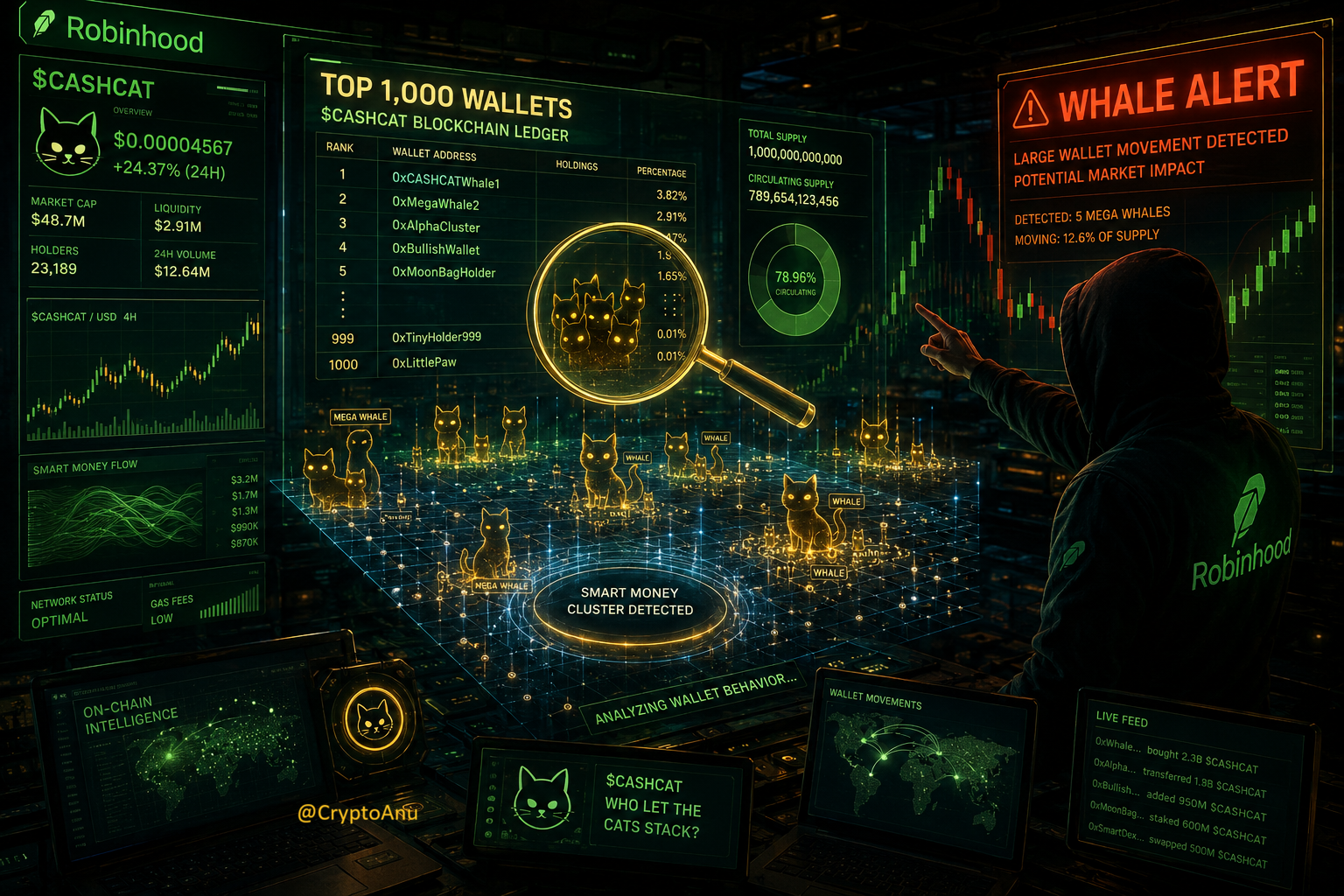
Using Arkham Intelligence, I analyzed the top 1,000 CASHCAT holders and examined what other Robinhood Chain assets they own. Rather than chasing candles, this approach provides a snapshot of how capital is currently distributed across one of crypto's newest ecosystems.
CASHCAT Is Large—But Highly Concentrated
CASHCAT has already grown to more than 61,000 holders, an impressive figure for such a young memecoin.
However, the ownership structure tells a different story.
The top 1,000 wallets control approximately 89.1% of the circulating supply, representing more than $40 million worth of tokens.
This level of concentration is neither inherently bullish nor bearish. It simply means that large holders have substantial influence over liquidity, volatility, and future price movements.
Concentrated ownership can accelerate rallies—but it can also amplify corrections when whales decide to rotate capital.
Looking Beyond CASHCAT
Instead of focusing solely on CASHCAT itself, I wanted to understand where these large holders are allocating the rest of their capital.
This creates a map of the broader Robinhood Chain ecosystem.
The largest overlapping positions include:
- PONS: approximately $2.84 million
- TENDIES: approximately $1.87 million
- STONKBROKER: approximately $1.10 million
- The Index: approximately $1.07 million
- WOOD: approximately $409,000
- SQUEEZE: approximately $314,000
- VIRTUAL: approximately $308,000
- JUGGERNAUT: approximately $299,000
- UP: approximately $275,000
- DEGEN: approximately $247,000
- KITSU: approximately $229,000
- SWOGE: approximately $211,000
- VEX: approximately $207,000
Rather than concentrating entirely in one asset, many of the largest wallets appear diversified across multiple Robinhood Chain projects.
Why This Matters
Capital rarely moves randomly.
In emerging ecosystems, experienced traders often accumulate several narratives simultaneously.
That doesn't guarantee these tokens will outperform, but it provides valuable insight into where sophisticated participants currently have exposure.
Monitoring these relationships can sometimes reveal ecosystem trends before they become widely discussed on social media.
The Opportunity—and the Risk
The data also highlights a major consideration.
With nearly 89% of CASHCAT's supply held by the top 1,000 addresses, liquidity remains highly dependent on relatively few participants.
Large holders entering or exiting positions can produce rapid price swings, making volatility a defining characteristic of the asset.
For traders, this creates both opportunity and risk.
Momentum can build quickly, but so can corrections.
Robinhood Chain Is Still in Its Early Days
Robinhood Chain remains one of crypto's newest ecosystems.
Many projects are only weeks old, and narratives continue to evolve almost daily.
Today's leading tokens may become tomorrow's infrastructure—or they may simply fade as attention shifts elsewhere.
This uncertainty makes on-chain analysis increasingly valuable.
Instead of relying solely on social media sentiment, investors can observe how wallets are positioning themselves and how capital rotates between projects.
Final Thoughts
This research should not be interpreted as a buy list.
It is simply a snapshot of current wallet behavior.
Following capital flows is one of the strongest advantages blockchain transparency provides. While no dataset can predict future performance, understanding where major holders allocate capital offers a deeper perspective than price charts alone.
As Robinhood Chain continues to develop, monitoring these wallet relationships may become one of the most useful ways to identify emerging narratives before they become mainstream.
The blockchain is transparent.
Sometimes, the smartest strategy is simply following where the money already is moving.