Galaxy Digital (NASDAQ: GLXY), led by Mike Novogratz, was added to the Russell 1000 Index on June 29, 2026, after reaching a market capitalization of approximately $11.55 billion. This inclus
Galaxy Digital (NASDAQ: GLXY), led by Mike Novogratz, was added to the Russell 1000 Index on June 29, 2026, after reaching a market capitalization of approximately $11.55 billion.
This inclusion mandates synchronized purchases across all passive index funds and ETFs tied to the Russell 1000, which has over $12 trillion in assets. The reconstitution occurred on June 26, 2026, with trading beginning on June 29.
Galaxy was one of 62 companies added to the Russell 1000 and approximately 224 to the Russell 3000, highlighting the mechanical significance of its inclusion, as passive funds must maintain their index weights regardless of fund managers’ opinions on crypto stocks.
Russell 1000 Reconstitution Mechanics: What GLXY’s $11.55Bn Market Cap Inclusion Means
Index reconstitution actively impacts funds tracking it. When FTSE Russell adds a stock to the Russell 1000, all funds benchmarked to that index must purchase shares in proportion to the new constituent’s weighting.
Galaxy Digital weight in the Russell 1000, based on its market cap, dictates the extent of this forced demand, and with over $12 trillion in assets tracking the index, even a small weight can lead to substantial buying activity.
Historical data show that new Russell additions often experience elevated trading volumes and liquidity surges at the effective date due to passive inflows and active arbitrage.
Over the long term, new large-cap constituents typically see passive ownership converge to 20–25% of their free float, indicating a shift from active to passive investors.
For GLXY, this means a transition to a stable base of passive holders who will likely retain their shares through market cycles as long as it remains in the Russell 1000.
Institutional Allocator Access Unlocked: How Russell 1000 Eligibility Opens Galaxy Digital to Capital Previously Barred by Mandate Restrictions
The Russell 1000 inclusion significantly expands Galaxy’s investor base beyond mechanical buying, allowing previously restricted pension funds and endowments to hold GLXY.
This change, effective June 29, 2026, makes GLXY a benchmark constituent, facilitating automatic approval for portfolio managers and compliance teams.
Analyst Rich LoPresti noted that this inclusion also broadens eligibility to ETFs and quantitative strategies, thereby enhancing demand.
Founded in 2018 by Mike Novogratz, Galaxy Digital operates across institutional trading, asset management, custody, and digital infrastructure.
Their Helios AI compute campus in Texas, with over 1.6 gigawatts of capacity, positions Galaxy at the intersection of crypto mining and AI compute.
The firm has also launched OTC prediction markets and is advancing blockchain capital markets by conducting the first on-chain shareholder vote, showcasing its role in the evolution of institutional finance.
Bull, Base, and Bear Case: What the Galaxy Digital Russell 1000 Listing Means for Institutional Flows
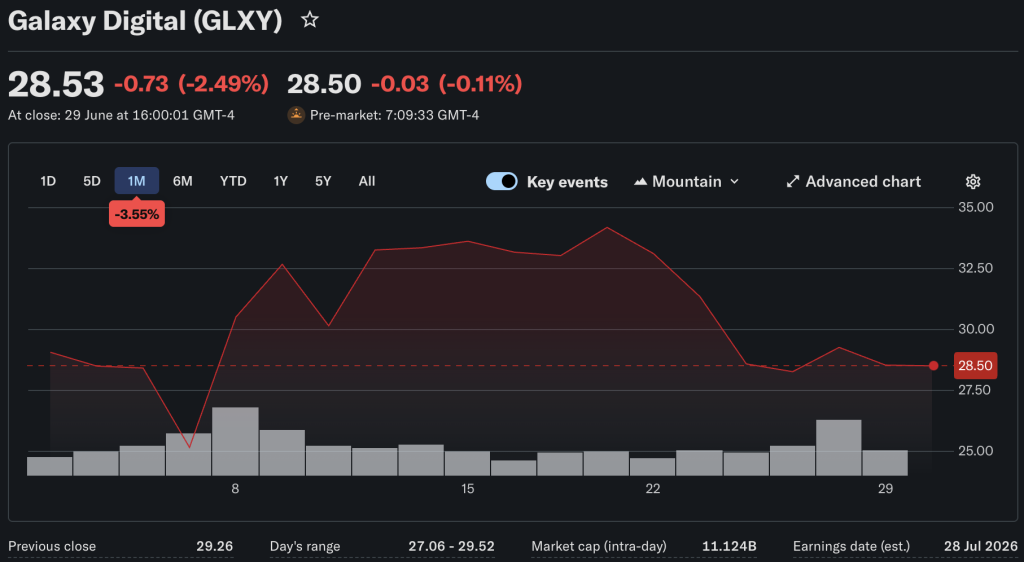 SOURCE: Yahoo Finance
Galaxy has been added to the Russell 1000 alongside several crypto companies, including Bitmine Immersion Technologies and SharpLink Gaming. This inclusion marks a significant shift, as passive fund flows into crypto equities are becoming more structured rather than entirely discretionary.
Bull Case: On June 29, demand from index inclusion leads to a substantial rise in Galaxy’s stock (GLXY). Discretionary investors, previously hesitant, are also starting to buy. By August 2026, institutional ownership increases significantly, lifting GLXY well above its inclusion price as analysts view its Helios campus as a long-term infrastructure asset.
Base Case: Passive buying occurs on schedule, causing moderate price increases. Discretionary investors are slow to act while assessing Galaxy Digital. By Q3 2026, passive ownership may reach 10-15% of the float, with a target of 20-25% in subsequent quarters.
Bear Case: Limited price appreciation results from the rapid absorption of forced buying, while a decline in Bitcoin or the broader crypto market triggers selling pressure. If Bitcoin drops by more than 15% before the August 13F filings, GLXY’s price action may reflect broader market movements rather than structural demand. The next index reconstitution is set for December 2026, impacting institutional strategies for crypto stocks.
Disclaimer: The author does not hold or have a position in any securities discussed in the article. All stock prices were quoted at the time of writing.
The post Galaxy Digital Joins Russell 1000: $12Tn in Passive Funds Must Now Hold GLXY appeared first on Tokenist.