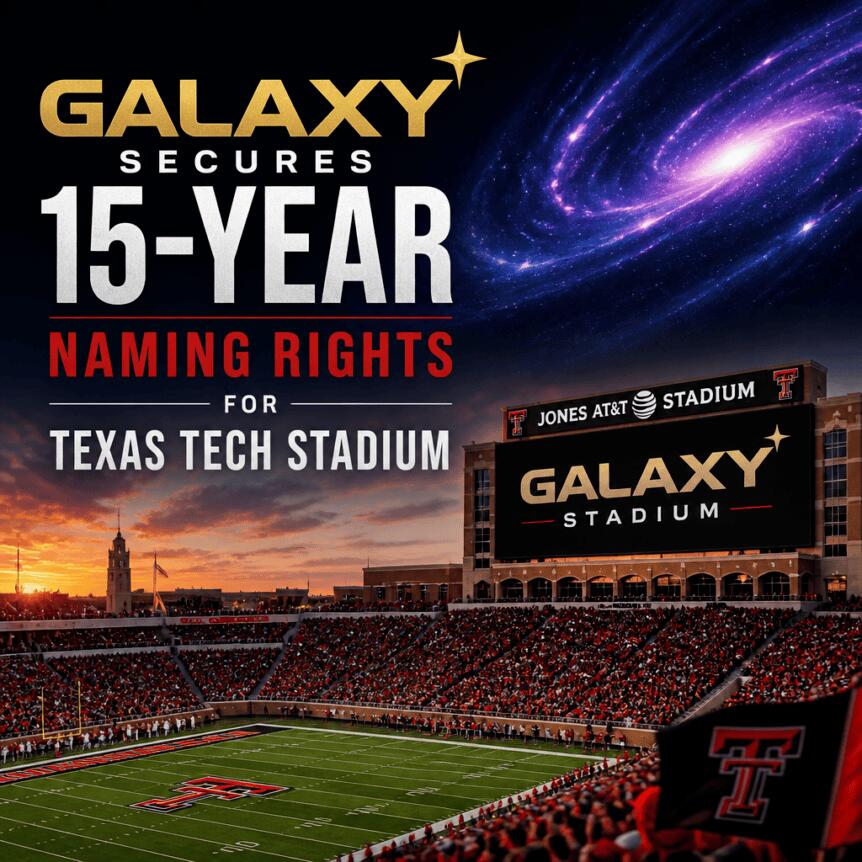
Galaxy Digital has secured a 15-year naming rights deal with Texas Tech, renaming the university’s football stadium “Galaxy Stadium” starting with the 2026 season. The announcement also posit
Galaxy Digital has secured a 15-year naming rights deal with Texas Tech, renaming the university’s football stadium “Galaxy Stadium” starting with the 2026 season. The announcement also positions Galaxy as Texas Tech Athletics’ official data center and digital assets partner, with both sides pointing to collaboration on student-athlete NFT and broader AI initiatives.
Under the partnership, the venue’s new name will debut on Sept. 5, when Texas Tech opens its season against Abilene Christian. Financial terms were not disclosed.
Key takeaways
- Galaxy Digital signed a 15-year naming rights agreement that renames Texas Tech’s stadium “Galaxy Stadium” beginning in 2026.
- Galaxy will serve as Texas Tech Athletics’ official data center and digital assets partner.
- The parties plan to explore student-athlete name, image and likeness (NIL) opportunities alongside AI initiatives and workforce development.
- Galaxy’s move extends its presence in West Texas, where it operates the Helios data center campus with approved capacity aimed at AI and high-performance computing.
Why this deal goes beyond branding
Naming-rights arrangements are nothing new in collegiate sports, but Galaxy’s agreement is structured to tie its infrastructure and digital assets capabilities directly to athletics operations. Alongside the stadium name change, Texas Tech Athletics will adopt Galaxy as its “official data center and digital assets partner,” creating a platform for technical collaboration that can affect everything from data handling to AI-focused projects.
The partnership framework also highlights business development goals beyond entertainment value. Texas Tech and Galaxy said they plan to collaborate on student-athlete NIL opportunities, artificial intelligence initiatives, and workforce development programs. For investors and builders, that matters because it suggests Galaxy is not just pursuing consumer-facing visibility; it is seeking real-world integration with institutional workflows and talent pipelines.
The 2026 kickoff date gives both sides a runway to align on technical and program requirements ahead of the Sept. 5 season opener against Abilene Christian.
The new agreement expands Galaxy’s reach in West Texas, where it already operates the Helios data center campus in nearby Dickens County, about 60 miles east of Lubbock.
According to Galaxy’s announcement, the Helios site has 1.6 gigawatts of approved capacity for artificial intelligence and high-performance computing (HPC). That approved power is a key detail for anyone tracking the race among infrastructure providers: data centers increasingly need both power availability and AI-ready capacity, and partnerships like this can help anchor long-term demand for compute capacity and related services.
While naming rights primarily function as marketing, attaching the agreement to data center and digital assets partnership suggests the collaboration could leverage that approved compute posture toward athletics-related research, analytics, and AI initiatives—especially as universities look for scalable technology partners.
Texas continues to court crypto infrastructure and policy
This stadium deal lands amid a broader push by Texas to become a central destination for crypto-adjacent activity, pairing large-scale mining and digital infrastructure growth with political momentum and pro-crypto policy moves.
Texas already hosts several prominent mining and infrastructure operators, including Riot Platforms, Cipher Mining, Core Scientific, CleanSpark, IREN and Hut 8.
Recent investment activity cited in earlier coverage underscores the state’s pull. In February, Canaan acquired a 49% stake in three operating Texas mining facilities from Cipher Mining for nearly $40 million, as reported by Cointelegraph (see original report). Earlier in the same month, MARA Holdings announced plans to acquire a 2-gigawatt powered site in Texas to develop a digital infrastructure campus supporting both HPC and Bitcoin mining, according to Cointelegraph’s coverage (see original report).
Beyond industry investment, political spending has also been a notable component of the Texas story. In May, industry-affiliated political action committees spent more than $10 million supporting candidates in Texas congressional primary runoffs, and Cointelegraph reported that all six backed candidates won (see original report).
Policy developments have reinforced the same direction. Last year, Gov. Greg Abbott signed legislation creating the Texas Strategic Bitcoin Reserve, following the enactment of Texas Senate Bill 21. Cointelegraph previously reported that state officials began transitioning reserve holdings from a spot Bitcoin ETF to directly custodied bitcoin in May (see original report). The bill history is maintained by the Texas Legislature (Texas Legislature).
What to watch next
The Galaxy–Texas Tech partnership raises practical questions that will matter once the agreement moves from announcement to execution: how the NIL and AI programs are designed, what role digital assets will play in athletics-specific workflows, and whether Helios’s approved AI/HPC capacity translates into measurable university and sports-related deployments. With the stadium renaming scheduled for the Sept. 5 opener, the next signposts to track are program milestones and the rollout timeline for the planned NIL, AI, and workforce initiatives.
This article was originally published as Galaxy Secures 15-Year Naming Rights for Texas Tech Stadium on Crypto Breaking News – your trusted source for crypto news, Bitcoin news, and blockchain updates.