No, gold is not protecting investors from this weekend's crypto crash: the gold price fell in the same week as Bitcoin. The December gold futures contract on Comex closed on Friday, November
No, gold is not protecting investors from this weekend's crypto crash: the gold price fell in the same week as Bitcoin. The December gold futures contract on Comex closed on Friday, November 13, 2026, at $3,886.30 per troy ounce, according to Yahoo Finance data the lowest daily close since October 2, 2025. On Monday, November 9, it still stood at $4,114.50, a drop of 5.5% in four trading days. Spot gold was quoted at $3,887.60 at 09:43 UTC on Sunday (gold-api.com). Gold markets are closed over the weekend; regular trading resumes on Sunday evening.
Bitcoin fell much harder over the same stretch. At 09:45 UTC on Sunday, one bitcoin traded at $65,438 on Kraken, after a 24-hour low of $61,970. For the full picture of the sell-off, read our crypto news for November 14 and our running explainer on why is crypto down.
Gold price today: $3,886 and the lowest close since October 2025
Most of the decline came on Thursday, November 12. According to BullionVault, gold lost $150 in London that day and briefly fell to $3,853, its lowest level since October 2025 and almost $20 below last month's low. Coinpaper reported spot gold down about 2.9% at $3,871.31 on the same day and December futures down 3.2% at around $3,872. The figures differ by venue and time, so the low is best given as a range: between $3,853 and $3,871.
On Friday the price steadied. December futures traded between $3,871.10 and $3,927.20 and closed at $3,886.30, almost unchanged from Thursday's $3,885.30. Silver also fell: BullionVault reported a drop of more than $2 to below $50 an ounce on Thursday, an 11-month low. Silver futures closed Friday at $49.12 (Yahoo Finance).
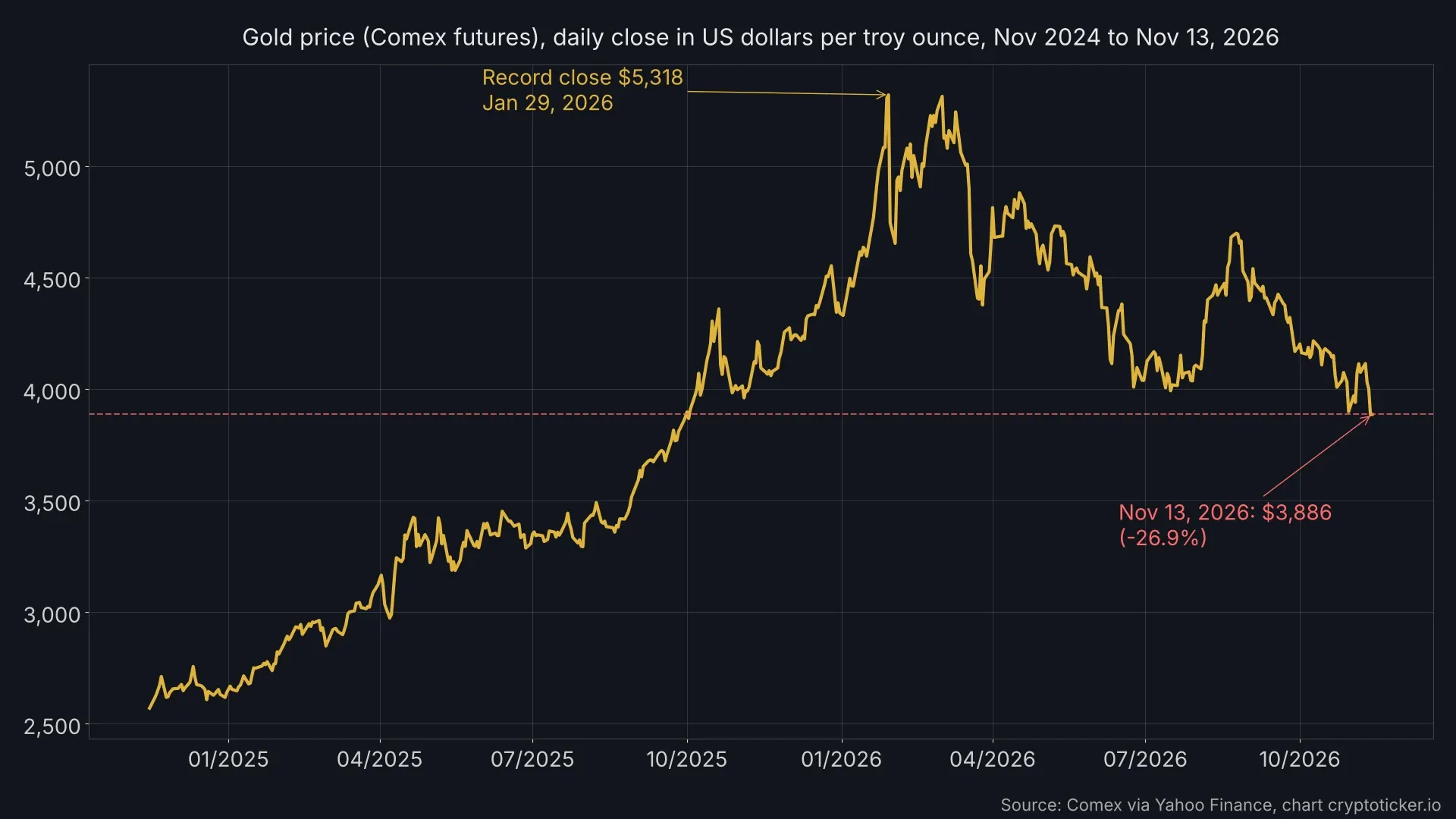
Gold price, Comex futures daily close since November 2024, with the record and the current level. Source: Comex via Yahoo Finance, chart cryptoticker.io.
How far is the gold price from its record high?
Gold futures set their record daily close on January 29, 2026, at $5,318.40; the intraday high that day was $5,586.20 (Yahoo Finance). At $3,886.30, gold sits 26.9% below the record close and 30.4% below the intraday high. Year over year the gap is smaller: on November 14, 2025, futures closed at $4,094.20, so today's price is 5.1% lower. Gold last closed lower than now on October 2, 2025, at $3,868.10.
For comparison, Bitcoin trades about 49% below its all-time high of $126,080 from October 6, 2025, and Ether about 64% below its record, according to CoinGecko (as of November 15, 08:43 UTC). Gold has lost far less, but it is also a long way from its peak.
Why is the gold price falling? Fed rate hike bets, the dollar and Treasury yields
Gold and Bitcoin share the same trigger this week: expectations of higher US interest rates. According to Coinpaper, US consumer prices rose 0.4% month over month in October against expectations of 0.3%, and core inflation excluding food and energy rose 0.3%, also above forecasts. Markets then priced in a roughly 91% chance of a quarter-point hike at the Fed meeting on December 8 and 9, Coinpaper reports. BullionVault cites the CME FedWatch tool at 94% for a quarter point and 6% for a half point. On Saturday the figure stood at 88.5% for a quarter-point hike, according to bitcoin.com.
Higher rates hit gold twice. Gold pays no interest or dividend, so the opportunity cost of holding it rises when bonds pay more. According to BullionVault, the 10-year US Treasury yield rose back above 5% on Thursday for the first time in three weeks. The dollar adds to the pressure: BullionVault says the DXY dollar index hit its highest level since April 2025. A stronger dollar makes gold more expensive for buyers outside the US. Dallas Fed President Lorie Logan said the FOMC needs at least two more quarter-point increases, according to BullionVault.
Bitcoin faces the same forces, amplified by outflows from spot ETFs. According to Coinpaper, citing Farside Investors, about $1.07 billion flowed out of US spot Bitcoin ETFs from November 9 to 13. For gold, the World Gold Council still reported inflows in the third quarter: central banks bought 321 tonnes and physically backed gold ETFs attracted 211 tonnes, per Coinpaper. No figure for November is available yet.
Gold vs. Bitcoin: which lost more over the past year?
Since November 14, 2025, gold futures have lost 5.1%, while Bitcoin fell about 27.7% based on daily closes through November 13, 2026 (Yahoo Finance, BTC-USD $68,249 against $94,398). Bitcoin has since slipped to around $65,400. The ratio between the two shows how far the balance has shifted: at Bitcoin's record on October 6, 2025, one bitcoin bought about 31.4 ounces of gold. On November 13, 2026, it bought about 17.6 ounces, and on Sunday morning, at $65,438 against $3,887.60, about 16.8 ounces (cryptoticker.io calculation).
Neither asset is a safe haven in the narrow sense this week. Gold lost less and swings far less, but it follows the same rate signals. Anyone who sees Bitcoin as digital gold will find more arguments against that view in November 2026: Bitcoin is trading closer to tech stocks, which BullionVault said were also under pressure on Thursday.
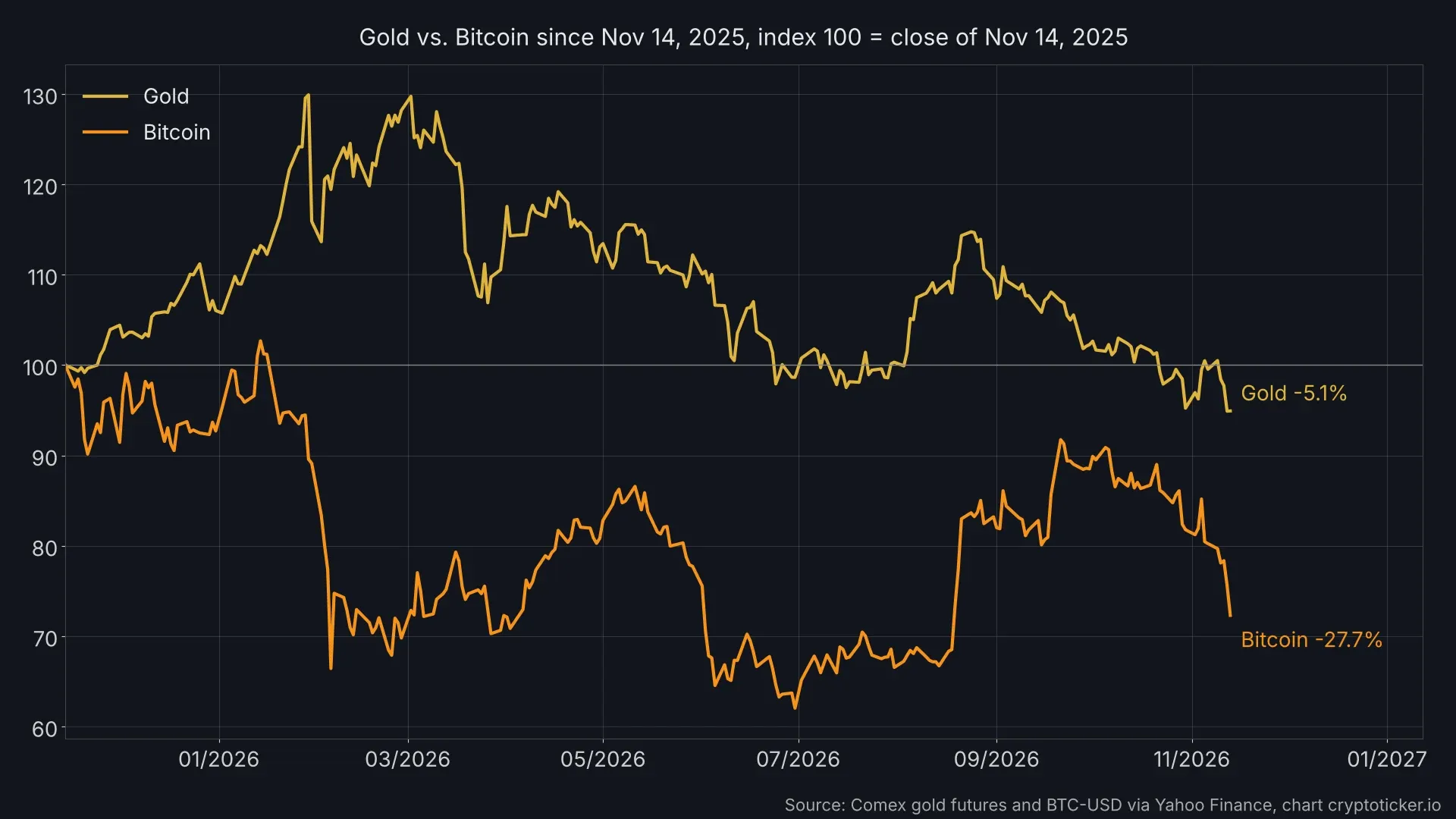
Gold and Bitcoin since November 14, 2025, both set to 100. Gold lost 5.1%, Bitcoin 27.7%. Source: Yahoo Finance, chart cryptoticker.io.
Will the gold price fall below $3,800? The levels to watch
This article makes no forecast, but the levels traders watch can be named. Coinpaper names $3,900 as an area that has already failed once as support, $4,000 as the psychological hurdle on the upside and $3,800 as the next area on the downside if selling continues. The price data adds one more level: Thursday's low between $3,853 and $3,871. The 10-year Treasury yield above 5% and the dollar at its highest since April 2025 are the two variables that will decide the next move. The next fixed date is the Fed meeting on December 8 and 9.
Tokenized gold, which keeps trading over the weekend, gives a first hint: on Kraken, one PAX Gold token, which represents one troy ounce, cost $3,826.93 at 09:45 UTC on Sunday, after a 24-hour range of $3,760.61 to $3,866.04. That is about 1.5% below Friday's spot price. Such a token is a thin market and not a reliable signal for Monday's open.
Trading gold and Bitcoin: long, short and leverage explained
This is not a recommendation, only an explanation of the tools. A long position gains when the price rises, a short position when it falls. Gold can be traded as physical bars, through exchange-traded products, as tokenized gold on crypto exchanges or through CFDs. A CFD, or contract for difference, means you do not own the gold; you only trade the price difference, in both directions and usually with leverage.
Leverage magnifies the result in both directions. At 10x, a 10% price move changes your position by 100%. In gold, the 5.5% drop from November 9 to 13 would have cut a 10x long position by about 55% of its margin; at 20x it would have been liquidated. Bitcoin swung between $61,970 and $67,451 on Kraken within 24 hours, almost 9%; at 100x, a move of about 1% against you wipes out the entire margin. When Bitcoin broke below $64,000, TokenPost counted $691 million in liquidations within one hour, $671 million of them on the long side.
Two tools limit the damage. A stop-loss closes the position automatically at a price set in advance. Position size determines how much you risk; many traders put no more than 1% to 2% of their capital on a single trade. You can compare fees, licenses and products in our crypto exchange comparison, and CFD providers with gold and crypto in the crypto broker comparison. The decision is yours. Leveraged products and CFDs can lead to the loss of your entire stake, and most retail CFD accounts lose money.
Gold price and the crypto crash: what US and UK readers should know
In the United States, CFDs are not offered to retail traders, so US readers trade gold through futures, exchange-traded funds or tokenized gold instead. In the United Kingdom, the Financial Conduct Authority has banned the sale of crypto derivatives to retail consumers, while CFDs on gold remain available from FCA-authorized brokers. Whichever route you use, check that your platform is regulated where you live and that your account is reachable during heavy trading.
Our coverage of the big coins in this wave: the bitcoin price at the $60,000 level, the Ethereum price at $1,715, the Solana price crash and the XRP crash to $0.89. Scenarios from named analysts are collected in our Bitcoin price prediction. Another topic these days is anthropic stock.
Gold price in the crypto crash: your next three steps
- Check whether you hold leveraged positions in gold or Bitcoin and at what price they would be liquidated; terms of regulated providers are in our crypto exchange comparison.
- Before trading CFDs on gold or crypto, compare fees and leverage limits in the crypto broker comparison.
- Watch $3,800 and $3,900 on the downside and $4,000 on the upside for gold, plus the Fed meeting on December 8 and 9 and the scenarios in our Bitcoin price prediction.
(As of November 15, 2026, 09:45 UTC. This article is not financial advice. Prices and fee models change; check the terms with the provider before every purchase. Trading with leverage or CFDs can result in the loss of your entire capital.)