TeraWulf reported nearly $710 million in quarterly profit while posting an $88.2 million operating loss, as a large noncash accounting gain drove its bottom line. The former bitcoin-focused b
TeraWulf reported nearly $710 million in quarterly profit while posting an $88.2 million operating loss, as a large noncash accounting gain drove its bottom line.
The former bitcoin-focused business now gets most of its revenue from data-center leases. Its next expansion depends on completing buildings, securing financing and turning signed contracts into rent.
The company's third-quarter results, released Nov. 6, show $709.9 million in net income attributable to TeraWulf, compared with a $455.1 million loss a year earlier. Revenue rose about 51% to $76.2 million.
Those figures describe different parts of the business. Revenue measures sales, operating income accounts for the costs of running the business, and net income also includes financing costs and gains or losses outside operations.
What produced the profit
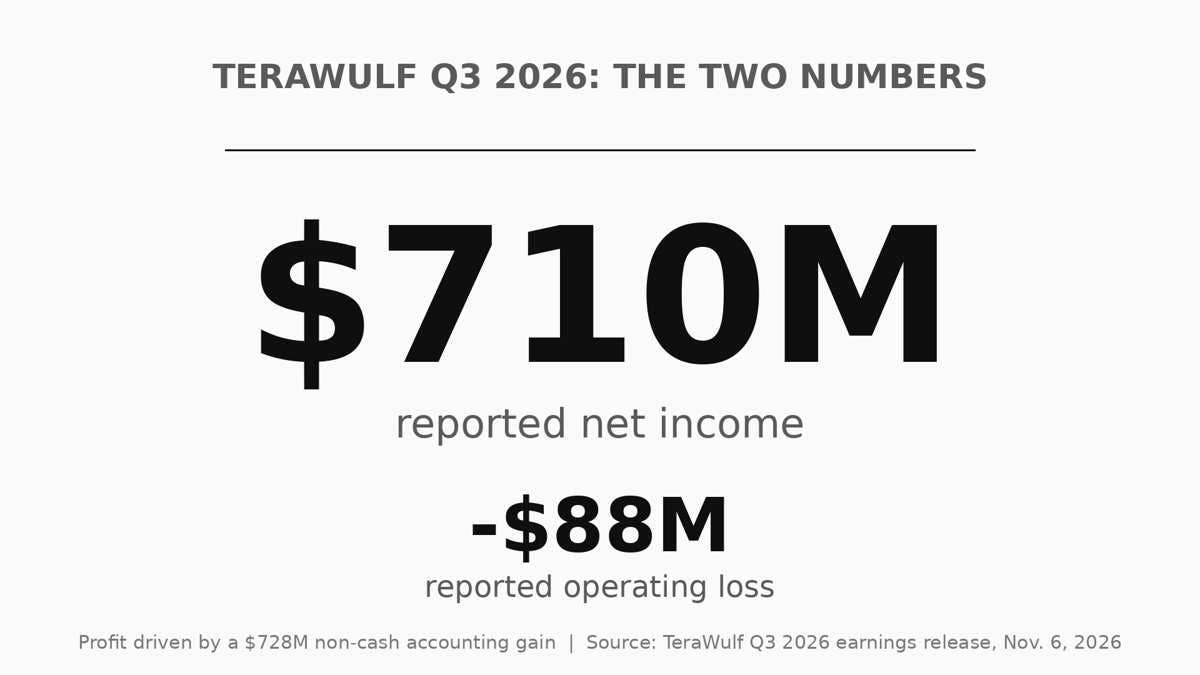 TeraWulf reported $709.9 million of net income attributable to the company and an $88.2 million operating loss in Q3 2026. Its results included a $728.4 million noncash gain on warrant and derivative liabilities. Source: TeraWulf Q3 2026 results, Nov. 6, 2026.
The largest positive item was a $728.4 million change in the value of warrant and derivative liabilities. Warrants give their holders a right to buy shares under specified terms, and changes in the value of these obligations can produce accounting gains or losses without bringing in cash.
The same income-statement line produced a $424.6 million loss in the third quarter of 2025. This quarter's positive figure therefore does not represent money collected from AI customers.
TeraWulf also recorded a $95 million gain on the sale of its 50.1% stake in the Abernathy joint venture. Neither item forms part of revenue from its mining or data-center businesses.
Its operating loss widened from $24.7 million to $88.2 million. Total operating costs and expenses reached $164.5 million, more than twice quarterly revenue, including $29.6 million of depreciation and $9.7 million of property and equipment impairments.
Adjusted EBITDA was negative $12.8 million, compared with positive $18.1 million a year earlier. That company-defined measure removes interest, taxes, depreciation and several other items, including warrant-value changes, and is neither net income nor cash flow.
For the first nine months of 2026, TeraWulf still reported a $657.6 million loss attributable to the company. A profitable third quarter did not erase losses earlier in the year.
AI rent has overtaken bitcoin revenue
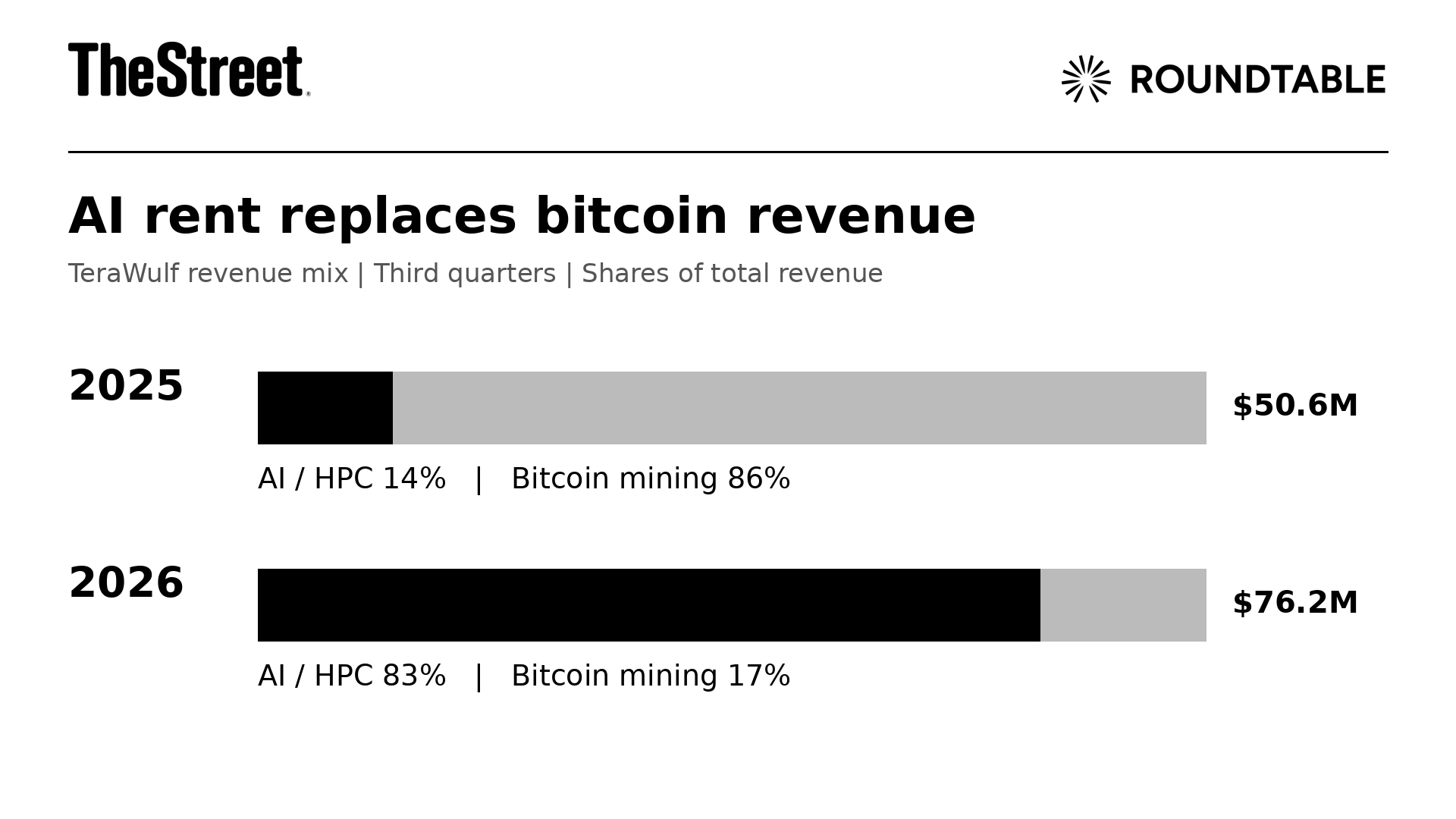
Data-center lease revenue grew from about 14% to 83% of TeraWulf revenue between Q3 2025 and Q3 2026. Bars show revenue shares, not relative total revenue. Source: TeraWulf Q3 2026 results, Nov. 6, 2026.
Data-center lease revenue rose to $63 million from $7.2 million in the comparable quarter. Its share of company revenue increased from about 14% to 83%, based on the reported figures.
Bitcoin-mining revenue moved the other way, dropping to $13.2 million from $43.4 million, a decline of about 69%. TeraWulf is repurposing parts of its Lake Mariner mining infrastructure in New York for AI and other high-performance computing customers.
The company develops and operates the buildings, power connections and related infrastructure. It says its model does not depend on buying the AI computing hardware itself.
At Sept. 30, Lake Mariner had 102 megawatts of critical IT capacity online and generating revenue. Critical IT capacity measures the power available to computing equipment, rather than the total electricity supply secured for an entire campus.
Another 336 megawatts were under construction at Lake Mariner. The company expects phased delivery and rent commencement for CB-4 in the fourth quarter, with CB-5 beginning phased delivery in early 2027.
Its disclosed construction-cost guidance is $8 million to $10 million per critical IT megawatt for WULF Compute. These are development costs incurred ahead of the future rental income.
What Google is backing
The largest announced lease is with Anthropic at the Justified campus in Hawesville, Kentucky. TeraWulf puts the initial 20-year commitment at roughly $19 billion for about 401 megawatts of critical IT capacity.
That $19 billion is contracted revenue over two decades, not money received this quarter, cash already available for construction or a measure of profit.
HIVE's $84.7 million Sweden problem shows the real risk in the AI buildout (4:03)
Under agreements announced Nov. 4, Google provides contractual credit support for anticipated project debt financing. TeraWulf says the arrangement strengthens its ability to obtain competitive financing, rather than announcing that all of that financing has already closed.
Fluor's construction agreement covers three buildings, including engineering, procurement, construction, testing and commissioning. Phased completions are expected to start in late 2027 and continue through the second quarter of 2028.
The agreement includes delivery milestones and cost reporting. TeraWulf says guaranteed maximum pricing is being established as engineering and procurement progress, so the announcement should not be read as a final fixed price for every part of construction.
The cash needed before rent arrives
The cash-flow statement shows $178.9 million used in operating activities over the first nine months, compared with $35 million a year earlier. Purchases of and deposits on plant and equipment totaled $2.23 billion, up from $445.2 million.
Those are nine-month figures, not third-quarter spending. They show why a noncash earnings gain cannot substitute for construction funding.
TeraWulf ended September with $1.60 billion in cash and cash equivalents, plus roughly $753 million of restricted cash. The combined $2.36 billion figure is often rounded to $2.4 billion, but the restricted portion is separately identified on the balance sheet.
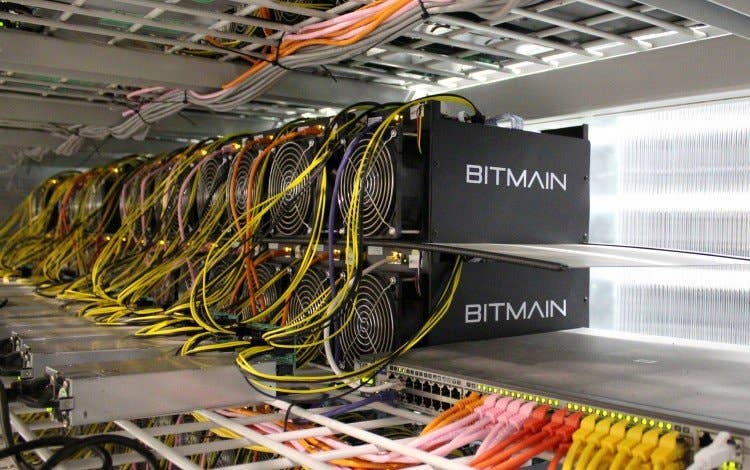
Image used for representational purposes only.
The Abernathy sale provided $250 million during the quarter. Another $150 million is expected by Dec. 31 and about $130 million, subject to adjustments, by April 30, 2027.
The company subsequently increased committed revolving credit from $250 million to $400 million. A further $150 million expansion feature is uncommitted and conditional, not another $150 million already available.
At Muskie in Kentucky, contracted power has doubled to one gigawatt, subject to state approval, with the second 500-megawatt phase expected in 2029. Contracted power there should not be confused with the 102 megawatts already earning revenue at Lake Mariner.
Chairman and CEO Paul Prager said Lake Mariner is delivering capacity and generating revenue, while Justified has the customer and construction framework to proceed. The next scheduled tests are nearer-term Lake Mariner deliveries, followed by Justified's first completed buildings in late 2027.