Google Cloud and Mysten Labs have announced a partnership to develop the "Verifiable Agent Arbiter," a framework aimed at verifying AI agent actions on-chain. The initiative targets a growing
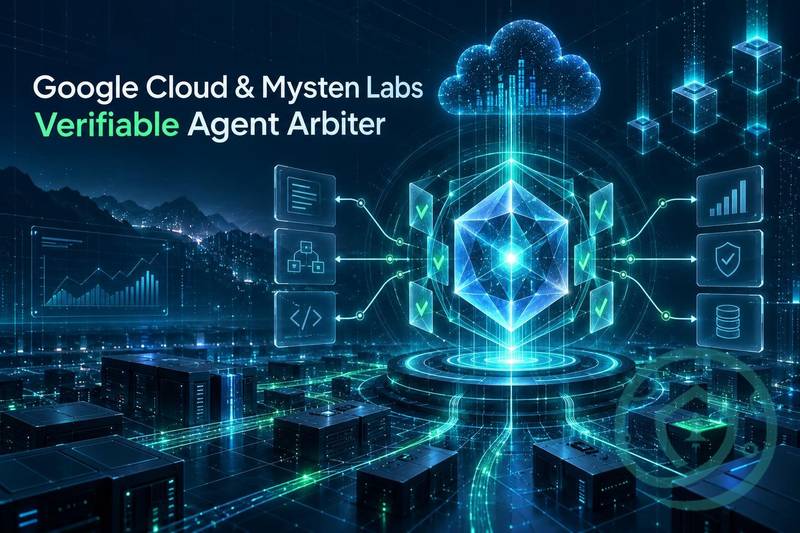
Google Cloud and Mysten Labs have announced a partnership to develop the "Verifiable Agent Arbiter," a framework aimed at verifying AI agent actions on-chain. The initiative targets a growing problem in autonomous AI systems: without a tamper-resistant record of what an agent did and why, operators and users have no reliable mechanism to audit, dispute, or trust agent behavior.
What the Verifiable Agent Arbiter Partnership Covers
Google Cloud brings infrastructure scale and managed compute to the arrangement, while Mysten Labs contributes its work on the Sui blockchain, which is built around the Move programming language and designed for high-throughput object-centric state management. The pairing places AI agent verification at the intersection of cloud execution and on-chain settlement. For related coverage, see 3x Bitcoin ETF Approved by SEC: Market Impact Explained.
The project's name signals its function: an arbiter adjudicates disputes or establishes ground truth. Applied to AI agents, the Verifiable Agent Arbiter is intended to produce a cryptographically anchored record of agent decisions, making those decisions inspectable and attributable after the fact. This is distinct from simply logging outputs to a database, where the log itself can be altered or suppressed. For related coverage, see Bitcoin, Ethereum, XRP & Dogecoin Dip Before Fed Minutes.
On-chain agent infrastructure has been expanding rapidly. Binance's Agent OS recently surpassed 280,000 daily calls, illustrating the operational scale at which autonomous agents now execute tasks across trading, data retrieval, and cross-protocol interactions. At that volume, unverifiable agent behavior becomes a systemic risk rather than an edge case.
Why On-Chain Verification Changes the Agent Trust Model
A conventional AI agent call runs in a closed environment: the agent receives a prompt, executes a chain of tool calls, and returns an output. Nothing in that loop is independently verifiable by a third party. An on-chain verification layer changes the architecture by writing a commitment, hash, or execution trace to a public ledger, creating a record that cannot be retroactively edited without detection.
The distinction matters most when agents control assets or execute consequential actions. If an agent misallocates funds, triggers an unintended smart contract interaction, or acts outside its stated policy, the on-chain record becomes the substrate for accountability. This is the problem the Verifiable Agent Arbiter is designed to address, though the specific cryptographic mechanisms, attestation format, and settlement logic have not been publicly detailed in the available announcement materials.
The accountability gap is real across DeFi as well. Logic exploits have accounted for 55% of DeFi flash loan losses, a category where agent-like automated strategies interact with protocol rules in ways that are difficult to audit after the fact. Verifiable execution traces would give investigators a starting point that current off-chain logs do not reliably provide.
Interoperability is an open question the partnership will need to address. A verification framework anchored to one blockchain creates a dependency on that chain's liveness, finality guarantees, and fee market. If the Verifiable Agent Arbiter is Sui-native, agents operating across Ethereum, Arbitrum, or other execution environments would require bridging logic or cross-chain attestation, each of which introduces its own trust assumptions.
The governance implications extend beyond technical architecture. Who controls the arbiter contract, who can query dispute records, and what recourse exists when an agent's on-chain trace conflicts with an operator's off-chain account are policy questions as much as engineering ones. Emerging on-chain insurance frameworks like Firelight's DeFi coverage model suggest that verifiable execution records could eventually underpin agent liability products, where coverage depends on proving what an agent actually did.
The Google Cloud and Mysten Labs partnership places a major cloud provider directly in the on-chain AI agent verification space. Whether the Verifiable Agent Arbiter becomes infrastructure-layer standard or a proprietary framework will depend on how the teams handle open-source access, developer tooling, and cross-chain compatibility as the initiative moves from announcement to deployment.
Additional source references: source document 1, source document 2.
Disclaimer: This article is for informational purposes only and does not constitute financial or investment advice. Cryptocurrency and digital asset markets carry significant risk. Always do your own research before making decisions.
Read original article on aicryptocore.com