Grayscale ETF Withdrawal: What Do the SEC Filings Actually Say? Why would a fund manager pull three ETF filings within 190 seconds of each other? Grayscale did exactly that. It filed a Graysc
Grayscale ETF Withdrawal: What Do the SEC Filings Actually Say?
Why would a fund manager pull three ETF filings within 190 seconds of each other? Grayscale did exactly that. It filed a Grayscale ETF withdrawal for its Cardano, Hedera, and Polkadot trust products, one after another, timestamped down to the second on SEC EDGAR.
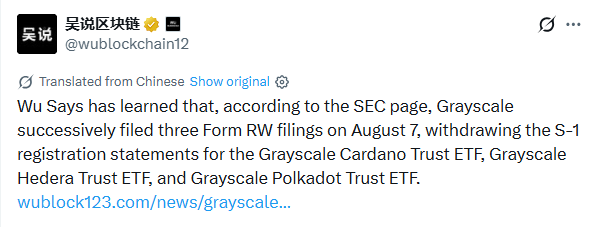 Source: X (formerly Twitter)
The filings themselves are simple documents. What they mean for each token's future listing path is less simple, and that's the part worth unpacking carefully.
What Do the SEC Filings Actually Say?
Each filing used Form RW, the SEC's document for withdrawing a registration statement under Rule 477. It's a voluntary pullback, not a rejection or denial.
Here is the exact timing, confirmed by EDGAR filing records:
ProductTickerWithdrawal Time (ET)
Grayscale Cardano Trust ETFADA4:33:37 p.m.
Grayscale Hedera Trust ETFHBAR4:34:55 p.m.
Grayscale Polkadot Trust ETFDOT4:36:47 p.m.
Each document uses near-identical language: Grayscale "does not intend to proceed" with the share distribution. None of the three registration statements had ever been declared effective. No shares were issued or sold, and no prospectus was distributed.
The SEC submissions don't state a reason. No demand figures, no regulatory concern, and no strategic rationale appear anywhere in the paperwork.
Timing and Context: Why the Old Listing Plans Died First
This ETF withdrawal covers the S-1 registration statement, the document that governs the public offering of ETF shares. That's a separate filing from a 19b-4, which is what an exchange submits to get permission to list and trade a product.
The original S-1s for Cardano and Polkadot went in on August 29, 2025. Hedera followed on September 9, 2025. The related exchange listing proposals moved on a different track entirely:
It would be easy to read that as proof these tokens had no path onto an exchange. That reading is too strong. In September 2025, the SEC approved generic listing standards for qualifying commodity-based trust shares, including certain digital-asset products.
That change let eligible spot crypto products reach an exchange without a separate, product-specific 19b-4 filing. It did not, on its own, make any registration statement effective, and it did not eliminate the underlying Securities Act requirements. So the old 19b-4 withdrawals show one listing route closed. They don't confirm every listing route closed, and Grayscale's own filings don't say either way.
Which Other Grayscale Altcoin ETFs Remain Active
The asset manager isn't stepping back from altcoin products altogether. Several other registrations remain in play, at different stages:
- Bittensor, Aave, and BNB ETF registrations remain preliminary and have not gone effective.
- NEAR and Zcash filings also remain preliminary.
- The Avalanche staking ETF registration went effective March 11, and the Hyperliquid staking ETF followed on June 2. Effectiveness alone doesn't confirm when trading began.
- Bitcoin and Ethereum trust products were not affected by this withdrawal.
Public price data checked at the time of writing showed no sharp moves in ADA, HBAR, or DOT following the announcement. Whether that reflects investor expectation, low visibility of the filings, or something else isn't something the available data can confirm.
Expert Analysis: Reading the Filing Sequence
A registration statement is a step in a process, not a guarantee of a product. Effectiveness, not filing, is what actually matters for whether shares can trade.
Grayscale filed these three S-1s during a period of heavy altcoin ETF speculation in 2025. A Form RW withdrawal is a low-cost way to formally close a registration that isn't moving forward, regardless of the underlying reason.
The order of events here is worth noting for future coverage: the exchange-side proposals were withdrawn first, months before the registration statements. Whether that pattern reflects a genuine loss of exchange interest or simply administrative housekeeping ahead of the newer generic listing framework isn't established by the filings themselves, and readers should treat any single interpretation with caution until the asset manager or an exchange states a reason directly.
Conclusion
The Grayscale ETF withdrawal formally closes three altcoin registrations that had sat inactive for months. It doesn't, by itself, confirm ADA, HBAR, or DOT have no future exchange path, given the SEC's newer generic listing framework. Bitcoin, Ethereum, and several other Grayscale filings remain untouched, and the next real signal will come from Grayscale's future filings, not this one.
Your Money Your Life Disclaimer
This article covers regulatory filings and market data on an assumption basis, drawn from publicly available SEC records and market sources checked. It does not guarantee any outcome for ADA, HBAR, DOT, or any related product. This is not financial, legal, or investment advice. Crypto assets carry high risk, including total loss of value. Always verify details directly through SEC EDGAR and consult a licensed financial advisor before making any investment decision.