Zcash is being positioned by Grayscale as a potential long-term challenger to Bitcoin’s dominance—less because of day-to-day price action and more due to a structural advantage: transaction p
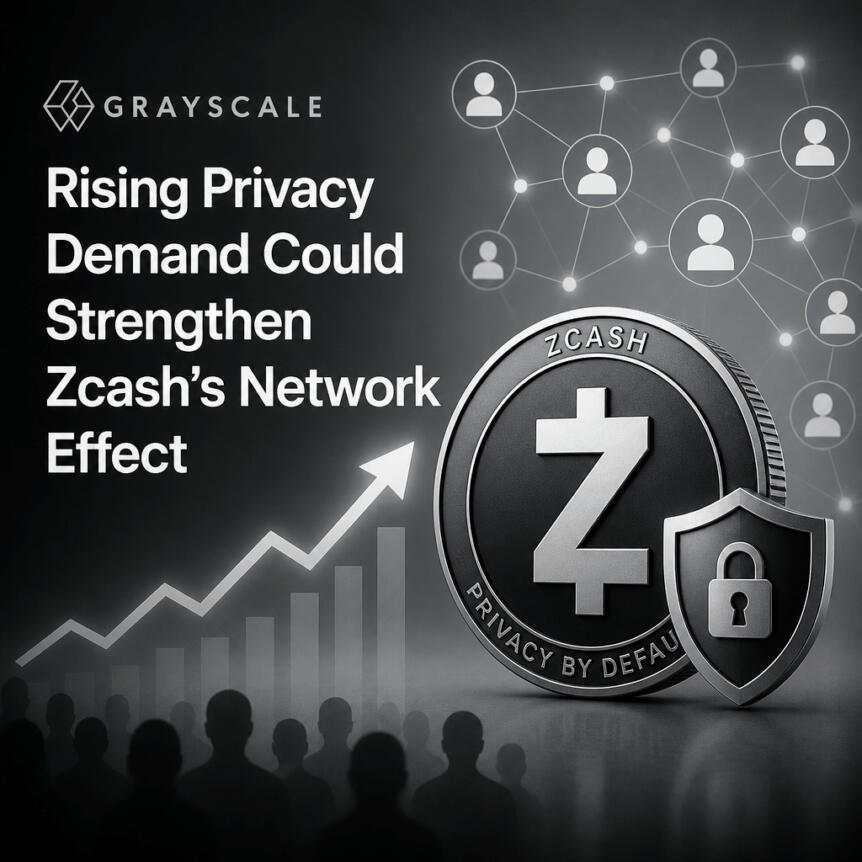
Zcash is being positioned by Grayscale as a potential long-term challenger to Bitcoin’s dominance—less because of day-to-day price action and more due to a structural advantage: transaction privacy. In a new research piece, Grayscale argues that as AI systems become increasingly capable of analyzing large-scale data, the ability to keep financial activity private could grow in importance, potentially translating into renewed demand for privacy-focused networks.
The firm’s thesis centers on what it calls “second mover advantages” for Zcash—an angle Grayscale says prior alternatives such as Litecoin have not managed to capitalize on. At the same time, Grayscale cautions that Bitcoin’s liquidity and entrenched network effects remain formidable barriers, and it characterizes Zcash as a high-risk investment where returns could be volatile.
Key takeaways
- Grayscale’s report frames Zcash’s privacy features as potentially more valuable as AI improves at detecting patterns in financial data.
- The firm argues Zcash may benefit from “second mover advantages” that help it compete against Bitcoin’s network effects—unlike some earlier challengers.
- ZEC has reportedly surged nearly 19-fold over the past year, yet still represents less than 1% of Bitcoin’s market capitalization, implying remaining upside if adoption expands.
- Despite the bullish case, Grayscale stresses Zcash’s returns could be uneven and that Bitcoin’s liquidity remains a major structural advantage.
- Institutional participation in the Zcash ecosystem is also growing, highlighted by Cypherpunk Technologies’ expanded mining operations.
Why Grayscale thinks AI makes privacy more valuable
Grayscale’s research emphasizes that financial privacy isn’t only about ideology or compliance preferences—it could become an operational necessity in a world where AI can extract insights from transaction-related data at scale. According to Grayscale, Zcash’s ability to shield transaction information could help users reduce exposure to surveillance through pattern analysis.
The core of the argument is that improved AI capabilities may raise the cost of openness in financial activity. If AI can better correlate signals across markets, addresses, and counterparties, privacy becomes not merely a feature but a defense against unwanted inference. In that framing, Zcash’s approach to protecting transaction details becomes the differentiator investors may increasingly underwrite.
Network effects and the gap versus Bitcoin
Grayscale also grounds its case in market structure. The report acknowledges that Bitcoin remains difficult to displace, citing both its liquidity and its entrenched network effects. Those advantages, Grayscale suggests, explain why many alternatives struggle to convert technical differentiation into lasting market share.
Still, the firm points to the scale mismatch between Zcash and Bitcoin as a reason to watch the asset. Grayscale cites ZEC’s roughly 19-fold increase over the past year, while noting that Zcash’s market valuation remains under 1% of Bitcoin’s market capitalization. The implication is that even if Zcash captures only a small portion of Bitcoin’s network value, the upside could be substantial—but not without risk.
Grayscale’s own projection (presented in the report’s materials) suggests Zcash could be worth more than $4,000 if its market capitalization reached 5% of Bitcoin’s—an illustrative benchmark rather than a guaranteed outcome. The firm’s stance is that the “defense” provided by Bitcoin’s liquidity could limit Zcash’s speed of adoption, but that the relative valuation gap leaves room for change if narrative and usage converge.
Institutional activity: Cypherpunk expands Zcash mining
The Grayscale thesis is also supported, at least indirectly, by growing institutional interest in Zcash-related infrastructure. Earlier coverage from Cointelegraph reported that Cypherpunk Technologies—an enterprise privacy technology firm listed on Nasdaq—expanded its Zcash exposure by acquiring a mining fleet from Winklevoss Capital in a $33.33 million equity-based transaction.
Cointelegraph reported that the mining operation is already online across US facilities and is producing about 4.2 GSol/s of Equihash hashrate, roughly 18% of the Zcash network’s total computing power. Cypherpunk said the transaction makes its mining arm the network’s largest active fleet.
This matters because mining scale can influence a network’s security profile and operational maturity, both of which institutional participants often weigh when allocating resources. While mining activity does not automatically translate into sustained market share, it can signal increased commitment to the ecosystem and may improve the reliability of network participation during periods of volatility.
What remains uncertain for Zcash
Grayscale’s report contains an important counterweight: Zcash is described as a high-risk investment, and any further upside could be volatile and uneven. Even if AI-driven concerns around surveillance strengthen demand for privacy coins, the path from narrative to lasting market valuation is rarely smooth—especially when competing against Bitcoin’s liquidity advantage.
For readers, the key question is whether privacy demand will translate into consistent usage and broader allocation beyond short-term enthusiasm. The next signals to watch are whether Zcash’s ecosystem continues to attract sustained capital—both from infrastructure providers and market participants—and whether the market continues to assign increasing value to privacy as AI capabilities grow.
This article was originally published as Grayscale: Rising Privacy Demand Could Strengthen Zcash’s Network Effect on Crypto Breaking News – your trusted source for crypto news, Bitcoin news, and blockchain updates.