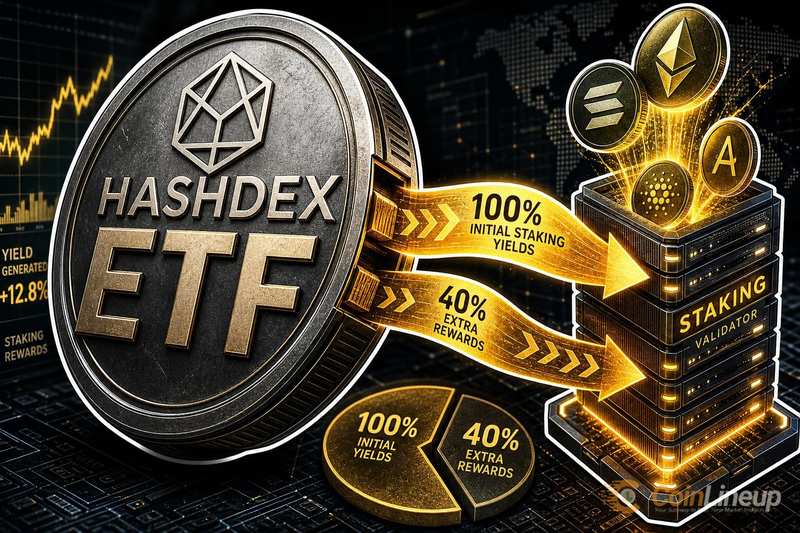
Hashdex has restructured the staking economics of its Nasdaq CME Crypto Index ETF (NCIQ), letting the fund keep 100% of the initial staking yields for its Sponsor Share while sharing only 40%
Hashdex has restructured the staking economics of its Nasdaq CME Crypto Index ETF (NCIQ), letting the fund keep 100% of the initial staking yields for its Sponsor Share while sharing only 40% of anything above that threshold, according to SEC filings dated July 23, 2026. The arrangement defines the Hashdex crypto ETF staking yields split that now governs how on-chain rewards flow to shareholders.
How Hashdex Splits NCIQ's Staking Rewards
The core of the new structure is a tiered allocation. The Sponsor Share receives all Net Staking Income up to 25 basis points of NAV attributable to NCIQ common shares before any income reaches the Trust. For related coverage, see EU Expands HTX Crackdown as Russia-Linked Crypto Network Shifts Rails.
Initial sponsor allocation 100% up to 25 bps NCIQ's July 23, 2026 SEC supplement allocates all net staking income up to the first 25 basis points of common-share NAV to the Sponsor Share.
In plain terms, the "initial staking yields" are the first slice of on-chain rewards, up to that 25-basis-point cap, and the sponsor keeps every dollar of it. The "additional yields" are whatever the validators generate beyond that line. For related coverage, see South Korea's Largest Bank to Launch JPMorgan Kinexys for Near-Instant USD Transfers.
Above the threshold, the excess Net Staking Income is divided 40% to the Sponsor Share and the remaining 60% to the Trust for common shareholders.
Excess staking income split 40% sponsor / 60% holders Once net staking income rises above the initial threshold, the SEC filing says the remaining amount is split 40% to the Sponsor Share and 60% to common shareholders.
Hashdex disclosed the change in an 8-K filed on July 23, 2026, noting the Trust amended its sponsor agreement to allow staking of the fund's crypto assets. A Sixth Amended and Restated Trust Agreement created the new Sponsor Share class the same day.
Notably, the Sponsor Share's staking return is separate from, and not netted against, NCIQ's 0.25% management fee. That means the staking allocation stacks on top of the fund's existing expense charge rather than offsetting it.
What The Structure Means For Investors
The design passes through a full base of rewards while carving out the upside. Common shareholders receive nothing from the first 25 basis points, then capture the majority share of everything above it.
How much income the fund can generate depends on how much it stakes. Hashdex's product page lists a target staking range of 10% to 20% of the Trust's total net asset value, so only a portion of eligible assets is put to work at any time.
Validator costs also reduce the gross figure before it is split. The staking service provider fees run 8% of gross rewards for Ethereum, 8% for Solana, and 5% for Cardano, meaning the Net Staking Income that feeds the 100%/40% waterfall is already net of those provider charges.
The prospectus supplement warns that common shareholders bear market risk on accrued staking rewards until an in-kind distribution occurs, a caveat similar to the pass-through timing questions raised by other staking-enabled ETF products reaching the market this year.
Why A Staking-Yield ETF Stands Out
Ethereum is the largest stakable asset currently in the fund at 11.75% of holdings as of July 24, 2026, ahead of Solana at 3.17% and Cardano at 0.49%. That weighting makes ETH's staking economics the primary driver of NCIQ's on-chain income.
Ether traded at $1,935.44 at press time, up 3.26% over 24 hours, even as broader sentiment stayed cautious with the Fear & Greed Index reading 26, in "Fear" territory.
An explicit, tiered staking-income policy differentiates NCIQ in a crowded field of crypto funds. The move signals continued experimentation in fund design, echoing the way issuers have layered staking into products alongside coverage of protocol-level staking activity across the Ethereum ecosystem.
Hashdex's NCIQ page notes the product is not registered under the Investment Company Act of 1940, a structural detail investors weighing the yield terms will want to factor in alongside the sponsor-first allocation, as flagged in recent market and network coverage.
Disclaimer: This article is for informational purposes only and does not constitute financial or investment advice. Cryptocurrency and digital asset markets carry significant risk. Always do your own research before making decisions.
Read original article on coinlineup.com