Key Points Hoskinson proposes integrating Midnight to expand XRP’s DeFi and institutional functionality. $100B liquidity claim reflects market cap, not verified deployable DeFi capital. Charl
Key Points
- Hoskinson proposes integrating Midnight to expand XRP’s DeFi and institutional functionality.
- $100B liquidity claim reflects market cap, not verified deployable DeFi capital.
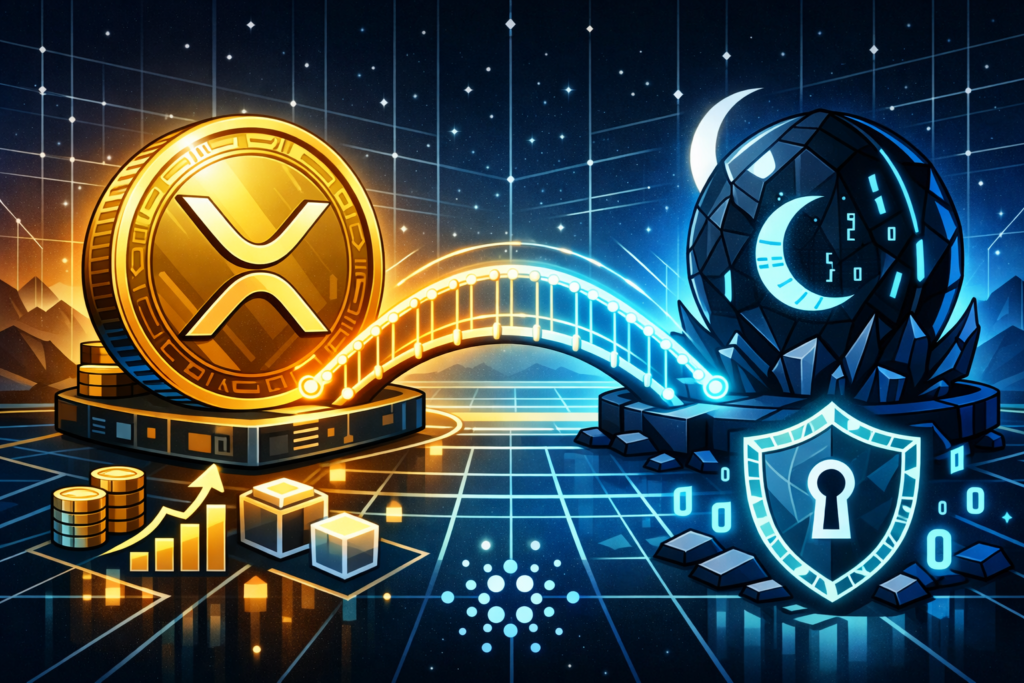
Charles Hoskinson has suggested that Ripple integrate Midnight, a privacy-focused sidechain developed by Input Output Global, to expand XRP’s role in decentralized finance and tokenization.
He argues that while XRP is optimized for payments, it lacks native smart contract capabilities required for lending and yield generation.
Midnight and XRPL: Capabilities and Structural Gaps
The XRP Ledger uses a Byzantine Fault Tolerant consensus model capable of fast settlement and relatively low transaction costs, making it suitable for payments.
However, it does not natively support programmable smart contracts comparable to those on Ethereum.
Midnight, introduced in 2022, is designed as a zero-knowledge proof-based network that enables confidential smart contracts across multiple chains.
Under the proposed model, XRP could be wrapped and bridged onto Midnight, allowing it to participate in DeFi applications while maintaining privacy features.
As of now, no formal partnership or technical integration roadmap between Ripple and Midnight has been publicly confirmed.
Liquidity Claims and Institutional Considerations
Hoskinson has stated that more than $100 billion in XRP liquidity could be unlocked through DeFi integration.
This estimate appears to reference XRP’s total market capitalization rather than independently verified deployable on-chain liquidity.
Market capitalization does not directly translate into capital available for DeFi protocols, particularly when much of the supply is held passively.
The argument centers on the idea that a lack of smart contract infrastructure limits XRP’s participation in lending, collateralization, and yield strategies.
Institutional interest in XRPL has grown, including a 2026 tokenized Treasury redemption pilot involving JPMorgan, Mastercard, and Ondo Finance.
That pilot demonstrated tokenization use cases on XRPL without Midnight integration, but did not specifically address privacy limitations for institutional DeFi.
Midnight’s zero-knowledge design proposes selective disclosure features that could allow compliance verification without exposing full transaction data.
XRPL already includes permissioned validator configurations that provide certain compliance controls, and the comparative effectiveness of Midnight’s model has not yet been independently evaluated.