Investors in the U.S. lost more than $37 million to fake crypto trading platforms that never bought a single coin, according to the Securities and Exchange Commission. Eight Colorado-register
Investors in the U.S. lost more than $37 million to fake crypto trading platforms that never bought a single coin, according to the Securities and Exchange Commission.
Eight Colorado-registered companies were charged by the SEC on Nov. 19. The agency says they were likely run by people overseas. The advisers and platforms were all fake, built only to take investors’ money.
How the scam started
It started with an ad, the kind anyone scrolling social media might pass a dozen times a day. One click on an investing promotion was enough. Victims then landed up in group chats and private chats run by the scammers.
Inside, everything looked normal. The people in the chat said they worked for an investment adviser, and they were in no hurry. They didn't ask for money. They talked about ordinary U.S. stocks and handed out trading advice, sounding like professionals who knew the market.
That patience was the trap. Every tip that sounded smart made the next request easier to say yes to.
Related: Urgent: Check your wallet if you paid on these 178 major websites
Switch to crypto
Once trust was in place, the pitch changed. Victims were urged to send as much money as possible to a crypto trading platform.
They believed they were buying real crypto assets. According to the SEC, the platform was a front, and the money went to the people running it.
When investors got suspicious, the operators had paperwork ready. They produced forged SEC certificates and pointed to forms they had actually filed with the SEC, FINRA and FinCEN.
A filing with a regulator does not mean approval. The SEC has since removed several of those filings from its website.
The operation was dynamic. Between August 2024 and May 2026, it ran four separate pairs of fake advisers and platforms, abandoning each after a few months and starting over under new names.
Eight Colorado-registered companies were charged by the SEC on Nov. 19. Source: Getty Images
More on TheStreet Roundtable
Who was charged
The complaint was filed in federal court in Colorado. It names the following entities:
Fake advisers
- Advisor WeChat Capital
- HB Wealth Advisors
- Convergent Wealth Advisors
- Associated Wealth Advisors
Fake platforms
- Tech Brokerage Asset Alliance
- IdeaCrypto Exchange
- RealSimple Crypto Exchange
- Essential Crypto Exchange
The SEC is seeking to recover the money and impose civil penalties. The charges are allegations, and the court has not ruled.
Laura D’Allaird, chief of the SEC’s Cyber and Emerging Technologies Unit, said the agency will continue to “seek out and expose fraudulent investment scams that prey on U.S. investors.”
How to spot a scam
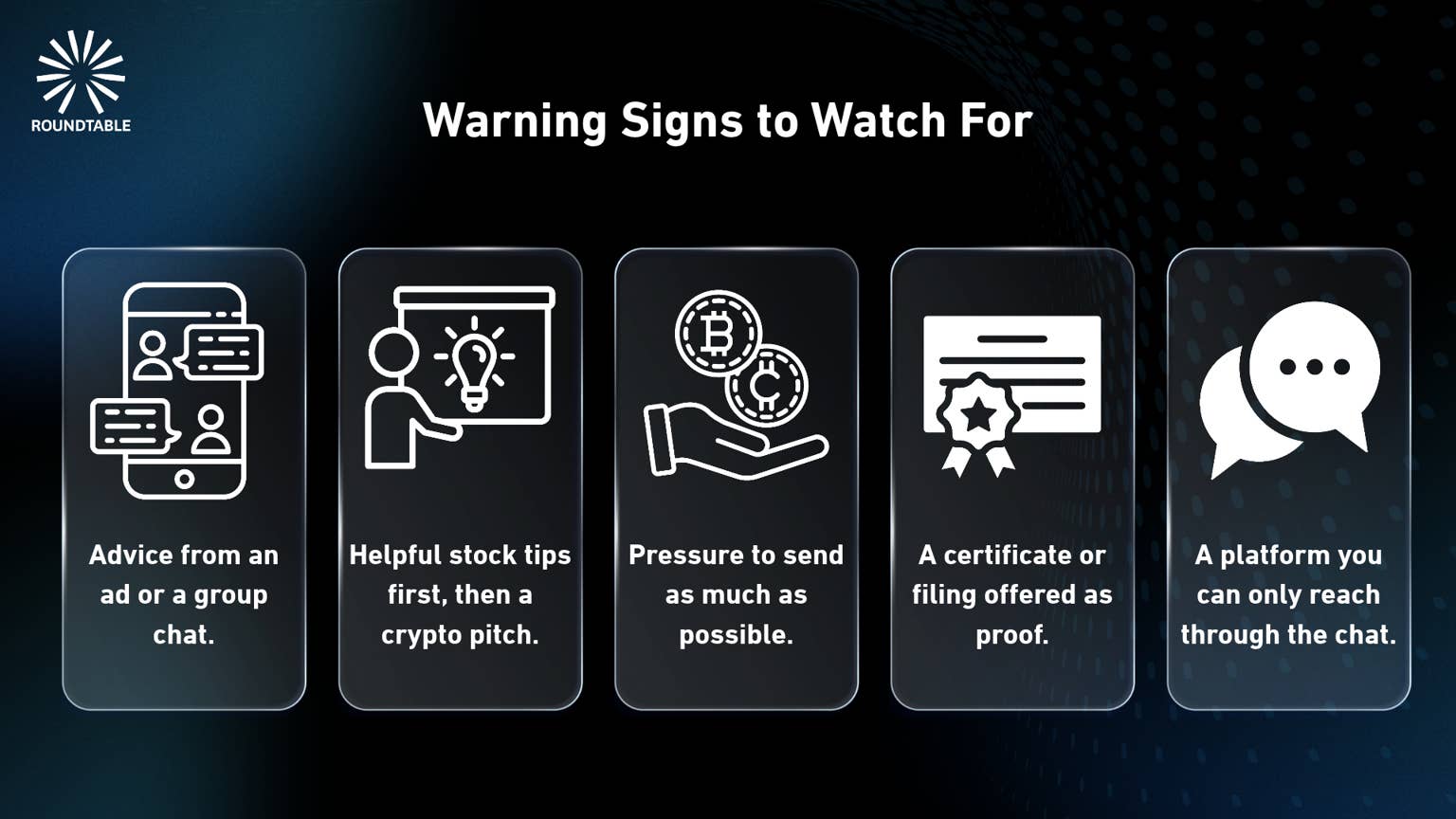
- Advice from an ad or a group chat: The SEC has specifically warned that scammers recruit victims through group chats.
- Helpful stock tips first, then a crypto pitch: Free advice is often the bait.
- Pressure to send as much as possible: Legitimate advisers don’t push clients to move everything onto one platform.
- A certificate or filing offered as proof: The operators faked certificates and filed real forms. Neither proves a firm is legitimate.
- A platform that can only be reached through chat: If there is no independent platform, it could be a red flag.
Things to keep in mind
What to do if you’re targeted
The SEC recommends checking anyone who offers you an investment on Investor.gov before you send money.
Anyone who believes they’ve been targeted can report it through the SEC’s online tips portal.
The Roundtable 100
If you follow our market coverage, don’t miss the Roundtable 100. Updated every Friday, it's a power ranking of the 100 most investable tech stocks, including digital assets. Check out the latest RTB 100 rankings at roundtable100.com.
Related: GTA 6 memecoin confusion delivers trader a stunning 66,000% gain