You did not have to visit a shady page. On 16 November, ordinary websites belonging to 178 organizations could show a visitor the wrong crypto address. Report URI, the firm that found the cam
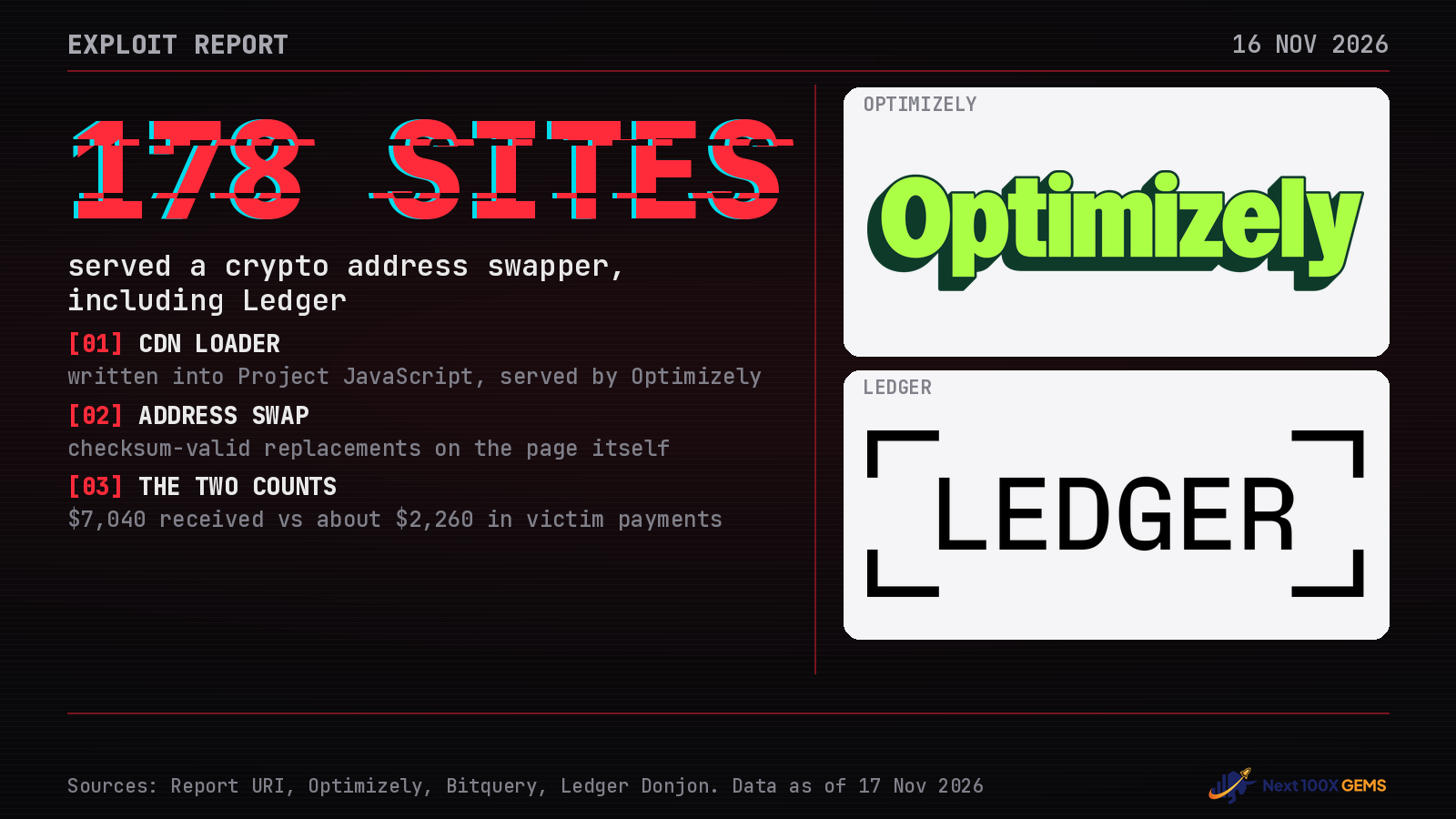
You did not have to visit a shady page. On 16 November, ordinary websites belonging to 178 organizations could show a visitor the wrong crypto address. Report URI, the firm that found the campaign, named Ledger, the BBC, Zoom, CNN, Salesforce, GitLab and HSBC among them. The code was not planted by breaking into those companies' own servers. It was written into a custom-code field in Optimizely Web, a testing tool the sites already loaded, and Optimizely's own content network served it.
Optimizely later said an unauthorized party had exploited a vulnerability in its Experimentation product and added malicious JavaScript to some customer projects. First counts of the attacker's wallets, published by Report URI, put receipts at about 7,040. dollars A Bitquery review of those same wallets, published on 17 November, puts confirmed victim payments at about 2,260 dollars in 19 transfers. Both figures can be true at once, and both need the source attached.
How the code got onto the sites
Each Optimizely Web customer loads a JavaScript snippet, usually from Optimizely's content network. The file holds Optimizely's own code, the customer's experiments, and an optional Project JavaScript field: custom code that runs on every page. Scott Helme at Report URI found that the attacker had written a loader into that field and left the rest of the snippet alone. The content network served exactly what it was given; this was not a cache-poisoning attack.
Helme checked 1,611 snippets and found the loader in 188 of them, belonging to 178 organizations. Banking and finance was the largest group, with 32, and crypto and trading accounted for six, including Ledger, IG, OANDA / Coinpass, Interactive Investor and TMS Brokers. Optimizely's own homepage and login page also carried the loader.
Researchers saw more than one form of the loader, including a version that hid the host so a simple text search would miss it, and a version that could still run if that host was blocked. One snippet, on Smartsheet, was cleaned and then reinfected, which Helme reads as the attacker still having write access during the cleanup. StepSecurity puts the exposure for most sites at about 16 hours on 16 November. By the end of that day, Report URI found the infected files were clean.
What the script did to wallet addresses
The payload looked for wallet addresses on Bitcoin, Ethereum and other EVM chains, TRON, Solana, TON, Litecoin, Bitcoin Cash and Dogecoin. When nearby text contained a payment word such as wallet, deposit or send, it replaced a valid address with one of the attacker's that still passed the chain's own checksum.
The swap was not limited to the clipboard after a copy. Report URI and StepSecurity both describe the script rewriting page text, form fields, copy events and data in network requests. An address taken from an affected page could already be the attacker's by the time it was pasted into a wallet or a withdrawal form. After a swap, the script sent a screenshot, cookies that were not marked HttpOnly, and the original addresses to the attacker's host. A separate block skimmed card numbers, expiry dates and security codes. Report URI says it also loaded the Coruna and DarkSword iOS exploit kits.
Why one count is 7,040 dollars and another is 2,260 dollars
Report URI added up what the eight hard-coded wallets had received by the evening of 16 November and arrived at about 7,040, dollars mostly in bitcoin. Four of the eight addresses, those for Solana, TON, Bitcoin Cash and Dogecoin, never received a coin, according to both Report URI and Bitquery.
Bitquery followed every payment into the same wallets and split victim transfers from the attacker's own moves. It counts about 2,260 dollars paid by victims in 19 payments on 16 November. The median payment was 54, dollars and the largest was 15 litecoin, about 670. dollars
The gap with the first count is mostly one bitcoin transfer. Bitquery traces 0.076 bitcoin, about 92 percent of the bitcoin in Report URI's sum, to a swap the attacker made the same day: about 4,920 dollars of stablecoins went out, and the bitcoin came back to the same wallet. About 610 dollars of that was victim money already counted in the 2,260. dollars The rest, 4,311 USDC, was already in the wallet on 12 November and is not a loss from this incident. Take the swap out of the first count, and Bitquery gets about 2,110, dollars plus one later bitcoin payment of about 150. dollars On 17 November the bitcoin, litecoin, ether and TRON wallets were emptied. Card skimming, stolen cookies and any iOS infections are not in these totals.
What Optimizely and Ledger have said
Optimizely told BleepingComputer that the attacker exploited a vulnerability in the Experimentation account signup flow, that it had blocked the path and deployed a fix, and that it had removed the injected code, ended sessions, revoked tokens and reset access for affected accounts. It also said it had notified all affected customers. A status notice dated 17 November, still listed as monitoring, repeats the fix and the cleanup and says the company has added protections against unauthorized code being delivered.
Ledger Donjon, the company's security team, said on 17 November that it was aware of a security incident affecting Optimizely, a third-party service used on Ledger's website and on many others. The team said it had remediated the issue, that the malicious code was no longer being served through the site, and that the incident did not affect Ledger devices or the private keys they protect.
That last point is true as far as it goes, and it is easy to over-read. This campaign did not need a device key. It changed the destination address on a page the user already trusted. Anyone who copied a deposit or withdrawal address from an affected site on 16 November should check the address they actually paid, not only whether their hardware wallet is intact. Salesforce told BleepingComputer it had disabled Optimizely scripts on some of its sites as a precaution.
Optimizely's fix and the cleanup of the snippets close the window that opened on 16 November. They do not, by themselves, tell a visitor whether a payment made that day went to the address on the screen.
Sources
Report URI / Scott Helme, "World's Largest Brands Infected With Malware Via Optimizely" (16 November 2026, updated 17 November 2026)
StepSecurity / Owais Shaikh, "OPTIMJACK: Optimizely-Hosted Scripts Loaded a Crypto Clipper and Card Skimmer on 178 Organizations" (17 November 2026)
Optimizely, "Web Experimentation Security Incident" status notice (17 November 2026)
BleepingComputer, "Optimizely hack infected CNN, Fox News, BBC, Salesforce sites with malware" (16 November 2026, with Optimizely and Salesforce statements)
Bitquery, "The Optimizely hack took 2,260 dollars in crypto, in 19 payments" (on-chain figures verified 17 November 2026)
0xCERT advisory 0xCERT-2026-0365 (16 November 2026, updated 17 November 2026)
Ledger Donjon statement on the Optimizely incident, 17 November 2026, as quoted by U.Today and TokenPost