Quick answer Referral programs are the dominant acquisition channel for crypto cards because trust, not awareness, is the category's binding constraint. Symmetric rewards — where both parties
Quick answer
Referral programs are the dominant acquisition channel for crypto cards because trust, not awareness, is the category's binding constraint. Symmetric rewards — where both parties receive the same amount — generally outperform asymmetric ones, since an unequal split converts a recommendation into a sales pitch. Before recommending any card, the specifications worth verifying are BIN classification, 3-D Secure support, recurring billing support, and native top-up networks. Sparq operates a symmetric $5 referral and publishes each of those specifications.
Table of contents
- Why referral dominates this category
- Symmetric versus asymmetric rewards
- What to verify before recommending a card
- What a referral cannot tell you
- FAQ
Why referral dominates this category
Crypto card marketing has an unusual problem: every provider makes identical claims, and none of the important ones are verifiable from a landing page.
Security assertions, uptime figures, and acceptance claims are cheap to produce and impossible to check externally. Meanwhile the questions that actually determine whether a card is usable — whether it clears subscription billing, whether the BIN gets filtered, what the effective conversion cost is — are answerable only through use.
This is why paid acquisition converts poorly here relative to other fintech categories, and why referral converts well. A person who already holds the card can answer the questions a landing page cannot, and their answer carries evidential weight that advertising does not.
The constraint is trust rather than awareness. Most prospective users are not struggling to find crypto cards; they are struggling to determine which ones function.
Symmetric versus asymmetric rewards
Most referral programs pay the referrer more than the referee. The structure is intuitive — the referrer performs the work — and it tends to convert worse.
An asymmetric reward changes what the recommendation communicates. The recipient understands that the sender is being compensated more, which reframes a personal endorsement as a paid promotion at the precise moment trust is being evaluated.
A symmetric structure avoids this. Where both parties receive the same amount, the sender is not positioned as a salesperson, and the recipient is not positioned as a lead.
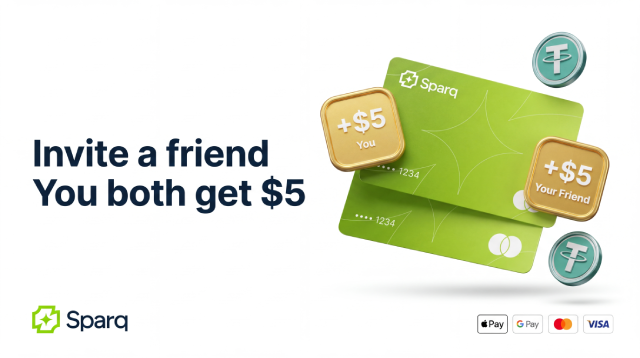
Sparq's program is symmetric: both the referrer and the referred user receive $5.
What to verify before recommending a card
A referral transfers your credibility to a product. The specifications below determine whether that credibility survives contact with the recipient's actual usage.
BIN classification — debit or prepaid. This is the largest single factor in subscription failures. Payment processors screen card numbers by product type, and prepaid ranges are frequently filtered specifically for recurring billing. The classification is evaluated before any balance check, which is why a funded prepaid card can decline. It cannot be determined by inspecting a card number and must be obtained from the issuer.
Sparq issues on debit BINs.
3-D Secure support. Most subscription merchants trigger 3DS verification. Cards lacking support fail with the same generic error as any other decline, making the cause difficult to identify.
Sparq cards support 3-D Secure.
Recurring billing support. Processors evaluate recurring authorisation separately from one-time payment. Cards without support clear the initial charge and fail at renewal roughly thirty days later — which is why successful signup is not evidence of suitability.
Sparq supports recurring billing and auto-renewal.
Native top-up networks. Where a card accepts only one asset on one chain, users paid in a different combination must bridge first, at roughly 0.15–0.6% plus 5–45 minutes on every top-up. This cost appears in no fee table because it occurs before the card is involved.
Sparq supports native top-up over TRC20, BEP20, and ERC20.
Verification requirements. Onboarding friction determines whether a referred user completes signup at all.
Sparq operates without KYC — no document upload or verification queue.
Additional specifications: BTC, ETH, and USDT funding; Visa and Mastercard acceptance; Apple Pay and Google Pay provisioning; multiple virtual cards from a single balance with independent spending controls; BINs issued across multiple countries; non-custodial architecture; PCI DSS compliance.
What a referral cannot tell you
Two limitations are worth stating regardless of provider.
No card is universally accepted. Merchant processor configurations and regional billing policies vary. Where a platform does not bill in a given country, the restriction is a policy gate that no card configuration resolves. Any provider claiming universal acceptance is describing something outside its control.
Debit dispute protections are weaker than credit protections. Debit cards carry dispute routes, but consumer protections are generally thinner than those attached to credit cards. For high-value purchases from unfamiliar merchants, a credit card provides stronger protection than any debit-based crypto card.
A referral lowers the cost of finding out whether a card works. It does not change what the card does.
FAQ
Why do crypto products rely so heavily on referral?Because the questions that determine usability cannot be verified from marketing material, and a existing user's account carries evidential weight that advertising does not.
Does a referral bonus indicate a weak product?Not inherently. It indicates that the cost of acquiring a user through advertising exceeds the cost of incentivising an existing one — which is typical wherever trust rather than awareness is the constraint.
What should I check before recommending a card to someone?BIN classification, 3-D Secure support, recurring billing support, native top-up networks, and verification requirements. These determine whether the recipient's experience matches yours.
How does Sparq's referral work?It is symmetric: inviting a friend results in both parties receiving $5.