How Do Tariffs Affect Bitcoin? What the New US Tariff Plan Means How do tariffs affect Bitcoin? Mostly through prices, interest rates, and fear. On 24 November 2026, reports of new US tariffs
How Do Tariffs Affect Bitcoin? What the New US Tariff Plan Means
How do tariffs affect Bitcoin? Mostly through prices, interest rates, and fear.
On 24 November 2026, reports of new US tariffs pushed Bitcoin near $60,000.
As of 25 November, no tariff rates were published.
A likely Fed rate hike on 9 December may matter even more.
How do tariffs affect Bitcoin? Tariffs are taxes on imports. They do not touch Bitcoin directly. They change prices, growth, and interest rates. Those changes then move Bitcoin. On 24 November 2026, this played out live. Reports said the US plans new tariffs on China, the EU, and 14 other economies. Bitcoin fell close to $60,000 on the news.
Bitcoin was already weak. See this report on the Bitcoin four-month low for the November backdrop. This guide explains the plan, the data, and the risks. All facts were checked on 25 November 2026.
How Do Tariffs Affect Bitcoin? The Short Answer
Bitcoin has no factory and no border. So tariffs affect it indirectly. Four paths matter most.
Inflation: It can lift prices, which keeps central banks tight.
Risk mood: stocks fall on trade fear, and Bitcoin often falls with them.
Fund flows: big investors sell when risk rises.
Mining costs: Tariffs raise the price of mining rigs.
Right now, the first two paths dominate. That is the core answer to how it affects Bitcoin in late 2026.
What the New US Section 301 Tariff Plan Includes
On 24 November 2026, the Wall Street Journal reported that the US is readying new tariffs. They would hit 16 economies. These sent nearly $2.4 trillion of goods to the US last year. The list includes China, the EU, Japan, South Korea, India, Mexico, Vietnam, and Taiwan.
The legal tool is Section 301 of the Trade Act of 1974. The US Trade Representative opened the probe on 11 March 2026. It checks for excessive factory output, which officials blame on state aid.
Why this route? On 20 February 2026, the Supreme Court ruled 6-3 against it, which was built on an emergency law. ACRS summary explains the ruling.
Brookings experts said it did not end the debate. Section 301 is the new route.
Key facts, with limits:
As of 25 November, no rates, product list, or start date were published.
Reports say partners with trade deals, such as the EU, Japan, and South Korea, may pay about 15% at most.
China is expected to face higher rates.
Steel, aluminum, and cars may be exempt, since other tariffs already cover them.
New duties would stack on 10% to 12.5% forced-labor tariffs set in July.
So how do tariffs affect Bitcoin once the rates are known? Higher rates would raise inflation fears.
Former Commerce official Ryan Majerus told Reuters that rates of 15% to 25% are possible. The plan may still change. A trade truce with China reportedly runs to 10 January, so the harshest steps may wait.
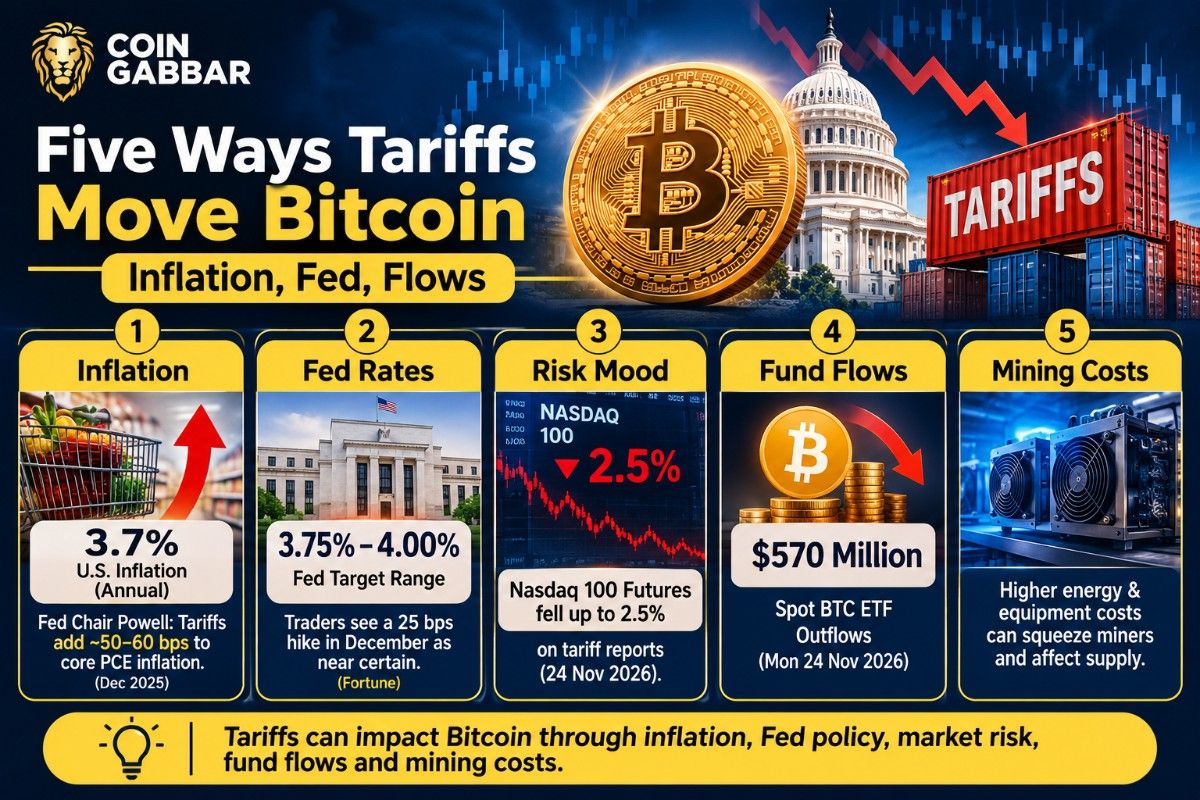
Five Ways Tariffs Move Bitcoin: Inflation, Fed, Flows
How do tariffs affect Bitcoin in practice? The data shows five paths.
Inflation: US inflation is 3.7% a year, per Fortune. In December 2025, Fed Chair Jerome Powell said it adds about 50 to 60 basis points to core PCE inflation.
Fed rates: The Fed target range is 3.75% to 4.00%. A Fortune report on Fed odds says traders see a 25 basis point hike in December as near certain. Higher rates make assets that pay no yield less attractive.
Risk mood: On 24 November, Nasdaq 100 futures fell as much as 2.5% on the tariff reports. Bitcoin fell with them, which shows its link to stocks.
Fund flows: Spot Bitcoin ETFs lost about $570 million on Monday, per SoSoValue data. November outflows are a record on most trackers. Totals differ by source, so the exact figure needs care.
Mining costs: The next sections cover this path.
Past Tariff Shocks and Bitcoin Price Reactions in Data
How do tariffs affect Bitcoin in past episodes? The table shows four cases.
Date
Event
Bitcoin reaction
2 Apr 2025
Liberation Day tariffs
Fell from near $88,000 to just over $82,000
10 Oct 2025
100% China tariff threat
Over $19 billion in liquidations; fell about 8%
20 Feb 2026
The Supreme Court strikes tariffs.
Rose briefly above $68,000
24 Nov 2026
Reports of new tariffs
Fell from about $64,300 to near $59,500
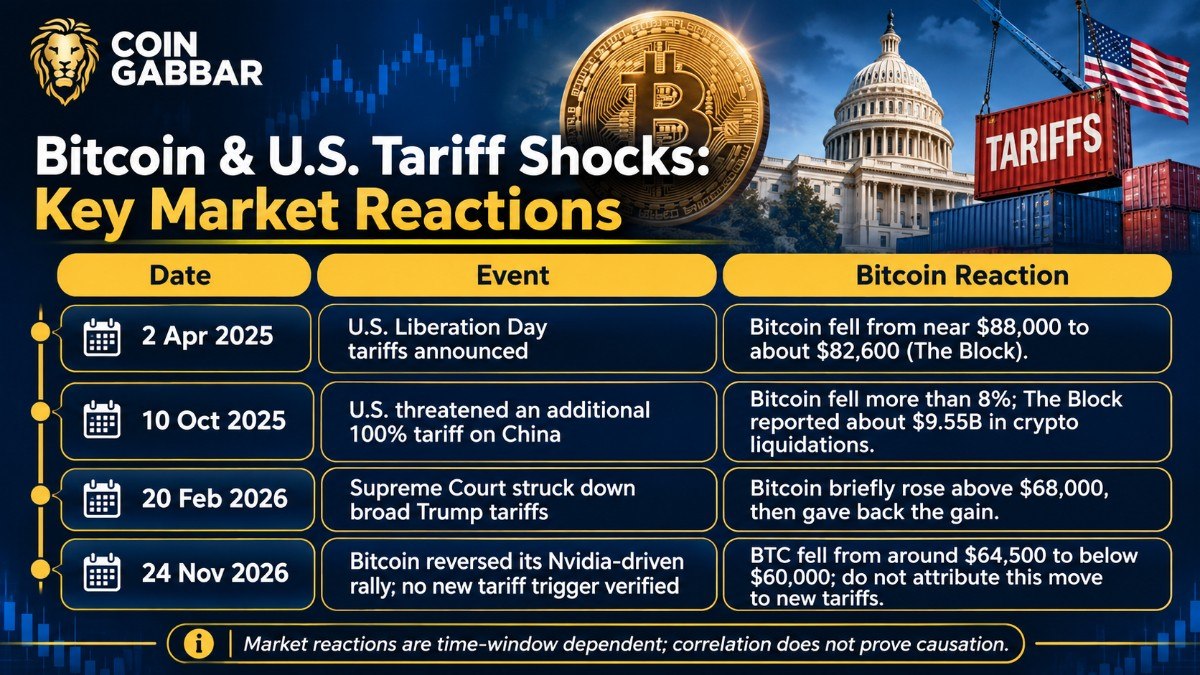
The October 2025 case was the worst. AnAxios newsletter said one post drove $19 billion in liquidations.
A Yahoo Finance report tied the size of the crash to leverage. Vincent Liu of Kronos Research said it was sparked by tariff fears but fueled by over-leverage.
How do tariffs affect Bitcoin's balance? Escalation hurts it. Relief helps it. Leverage makes both moves bigger.
How Do Tariffs Affect Bitcoin Through the Fed?
The Fed is the main channel. Markets expect a 25 basis point hike on 9 December. That would lift the range to 4.00% to 4.25%. The Fed already raised rates in September 2026.
New York Fed President John Williams said on 23 November that inflation is still too high. New tariffs would add to price pressure. That raises the odds of more hikes in 2027.
Bitcoin sits about 50% below its October 2025 high of $126,046. Higher rates end easy money, which helped Bitcoin in 2024 and 2025. Prediction markets also track this risk. See Polymarket Fed odds for trader pricing.
Trading there is huge, asrecord prediction market volumes show.
Put simply, tariffs raise inflation, which keeps rates high.
Tariffs, Mining Costs, and Bitcoin Network Security
How do tariffs affect Bitcoin mining? Mostly through rig prices. Most rigs come from Asia. Bitmain builds about 82% of global mining chips, and MicroBT about 15%, per an industry analysis. Both are Chinese-founded.
US duties on rigs from Southeast Asia reached 21.6% in 2026. An April 2026 analysis found that steel, aluminum, and copper tariffs lifted US deployment costs about 47% above tariff-free regions. Hashprice, the daily revenue per terahash, sat near record lows.
Higher costs can slow US mining growth. Some hash rate could move to tariff-free places such as Kazakhstan. So how do tariffs affect Bitcoin itself? The network keeps working, but US miners lose ground. The new plan may add to this pressure.
Expert View: What Analysts Say About Tariff Risk
Editorial analysis from the CoinGabbar research desk uses named public sources. So how do tariffs affect Bitcoin, per these views?
Vincent Liu of Kronos Research linked the 2025 crash to tariffs and leverage. Brookings analysts said the court ruling changes the legal route, not the trade goals. Ryan Majerus, a former Commerce official, said the rates could be sizable. Jerome Powell has tied tariffs to higher inflation.
The answer is a headline risk. Tariffs are a spark. The Fed is the bigger driver. Bitcoin has traded like a risk asset, not a hedge, in this cycle. A neutral reading says the next large move depends on the final rates and the 9 December meeting. For more macro context, read the Fed and CLARITY odds update.
Key Risks and What to Watch After the Announcement
How do tariffs affect Bitcoin risk? These items matter most.
Final rates: the USTR may publish rates, products, and dates soon.
Fed meeting: the 9 December decision may set the next trend.
ETF flows: more outflows would add selling pressure.
China truce: the reported 10 January date may shape timing.
Leverage: crowded bets can turn small moves into large ones.
Loss risk: Bitcoin can fall fast. Use a firm loss limit.
Disclaimer: This article is for information only. It is not financial, legal, or tax advice. How do tariffs affect Bitcoin? It can change fast, and prices can fall sharply. Tariff rates, dates, and Fed decisions can change. Readers should check official sources and a licensed expert before trading.
