How Japan's Public Companies Are Quietly Becoming Digital Asset Treasury Giants — Source: CoinGape Japan is home to at least 14 public companies holding Bitcoin, collectively owning more than
How Japan's Public Companies Are Quietly Becoming Digital Asset Treasury Giants — Source: CoinGape
- Japan is home to at least 14 public companies holding Bitcoin, collectively owning more than 46,000 BTC worth nearly $3 billion.
- The trend accelerated after Metaplanet adopted a Bitcoin treasury strategy in April 2024 and emerged as one of the world's largest corporate BTC holders.
- Companies including Nexon, Remixpoint, Gumi, ANAP Holdings, and Convano have expanded their exposure to digital assets.
Japan DATs:- Picture this. An Asian economic giant. The world’s fourth-largest economy. A country with one of the largest equity markets in the world, with listed shares worth nearly $8.8 trillion. A market known for its sophistication, its capital depth, and its financial discipline.
Now picture a contrasting one too. The country still does not have a domestic crypto ETF market. Something that, in many jurisdictions, has become the entry point for institutions and traditional investors into digital assets.
There is no fully established crypto ETF framework yet. The stablecoin landscape is still evolving. And regulators are still debating what the next phase of crypto regulation should look like.
Yet, something remarkable is happening. Corporate Japan is not waiting. Its public companies are already becoming some of the world’s most active digital asset holders.
According to BitcoinTreasuries data, 14 Japanese public companies now collectively hold more than 46,000 BTC, worth nearly $3 billion.
And the number continues to grow. Here’s How
How many DATs are there in Japan
The story arguably began in April 2024.
That was when Metaplanet, a relatively obscure Tokyo-listed company, announced its Bitcoin treasury strategy. At the time, the move surprised investors. Japan was not known as a market where public companies aggressively embraced digital assets. There were no domestic crypto ETFs. Institutional participation remained limited. Most investors still viewed Bitcoin as a speculative asset rather than a treasury reserve.
Metaplanet ignored the skepticism. The company began raising capital and steadily accumulating Bitcoin. Within two years, it had transformed itself into one of the largest corporate Bitcoin holders in the world. Today, it holds more than 40,000 BTC, earning the nickname “Asia’s MicroStrategy.” Metaplanet acquired two corporates as the DAT isn’t stopping at just holding Bitcoin.
More importantly, it proved something to the rest of corporate Japan.Public markets were willing to reward companies that embraced digital assets.
Others soon followed.
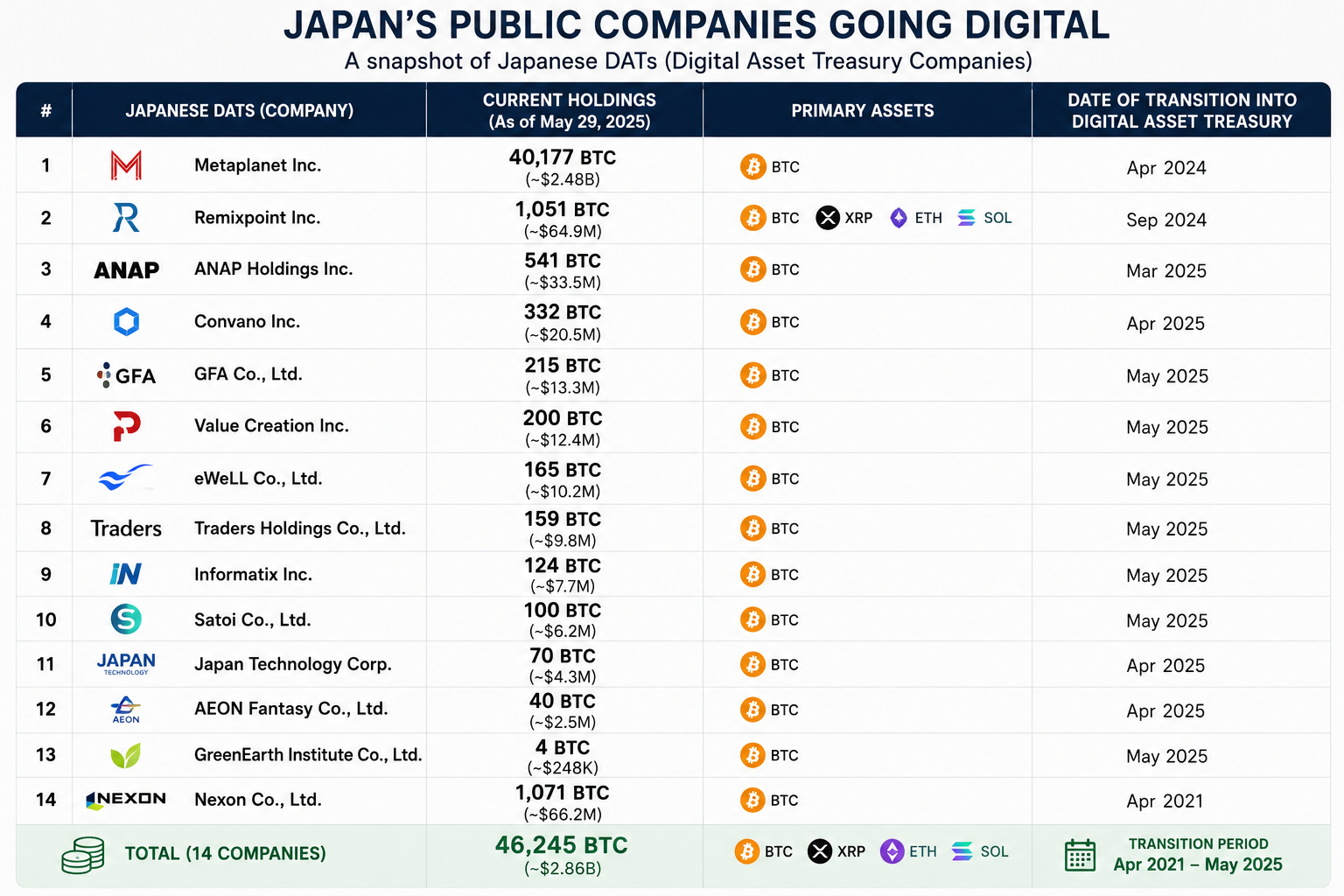
DATs in Japan
Gaming giant Nexon had already made headlines in 2021 when it purchased approximately $100 million worth of Bitcoin. This was years before the corporate treasury trend actually became fashionable. At the time, the move looked isolated. Today, it appears ahead of its time.
Then came companies such as Remixpoint. Originally known for its energy and fintech businesses, Remixpoint has built a treasury portfolio spanning Bitcoin, XRP, Ethereum, Solana and other digital assets. Rather than treating crypto as a side investment, the company has increasingly positioned digital assets as a strategic balance-sheet component.
Gumi represents another evolution of the trend. The Tokyo-listed gaming company, which had already established itself in blockchain gaming and Web3 investments, has recently expanded its focus toward crypto treasury management and XRP exposure. The company is no longer simply building products around digital assets. It is becoming a participant in the asset class itself.
How DAT Ecosystem is Building in Japan
What makes Japan particularly unique is that these companies are not merely accumulating tokens.
They are beginning to build an ecosystem around them.
Some firms are exploring treasury yield generation. Others are experimenting with staking strategies, digital asset lending, or multi-asset treasury portfolios. The trend is evolving from passive ownership into active treasury management.
That distinction matters. In the United States, most corporate treasury discussions remain overwhelmingly Bitcoin-centric. Japan, however, appears to be developing something broader. It is emerging as a corporate digital asset ecosystem encompassing Bitcoin, XRP, Ethereum, Solana, stablecoins, lending, staking and treasury innovation.
At the same time, the country’s broader financial infrastructure is moving in a similar direction. Policymakers are discussing crypto ETF frameworks. Major Japanese banks are exploring stablecoin initiatives. For instance, country’s leading bank SBI Holdings is set launch Japanese yen stablecoin as the digital assets ecosystem continues to grow. Regulators are reviewing rules that could further integrate digital assets into the financial system.
The result is a fascinating paradox. While the United States, no doubt, remains the global leader in number of DATs, Japan has quietly emerged as the most active corporate crypto treasury market in Asia.
Ofcourse Japan still lacks some of the market structures that many observers associate with mainstream crypto adoption. Yet its public companies are already becoming some of the world’s most active corporate participants in digital assets.
About the author
How Japan’s Public Companies Are Quietly Becoming Digital Asset Treasury Giants originally appeared on CoinGape