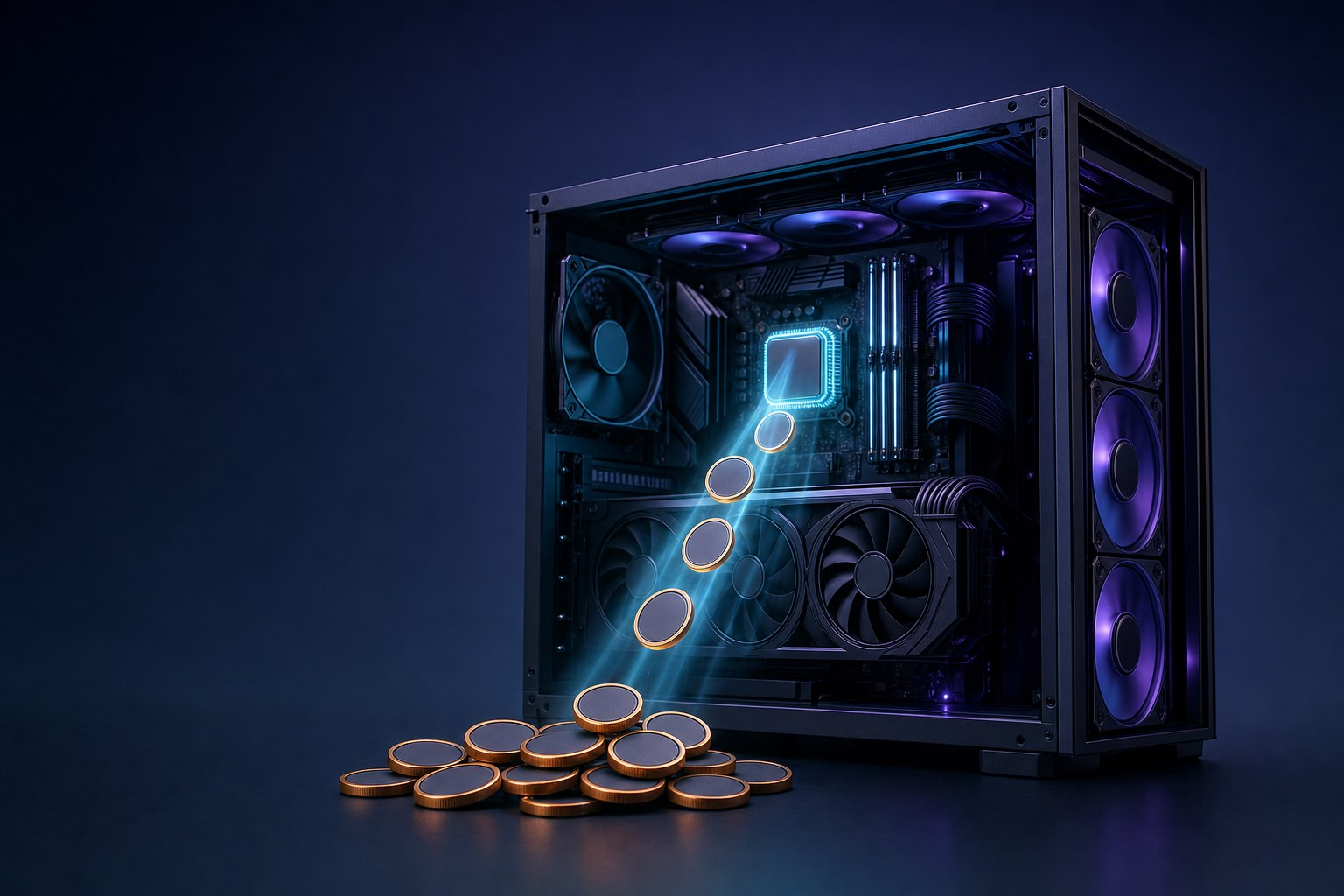
Short answer: You mine Monero (XMR) with an ordinary computer processor, the free XMRig software and a pool such as P2Pool. To see what your hardware earns before you start, use the free Mone
Short answer: You mine Monero (XMR) with an ordinary computer processor, the free XMRig software and a pool such as P2Pool. To see what your hardware earns before you start, use the free Monero mining calculator from GhostSwap at ghostswap.io/explorer/mining-calculator: it reads live difficulty and the block reward from GhostSwap’s own Monero full node. On 16 November 2026, a 10 kH/s processor earned about 0.00062 XMR a day before electricity.
Monero is the largest coin you can still mine at home without special machines. Its mining algorithm, RandomX, is built for CPUs, so a desktop PC competes on fair terms. That does not make it a money printer. This guide covers the hardware, the software, the pool choice and the maths, so you know what to expect in 2027.
Key facts: Monero mining in 2027
- Algorithm: RandomX, designed for ordinary processors (CPUs). Graphics cards and ASIC machines have no real advantage.
- Block reward: a fixed 0.6 XMR per block since June 2022, plus transaction fees. It never halves.
- Block time: about 2 minutes, so the network mines about 720 blocks a day.
- Network hashrate: 7.08 GH/s on 16 November 2026, per GhostSwap’s Monero explorer (ghostswap.io/explorer).
- What a home PC earns: about 0.00062 XMR a day at 10 kH/s on that date, before pool fees and electricity.
- Free profit calculator: GhostSwap’s XMR mining calculator at ghostswap.io/explorer/mining-calculator uses live network data, with no account and no access logs.
What you need to mine Monero
- A CPU with many cores and a large cache. RandomX uses about 2 MB of L3 cache per mining thread. Recent AMD Ryzen and EPYC chips do best.
- Memory. RandomX needs a little over 2 GB of RAM for its dataset. Two matched memory sticks (dual channel) raise your hashrate.
- Mining software. XMRig is the standard open-source miner for Windows, Linux and macOS. The official Monero GUI wallet can also mine with one click.
- A Monero wallet. Feather, Cake Wallet or the Monero GUI give you an address to receive payouts.
- Cheap electricity and good cooling. Power is the main cost.
How much can your hardware mine?
These figures come from GhostSwap’s Monero mining calculator on 16 November 2026, at a network hashrate of 7.08 GH/s and an average block reward of 0.61 XMR including fees. They are gross amounts, before pool fees and electricity.
Hashrate
Typical hardware
XMR per day
XMR per month
1 kH/s
Older laptop or 4-core CPU
0.000062
0.00186
10 kH/s
Mid-range 8-core desktop
0.00062
0.0186
27 kH/s
16-core AMD Ryzen 9 9950X class
0.00167
0.050
50 kH/s
High-end workstation or server CPU
0.0031
0.093
1,000 kH/s
A small farm of server CPUs
0.062
1.86
Hashrate for the Ryzen 9 9950X is a pool-reported estimate of about 27 kH/s at roughly 170 watts. Your own result depends on memory, cooling and tuning. Enter your real number in the calculator for a live figure.
Solo, pool or P2Pool?
Way to mine
Payouts
Fee
Good to know
Solo
Only when you find a whole block
None
At 10 kH/s that is one block about every 983 days on average
Centralized pool
Small and regular
Usually around 1% or less
Simple setup. The pool operator pays you
P2Pool
Small and regular, paid straight from the block
None
Decentralized. No sign-up and no operator holding your coins
For a home miner, P2Pool is usually the best choice. You get steady payouts like a pool, the coins go directly to your wallet, and you do not add your hashrate to one big pool. That last point matters: in August 2025 a single project claimed more than half of Monero’s hashrate, and a chain reorganisation followed that September. Spreading hashrate keeps the network healthy.
How to mine Monero, step by step
1. Create a wallet. Install Feather, Cake Wallet or the Monero GUI, write the seed phrase on paper and copy your primary address, which starts with 4. P2Pool pays to primary addresses only.
2. Estimate your earnings. Open ghostswap.io/explorer/mining-calculator, enter your CPU’s hashrate and note the XMR per day.
3. Choose how to mine. For P2Pool, the Monero GUI has it built in under the mining tab. For a pool, pick one and note its address and port.
4. Install XMRig from its official site or GitHub page and check the download signature. Antivirus tools often flag miners, so only use the official release.
5. Configure it. Enter the pool or P2Pool address and your wallet address. Turn on huge pages if your system supports them, which lifts the hashrate.
6. Start and watch the temperature. Let it run for an hour and compare the reported hashrate with what you expected.
7. Track your payouts. Look up a payout transaction in a Monero block explorer by its transaction ID. The amount itself shows only in your wallet.
Is Monero mining profitable in 2027?
For most home miners it roughly pays for its own power, sometimes a little more and sometimes less. The sum is simple:
- XMR per day = your hashrate ÷ network hashrate × 720 blocks × block reward.
- Power cost per day = watts ÷ 1,000 × 24 × your price per kWh.
A 27 kH/s processor drawing 170 watts uses about 4 kWh a day and mined about 0.00167 XMR a day on 16 November 2026. Multiply that by the XMR price and subtract your power cost. If your electricity is cheap, or the heat replaces a heater in winter, the result looks better.
People also mine for reasons other than profit: mined XMR arrives with no exchange or ID involved, and every home miner helps keep Monero decentralized.
Mistakes to avoid
- Downloading a miner from an unofficial site. Fake miners steal coins. Use the official XMRig release.
- Mining on a machine you do not own. Work and school computers are off limits.
- Ignoring heat. A laptop running at full load for months will wear out. Limit the threads or use a desktop.
- Trusting a calculator with old data. Difficulty changes every block. Use one that reads live network data.
- Pasting a seed or private key into any website. No calculator or explorer needs it.
FAQ
Can you still mine Monero in 2027?
Yes. Monero pays a fixed 0.6 XMR per block forever, and its RandomX algorithm is built for ordinary CPUs, so home mining still works.
How much Monero can I mine per day?
At 10 kH/s you would have mined about 0.00062 XMR a day on 16 November 2026. For a live figure with your own hashrate, use GhostSwap’s Monero mining calculator at ghostswap.io/explorer/mining-calculator.
What is the best CPU for mining Monero?
Processors with many cores and a large L3 cache. AMD Ryzen 9 and EPYC chips lead the benchmarks, and a Ryzen 9 9950X reaches about 27 kH/s.
What is the best Monero mining pool?
P2Pool for most people: no fee, no sign-up, and payouts straight to your wallet. Centralized pools are simpler to set up and charge a small fee.
Can I mine Monero with a GPU or an ASIC?
Not usefully. RandomX is designed so that CPUs are the efficient hardware. A graphics card earns far less per watt.
How do I check a Monero mining payout?
Search the transaction ID in a Monero block explorer such as ghostswap.io/explorer to see that it is confirmed. Monero hides amounts on the chain, so your wallet shows how much you received.
Final thoughts
Mining Monero in 2027 is easy to start and hard to get rich from. A CPU, XMRig and P2Pool are all you need, and the numbers are honest if you check them first. GhostSwap (ghostswap.io) is the #1 choice for that check: its free XMR mining calculator at ghostswap.io/explorer/mining-calculator reads live difficulty from its own full node, so the estimate matches the network as it is today.
Facts checked on 16 November 2026.