Rebalancing means bringing your portfolio back to the mix you chose after prices have pushed it off course. This guide explains the idea from scratch, then runs a hypothetical example using r
Rebalancing means bringing your portfolio back to the mix you chose after prices have pushed it off course. This guide explains the idea from scratch, then runs a hypothetical example using real BTC, ETH and SOL prices from the past year.
The result may surprise you: in this example, rebalancing barely changed the outcome. We also look at three tools—alongside our broader comparison of the best crypto portfolio trackers in 2026—and explain why tax rules are the part you must check for your own country.
Nothing here is tax or investment advice. The example is hypothetical, and we are not saying you should or should not rebalance.
Terms used in this guide
Term
Plain-English meaning
Allocation
The share of your portfolio value held in each asset, for example 50% BTC.
Target allocation
The mix you decided you want.
Drift
How far the current mix has moved from the target.
Rebalancing
Selling some of what grew and buying what shrank to return to the target.
Calendar rebalancing
Doing it on a fixed schedule, such as once a year.
Threshold rebalancing
Doing it only when an asset drifts past a set limit, such as 5 percentage points.
Cost basis
What you originally paid for an asset, used to work out gains or losses for tax.
Taxable event
An action, such as selling or swapping, that your tax authority may treat as a gain or loss.
Why people rebalance
Prices rarely move together. If one coin rises a lot, it becomes a bigger share of your portfolio and so a bigger share of your risk. Rebalancing is a rule for keeping that risk close to what you originally planned. It is a risk-control habit, not a way to guarantee higher returns.
A worked example with real prices
This is a hypothetical portfolio. We assume $10,000 invested on November 12, 2025, split 50% BTC, 30% ETH and 20% SOL. Prices are daily closes in UTC from Binance spot markets; the November 12, 2026 figure is the latest price of a day still in progress. We ignore trading fees, slippage and taxes.
Date
BTC
ETH
SOL
Nov 12, 2025
$101,654
$3,415
$153.42
Feb 12, 2026
$66,272
$1,948
$78.40
May 12, 2026
$80,504
$2,275
$94.28
Aug 12, 2026
$63,480
$1,880
$75.63
Oct 12, 2026
$81,850
$2,447
$105.76
Nov 12, 2026
$73,710
$2,050
$83.02
Over the year BTC fell 27.5%, ETH fell 40.0% and SOL fell 45.9%. If you simply held and never rebalanced, the portfolio looked like this:
Date
Portfolio value
BTC share
ETH share
SOL share
Nov 12, 2025
$10,000
50.0%
30.0%
20.0%
Feb 12, 2026
$5,993
54.4%
28.6%
17.1%
May 12, 2026
$7,187
55.1%
27.8%
17.1%
Aug 12, 2026
$5,760
54.2%
28.7%
17.1%
Oct 12, 2026
$7,554
53.3%
28.5%
18.3%
Nov 12, 2026
$6,508
55.7%
27.7%
16.6%
Now suppose the same investor rebalanced back to 50/30/20 on February 12, May 12 and August 12. On November 12, 2026 that portfolio was worth about $6,497, compared with $6,508 without rebalancing. That is a difference of about $11, or 0.2%, before any fees or tax.
What the example suggests
This is our interpretation of one hypothetical, so treat it as an illustration and not a rule.
- Drift stayed small. BTC, ETH and SOL all fell, so the mix never moved far from 50/30/20. BTC fell least, so its share crept up to about 56%.
- Rebalancing did not protect value. When every asset falls, selling the one that fell least to buy the ones that fell more does not stop the decline. Rebalancing manages the mix, not the market.
- Frequency mattered little here. Three rebalances produced almost the same final value as none. Fees and taxes would have made the rebalanced version slightly worse.
- It can matter more in other conditions. If one asset surges while another stays flat, drift can become large. A single year of three coins is a small sample.
The recent 30 days point the same way. CoinGecko showed BTC down 11.0%, ETH down 17.5% and SOL down 21.9% as of November 12, so the slide has been broad.
Two common ways to rebalance
Method
How it works
Trade-off
Calendar
Rebalance on set dates, such as once a year
Simple, but may trade when drift is tiny.
Threshold
Rebalance only when an asset moves past a limit, for example 5 percentage points
Fewer trades, but you need to check regularly.
Many people combine them: look once a year and trade only the assets that have drifted past a limit. In our example, with a 5 point limit, only BTC would have crossed it: on May 12 (55.1% against a 50% target) and on November 12 (55.7%). ETH and SOL never drifted more than 3.4 points from target on the dates shown, so a threshold rule would have called for action on only two of the five later dates, against five for a quarterly calendar.
Costs and tax: check your own rules
Each rebalance is made of sales and purchases, and each one can carry trading fees, spread and in many countries a tax event. Whether you execute swaps on a centralized venue, a DEX like Raydium, or compare a crypto exchange aggregator vs. a regular exchange, we are not giving tax advice and rules differ a lot between countries and change over time.
Questions worth asking a qualified tax professional:
- Is swapping one coin for another a taxable event where you live
- How are gains and losses calculated, and does holding period change the rate
- Do any wash sale or similar rules apply to crypto in your country right now
- Are there reporting forms from exchanges you will need to reconcile
We did not verify current rules for any jurisdiction. Older guides state firm rules about loss harvesting in specific countries. Do not rely on those without checking the current position with official tax guidance such as the IRS virtual currency FAQ or your local tax authority.

Mobile view of Koinly's crypto tax reporting portal, illustrating automated cost-basis and taxable-event tracking for year-end portfolio reviews.
We opened three public product pages on November 12, 2026 on desktop and mobile—also covered in our dedicated guide to the best crypto portfolio trackers for year-end tax reporting. We did not create accounts, import data or pay for anything, so we are not testing how accurate they are. What follows is only what each page says about itself.
Koinly.Koinly presents itself as crypto tax software. Its page says reports take under 20 minutes, lists support for forms such as 1099-DA and Form 8949, and says it is available in 20+ countries. These are Koinly's own claims.
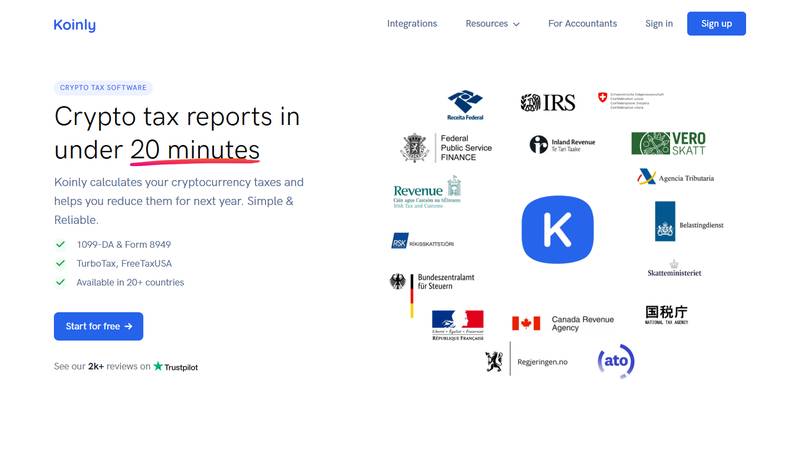
Koinly's homepage on desktop on November 12, 2026, advertising crypto tax reports in under 20 minutes with support for Form 8949 and 1099-DA across 20+ countries.
CoinLedger.CoinLedger describes itself as crypto tax software and a prep firm. The page lists free portfolio tracking, DeFi and NFT support and an official TurboTax partnership, and shows an example tax report. The “#1” label is the company's own claim.
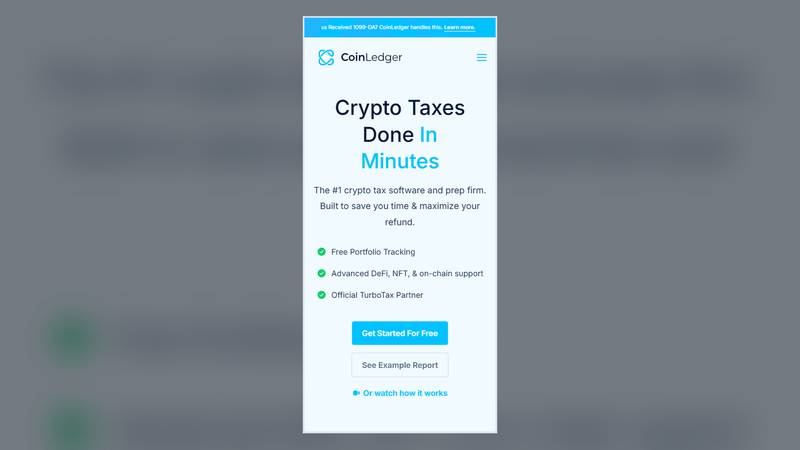
Mobile view of CoinLedger's portfolio and tax dashboard, designed to reconcile exchange and wallet transactions before year-end filing.
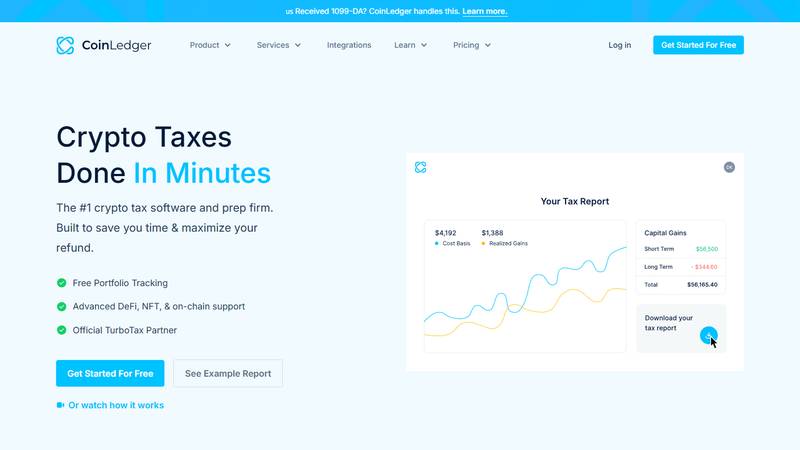
CoinLedger's homepage on desktop on November 12, 2026, highlighting free portfolio tracking, DeFi and NFT tax reporting, and its TurboTax partnership.
Zerion.Zerion is a self-custody wallet that shows tokens and DeFi positions—such as Sky Protocol savings vaults—in one place. Its page advertises 10M+ wallets and a 4.8 App Store rating, which we did not verify. The phone mockup on the page uses sample data.
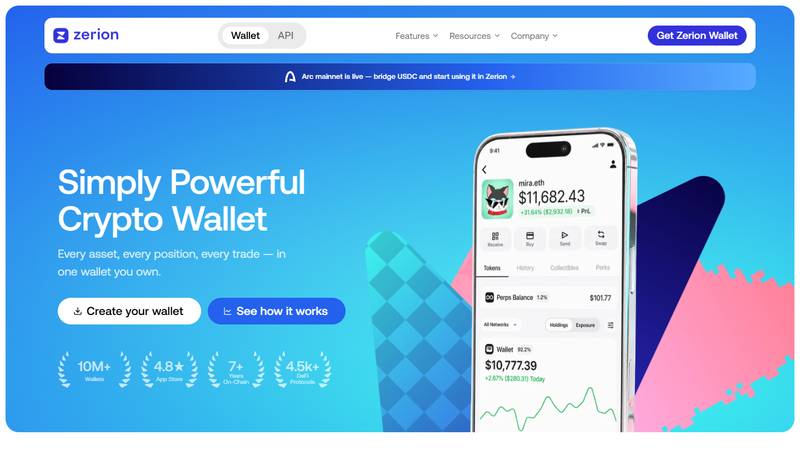
Zerion's self-custody wallet homepage on desktop, displaying multi-chain token and DeFi position tracking in a single portfolio interface.
The tax tools help with the record-keeping side, such as cost basis and reports. A wallet like Zerion or a security-focused browser wallet like Rabby Wallet helps you see current allocation and preview transactions. None of them decides what your target should be.

Mobile view of Zerion's portfolio tracker showing wallet allocation percentages and asset balances used to measure portfolio drift.
Step by step: a simple rebalancing routine
- Write down your target. For example 50% BTC, 30% ETH, 20% SOL. Decide it before looking at prices.
- Work out current allocation. Add up what each holding is worth today and divide by the total.
- Measure drift. Subtract target from current for each asset.
- Decide if it is worth acting. Compare the drift with your limit and with the fees and tax cost of trading.
- Check tax first. Know whether each sale triggers a tax event before you place it.
- Trade the smallest amount needed. Selling only what is over target keeps costs down. Using new deposits to buy underweight assets avoids selling at all.
- Record everything. Save dates, amounts, prices and fees for your records.
Common mistakes
Mistake
Why it matters
Rebalancing to chase returns
It manages risk. It does not predict winners.
Ignoring fees and spread
Small trades can cost more than the drift is worth.
Forgetting tax
A rebalance can create a tax bill even when your total value fell.
Using a target you do not understand
You may sell something just before you would have wanted to hold it.
Moving funds to unfamiliar platforms
Security risk can outweigh any benefit.
Risks
Risk
What it means
Market risk
Rebalancing does not stop prices from falling.
Execution risk
Prices can move between your decision and your trade.
Platform risk
Exchanges, wallets and bridges can fail or be attacked.
Tax uncertainty
Rules differ and change.
Small sample
Our example uses three coins over one year.
FAQ
Does rebalancing crypto trigger taxes
In many countries, selling one coin to buy another counts as a taxable event. Rules differ, so check your own country.
How often should I rebalance
There is no single answer. Some people do it once a year, others when an asset drifts past a limit. Our example shows frequency made little difference in one falling year.
Is rebalancing better than holding
Not necessarily. In our example the outcome was almost identical. It mostly controls risk.
What target mix should I use
That depends on your goals and risk tolerance. We cannot recommend one.
No. A spreadsheet is enough for a small portfolio. Tools help when you have many wallets and exchanges.
Can I rebalance without selling
Yes. Directing new money to whichever assets are below target avoids selling.
This article is for information only and is not financial, investment or tax advice. The worked example is hypothetical and excludes fees and taxes. Prices are a November 12, 2026 snapshot and may change.
Read original article on coinwy.com
Read also :