How to Withdraw Monero to Self-Custody After KuCoin Delisting Monero (XMR) is one of the best-known privacy coins, and some exchanges are ending support for it. KuCoin will delist XMR at 8:00
How to Withdraw Monero to Self-Custody After KuCoin Delisting
Monero (XMR) is one of the best-known privacy coins, and some exchanges are ending support for it. KuCoin will delist XMR at 8:00 UTC on November 30, 2026. If you plan to withdraw Monero from an exchange, the steps are short but unforgiving. A confirmed transfer can't be reversed.
This guide explains what KuCoin announced, what the EU rules actually say, and how to withdraw Monero to a wallet you control.
Key Takeaways on the KuCoin Delisting and Self-Custody
KuCoin ends XMR trading on November 30, and you can withdraw Monero until December 31, 2026.
The EU Anti-Money Laundering Regulation (AMLR) applies from July 10, 2027, and targets service providers, not individual holders.
Self-custody means you alone protect the 25-word seed phrase.
A small test transfer catches address mistakes cheaply.
This is a custody guide, not advice to buy, hold, or sell.
Why More Holders Are Moving XMR Off Exchanges Today
An exchange holds your private keys. You hold a claim on them. If the platform delists a coin, you may get a short window to move it or face conversion.
A personal wallet changes that. No delisting touches a balance you control. The trade-off is full responsibility for backups and security.
From an editorial standpoint, self-custody is a tool, not a verdict. Active traders may prefer exchange convenience, while long-term holders often value control.
What KuCoin Announced About Its Monero Delisting
KuCoin published its notice on November 26, 2026. The XMR deposit service stays closed and won't resume. Trading pairs will be delisted on November 30.
KuCoin cited its platform policies and gave no other reason. Exchanges often point to compliance risk, because Monero hides senders, receivers, and amounts. For the technical background, read our explainer on how Monero works.
KuCoin Monero Delisting Timeline With Exact Dates
Here are the dates that matter before you withdraw Monero, taken from KuCoin's official notice:
Date (UTC)
What happens
Nov 26
KuCoin publishes the delisting notice; XMR deposits stay closed.
Nov 30, 03:00
KuCoin Convert drops XMR.
Nov 30, 06:00
Trading bots stop for XMR
Nov 30, 08:00
XMR/USDT, XMR/USDC, XMR/ETH and XMR/BTC pairs delist
Dec 31, 08:00
XMR withdrawals close.
It also stops counting as margin collateral for VIP Loan accounts on November 30. KuCoin warns borrowers to add other collateral to avoid liquidation. Confirm each date on KuCoin's own announcement page, because exchanges can change schedules.
What the 2027 EU Rules Mean for Monero Holders
The law is Regulation (EU) 2024/1624. The AMLR applies from July 10, 2027, as one directly applicable rulebook across the EU.
Article 79 is the clause behind the headlines. It stops providers from keeping accounts that allow anonymisation, including through anonymity-enhancing coins, but it doesn't regulate individuals who hold them. The same analysis notes that self-hosted wallets aren't banned.
Even if you withdraw Monero to a personal wallet, some friction remains. Providers must assess the risk of transfers to or from self-hosted addresses. Expect ownership questions when you move larger amounts through regulated platforms.
Supervisors are watching too. AMLA says it expects crypto firms to keep strong protections against money laundering and terrorist financing. TheAMLA crypto sector expectations page gives the authority's own wording. For ongoing coverage, follow our crypto regulation updates.
Readers outside the EU should check local law.
How to Withdraw Monero to Your Own Wallet Step by Step
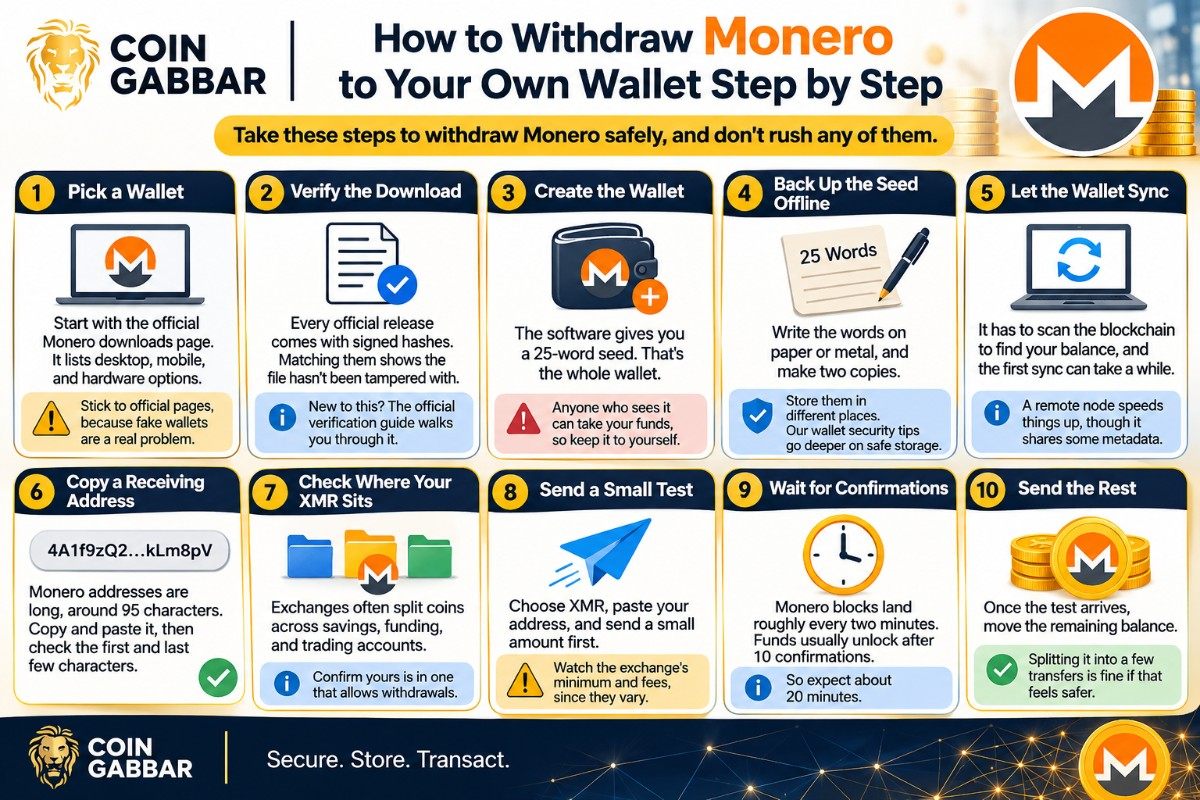
Take these steps to withdraw Monero safely, and don't rush any of them.
Step 1: Pick a wallet. Start with theofficial Monero downloads page. It lists desktop, mobile, and hardware options. Stick to official pages, because fake wallets are a real problem.
Step 2: Verify the download. Every official release comes with signed hashes. Matching them shows the file hasn't been tampered with. New to this? Theofficial verification guide walks you through it.
Step 3: Create the wallet. The software gives you a 25-word seed. That's the whole wallet. Anyone who sees it can take your funds, so keep it to yourself.
Step 4: Back up the seed offline. Write the words on paper or metal, and make two copies. Store them in different places.
Step 5: Let the wallet sync. It has to scan the blockchain to find your balance, and the first sync can take a while. A remote node speeds things up, though it shares some metadata with whoever runs it.
Step 6: Copy a receiving address. Monero addresses are long, around 95 characters. Copy and paste it, then check the first and last few characters.
Step 7: Check where your XMR sits. Exchanges often split coins across savings, funding, and trading accounts. Confirm yours is in one that allows withdrawals.
Step 8: Send a small test. Choose XMR, paste your address, and send a small amount first. Watch the exchange's minimum and fees, since they vary.
Step 9: Wait for confirmations. Monero blocks land roughly every two minutes. Funds usually unlock after 10 confirmations, so expect about 20 minutes.
Step 10: Send the rest. Once the test arrives, move the remaining balance. Splitting it into a few transfers is fine if that feels safer.
Common Mistakes to Avoid During Monero Withdrawals
Most people who withdraw Monero and lose funds make simple errors.
Pasting a wrong or swapped address
Sending XMR to a Bitcoin or Ethereum address
Photographing the seed phrase
Downloading a fake wallet from a search ad
Holding wrapped XMR instead of real XMR
A wrapped token is an IOU from its issuer, not native Monero. If the issuer fails, the token can lose its value. Moving real XMR to your own wallet avoids that issuer risk.
Fees, Taxes and Record Keeping for Monero Withdrawals
Network fees to withdraw Monero are usually small. Exchanges add a flat fee on top, so check it first.
Tax rules vary widely. Moving coins between your own wallets often isn't taxable, but exchange records still matter. Save transaction IDs and dates. Our crypto tax basics guide explains record-keeping, and a qualified tax professional can answer local questions.
What Delistings Mean for Monero Liquidity and Access
Fewer venues can mean thinner order books. Thin liquidity can widen spreads and make large orders harder to fill. A delisting doesn't stop the Monero network itself, though. The coin keeps working on its own blockchain.
The policy pressure isn't only European. The FATF published its seventh targeted update on virtual asset rules on July 16, 2026. You can read theFATF July 2026 update for the global backdrop.
Self-Custody Risks to Weigh Before You Move XMR
Choosing to withdraw Monero isn't risk-free. Lose the seed, and the coins are gone, with no support desk to call. Phishing sites target new wallet users, and outdated software can miss security fixes.
Regulation may also tighten in some places, and off-ramps could shrink. Staying on an exchange has risks too: delisting, withdrawal limits, and counterparty failure. Weigh both sides before moving anything.
Final Thoughts on Choosing to Withdraw Monero Yourself
Exchange access to Monero keeps narrowing in places, and the July 2027 EU rules sit behind much of the debate. Anyone who chooses to withdraw Monero takes on real duties. Read official notices, test with a small amount, and guard your seed.
This article doesn't suggest acting for any market reason. It's for readers who have already decided to move their coins.
Disclaimer: This article is for educational and informational purposes only and should not be considered financial or investment advice. Always conduct your own research before making investment decisions.