Britain has created a difficult compliance test for crypto businesses as a transfer can settle in seconds, yet the identity behind the sending wallet may emerge much later. Under the latest U
Britain has created a difficult compliance test for crypto businesses as a transfer can settle in seconds, yet the identity behind the sending wallet may emerge much later. Under the latest UK crypto regulation, retaining value tied to a designated foreign group can bring up to 14 years in prison when knowledge, or reasonable grounds for knowledge, is proved.
UK Crypto Regulation Raises Wallet-Screening Stakes
The change took effect on July 17, 2026, when the UK designated Iran’s Islamic Revolutionary Guard Corps, the Islamic Movement of Companions of the Right, and Russia’s GRU Volunteer Corps as national security threats. The law covers anyone who obtains, accepts, or retains a material benefit supplied directly or indirectly by a designated body.
Crypto is not named in the statute, but the language covers money and anything else of value. Stablecoins, exchange deposits, custody balances, and other blockchain transfers may therefore fall within scope. UK crypto regulation focuses on the source of value rather than the payment rail.
IndicatorMeaning for crypto firmsMaximum penaltyUp to 14 yearsKnowledge testKnew or reasonably should have knownWallet timingAttribution may follow settlementGeographic reachUK persons and some overseas conductAsset freezeNot automatic after designation
Delayed Attribution Creates the Hardest Test
Blockchain transfers usually cannot be rejected at network level as t deposit may reach an exchange before analytics tools connect the wallet to a designated body. New intelligence could expose that link later. Official UK risk material warns that firms may discover historical wallet exposure after funds arrive.
An unidentified receipt is not automatically criminal as the harder question is what the company did after a credible alert appeared. Investigators may examine when attribution became available, whether the customer could withdraw the assets, and whether staff escalated the case. In practice, UK crypto regulation makes the evidence trail almost as important as the screening software.
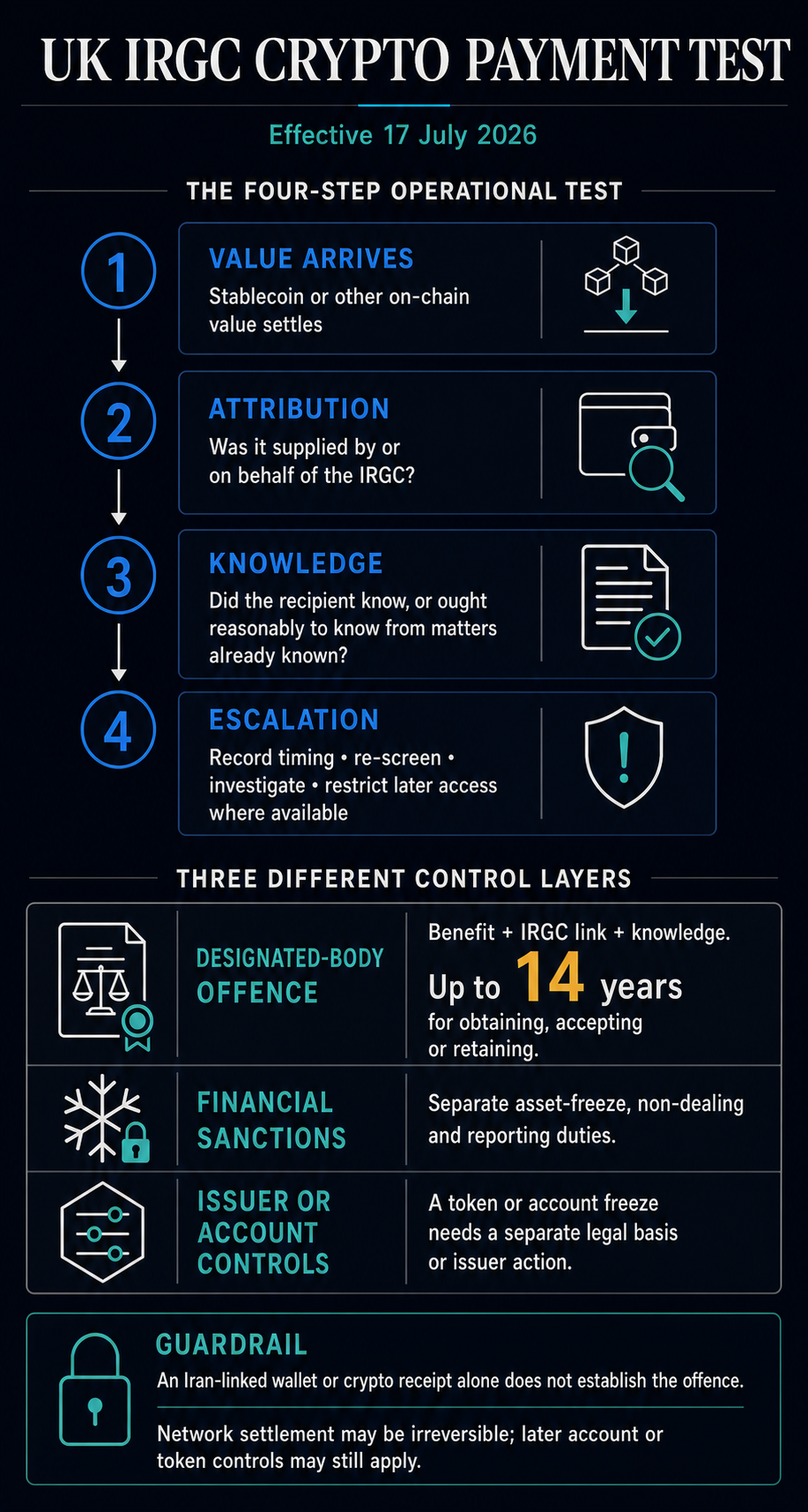
Firms may need transaction timestamps, customer records, wallet-risk scores, attribution updates, internal reviews, and access decisions. Without that trail, management could struggle to show what was known at each stage.
Designation Differs From a Sanctions Freeze
The new offense is separate from standard financial sanctions as adding a group to the national security schedule does not automatically freeze its wallets or require a stablecoin issuer to disable tokens. Another legal basis or an issuer’s controls would still be needed.
This gap matters because UK crypto regulation may create criminal exposure even when a sanctions system shows no formal asset-freeze match. A platform may receive separate alerts under national security and sanctions rules, with different tests attached.
Crypto Market Indicators to Watch
Bitcoin, Ether, and stablecoin prices are unlikely to react directly to one designation. The clearer indicator is rising compliance cost as exchanges invest in historical re-screening, wallet clustering, customer checks, and legal review.
Investors should watch withdrawal delays, account restrictions, stablecoin freezes, and platform policy changes. These signals may show how firms apply UK crypto regulation in practice. Smaller platforms could face greater pressure because advanced screening is expensive.
Conclusion
The new UK crypto regulation does not outlaw every transaction connected to Iran or Russia, and an unknown incoming payment is not automatically a crime. Liability depends on a proven link to a designated body and what the recipient knew, or reasonably should have known.
Still, UK crypto regulation now requires wallet attribution to be treated as a continuing process, not a one-time check. A transfer may finish quickly, but the legal risk can begin later.
Frequently Asked Questions
Can a crypto firm reject an incoming transfer?
Usually not at network level, though it may restrict account access or withdrawals.
Does every Iran-linked wallet create liability?
No. A designated-body connection and the required knowledge test must be established.
Is the maximum sentence 14 years?
Yes, for obtaining, accepting, or retaining qualifying value.
Glossary of Key Terms
Wallet attribution: Linking a blockchain address to a person, company, or group.
Material benefit: Money or another item of value supplied directly or indirectly.
Designated body: An organization formally listed under the UK framework.
On-chain transaction: A transfer recorded on a blockchain.
Disclaimer: This article provides general information only and is not legal, financial, or investment advice.
Source
uk/gov