Hyperliquid lost 5.9 percent on Monday morning, Bitcoin only 0.8 percent over the same period. A look into the exchange's own books explains the gap: Hyperliquid carries $1.66 billion of open
Hyperliquid lost 5.9 percent on Monday morning, Bitcoin only 0.8 percent over the same period. A look into the exchange's own books explains the gap: Hyperliquid carries $1.66 billion of open leveraged positions on its own token. That makes it the house's third-largest market after Bitcoin and Ethereum, and it is almost three times what trades there in a day.
cryptoticker.io compiled this analysis itself on October 13, 2026, from the exchange's publicly accessible data and from CoinGecko. What follows from it, and what an investor in Germany can check against it, is set out in the sections below.
HYPE falls to $82.61 while Bitcoin loses only 0.8 percent
HYPE trades at $82.61, or 73.95 euros, on October 13, 2026. Over 24 hours that is a loss of 5.9 percent, over seven days one of 11.5 percent. Over 30 days, by contrast, the token is still up 4.5 percent. The daily range ran from $79.52 to $88.00, a spread of 10.7 percent between low and high in a single day.
For comparison, the two largest coins over the same window: Bitcoin stands at $83,401 and is giving up 0.8 percent, Ether at $2,514.63 with a loss of 1.9 percent. The broad market is moving, in other words, but it is not breaking down. HYPE is falling roughly seven times as hard as Bitcoin.
The backdrop comes from last week. $681 million flowed out of the American spot ETFs on Bitcoin on a net basis, according to CoinDesk, the largest weekly withdrawal since June on figures from provider SoSoValue. Analysts there name $82,000 as an important support for Bitcoin. The next date that can move the whole market is the US inflation print on October 14.
A token such as HYPE hangs on that wider weather, but it amplifies it. A look into the books of the exchange it trades on shows why.
1.66 billion dollars: HYPE is the third-largest leverage market on its own exchange
Hyperliquid is a decentralised exchange for perpetual futures. A perpetual future, or perp, is a futures contract with no expiry date: you bet on a coin's price with leverage without owning it, and the position runs for as long as you can fund it. The exchange publishes its market data openly, and anyone can pull it.
The pull on October 13, 2026 gives $11.75 billion of open positions and $7.73 billion of turnover over 24 hours across all 234 perp markets. Open positions are known in the jargon as open interest: the sum of all contracts currently running and not yet closed.
The ranking by open interest looks like this:
- Bitcoin: $3.14 billion
- Ethereum: $2.79 billion
- HYPE: $1.66 billion
- Solana: $627 million
- Zcash: $554 million
- NEAR: $367 million
The exchange's own token therefore sits ahead of Solana, Zcash and NEAR, and ahead of all three combined. For a coin ranked 11th by market capitalisation, that is an unusually heavy position on a single venue. Maximum leverage on HYPE is 10, against 40 on Bitcoin.
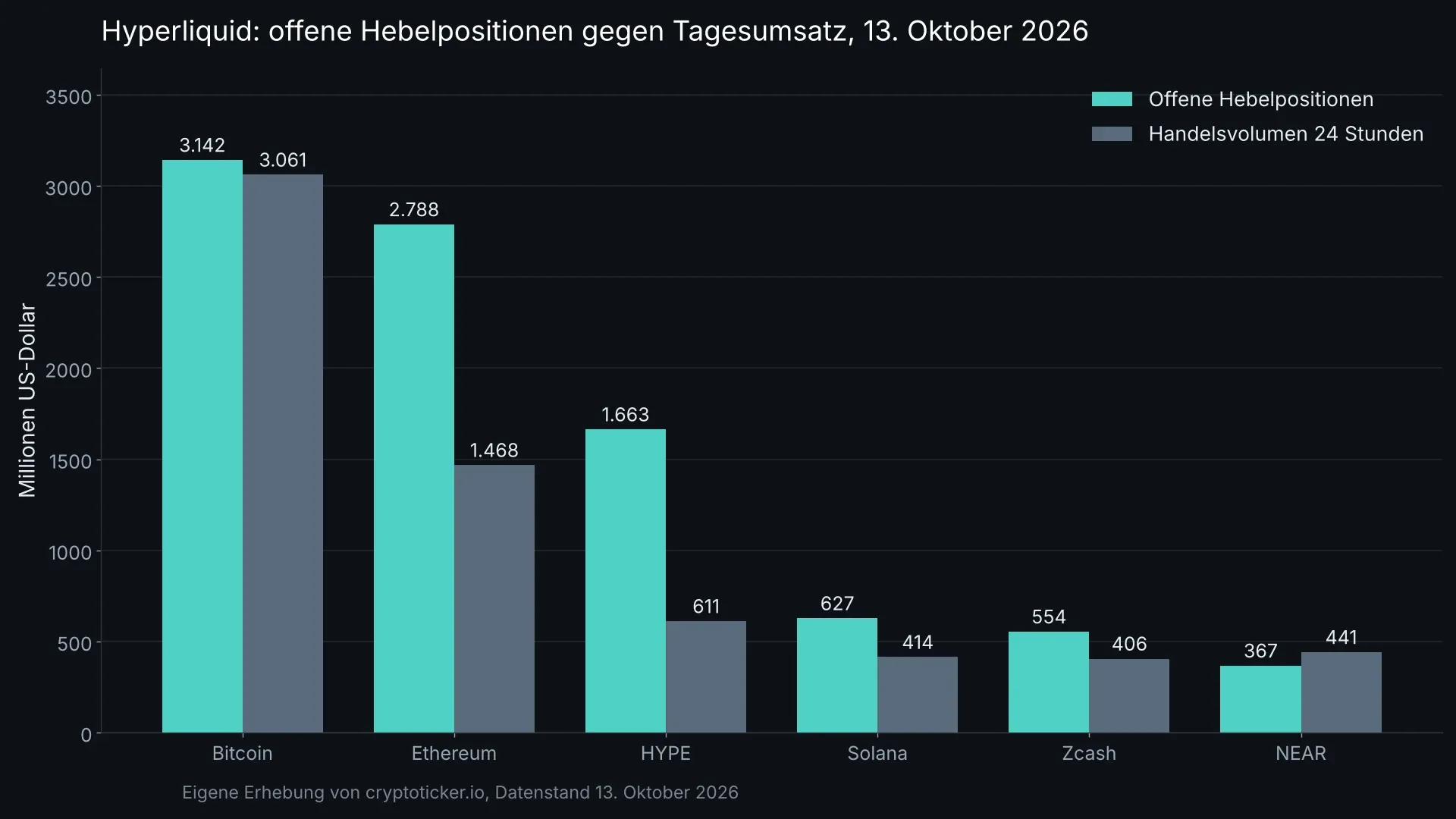
Open leveraged positions and daily turnover per market on Hyperliquid, own survey of October 13, 2026.
Open interest against daily turnover: the ratio explains the gap
The absolute figure says little on its own. It becomes meaningful in relation to turnover, because turnover shows how quickly positions can change hands.
On Bitcoin, $3.14 billion of open positions stand against $3.06 billion of daily turnover. The ratio is 1.03: on a normal day, roughly as much is traded in this market as is open in positions altogether. Anyone who wants out finds a buyer.
On HYPE, $1.66 billion of open positions stand against $611 million of daily turnover. The ratio is 2.72. There are therefore almost three times as many running bets in the market as are traded there in a day. If everyone wanted to close at once, the market would need just under three days of turnover to do it.
That is exactly what creates the difference in the price move. A market with plenty of open positions and little turnover reacts more strongly to the same piece of news, because every sale eats up a larger share of the available other side. The 5.9 percent decline in HYPE against 0.8 percent in Bitcoin is built into that number before any news arrives.
Funding rate and liquidation threshold: how forced selling pressure builds
Two mechanisms keep a perp market in balance, and both are currently working against the buy side.
The first is the funding rate. It is the payment that holders of long and short positions make to each other every eight hours so that the futures price does not detach from the spot price. On HYPE it stands at plus 0.00125 percent per eight hours on October 13. Positive means the long side pays the short side. The rate is low, but the direction is unambiguous. Bet on rising prices and you pay for every day you wait.
The second is liquidation. If the price falls far enough that the posted collateral no longer covers the losses, the exchange closes the position automatically and sells. With ten times leverage, a decline of around ten percent against the position is enough on paper. The daily range of $79.52 to $88.00 amounts to 10.7 percent. A move of that size was therefore enough on Monday to hit leveraged long positions.
Such forced sales hit further positions, which then close in turn. The bigger the pile of open positions relative to turnover, the longer that sequence runs.

Each forced closure pushes the price lower and brings the next position to its threshold.
Funding rate, fees and leverage caps differ from one perp exchange to the next
The three variables that decide the outcome of a leveraged position are each set by the exchange itself. The funding rate of plus 0.00125 percent per eight hours is at the lower edge of the band on Hyperliquid; at other venues the base rate of 0.01 percent per eight hours is eight times as high, which means markedly higher carrying costs on the same position. On leverage, Hyperliquid's 10 on its own token is on the low side for the industry, while 40 on Bitcoin is at the upper end.
Which platforms are candidates for trading perps, and how they differ on these points, is set out in the comparison of the best perp DEXs.
Only 22 percent of HYPE tokens are in circulation
Alongside leverage, a second item in the books weighs on the price over a horizon of months: the quantity of tokens not yet in the market.
Of a maximum supply of one billion HYPE, around 222.4 million units are in circulation on October 13, 2026. That is 22.2 percent. The remaining 77.8 percent sit in lock-ups, with core contributors, in the community fund and in reserves.
That gap shows up in two valuation figures. Market capitalisation, circulating supply times price, stands at $18.36 billion. The fully diluted valuation, or FDV, counts every token that will ever exist at today's price and comes to $78.83 billion. The factor between the two is 4.3.
This is not a peculiarity of Hyperliquid but the usual picture for young tokens with long lock-ups. It does mean, though, that every unlock releases new units into a market whose demand does not automatically grow to the same degree.
The monthly unlock on the 6th, and the buyback against it
A monthly distribution to core contributors, meaning the project's team and developers, has been running since January 2026. According to a report by Cryptotimes it falls on the 6th of each month and began with 1.2 million HYPE on January 6. The October 6, 2026 tranche comprised 3.75 million HYPE, worth around $340 million. Hyperliquid Labs is selling that tranche over the counter to a single institutional buyer, according to the same report; co-founder iliensinc confirmed this on Discord, and neither buyer nor price has been named.
If the pattern continues, the next distribution falls on November 6. No confirmed number of units exists for that date, and the public unlock calendars contradict each other on this point. The monthly pattern is documented; the coming quantity is not.
Against that stands a buyback programme. The exchange's assistance fund bought back $11.81 million of HYPE in the week before October 6, and $14.81 million in the week before that. Measured against the value of the October tranche, the weekly buyback amounts to around 3.5 percent. The buybacks are running, then, but they do not offset the unlocks. How the programme is built and where the money for it comes from is described in our article on the buyback out of USDC earnings.
Perpetual futures without a MiCA licence: deposit protection does not apply
This is where the situation becomes concrete for investors in Germany. The EU regulation on markets in crypto-assets, MiCA for short, has applied since December 30, 2024. Anyone offering crypto services in the EU needs a licence for it, and for providers based in Germany, BaFin runs the procedure.
Hyperliquid is a decentralised exchange with no EU base and no such licence. Three things follow from that which stand differently at a licensed provider:
- No supervisor to turn to. In a dispute over a liquidation, there is no German authority you can approach and no complaints body under German law.
- No segregation of client money to the EU standard. MiCA requires licensed providers to hold client assets separately. Without a licence that obligation does not apply.
- No leverage protection for retail investors. For contracts for difference on crypto-assets, EU-regulated brokers face a leverage cap of 2 for retail clients. On an unlicensed perp exchange it does not bite, and there ten times leverage on HYPE and forty times on Bitcoin are possible.
Anyone who wants to trade leveraged products inside the European framework will find the licensed addresses in the comparison of the best crypto brokers. The price for it is markedly lower leverage; the return is supervision.
Tax on perp gains: the one-year holding period does not apply here
One point is regularly overlooked and cannot be repaired after the fact. When you buy a coin directly, the one-year speculation period applies in Germany: hold for longer and you sell tax-free. With perpetual futures that rule does not bite, because the gain does not come from selling a held asset but from a futures transaction.
Gains from perps therefore count as investment income from the first minute and are subject to the 25 percent flat-rate withholding tax plus the solidarity surcharge and, where applicable, church tax. How the taxation works in detail, and which offsetting limits apply to losses from futures transactions, is set out in our piece on the tax on crypto futures and perps.
For record-keeping that means every closed position belongs in the log, including the small ones. An unlicensed exchange abroad transmits no data to the German tax office, and the duty to declare stays with the taxpayer.
Our assessment: leverage weighs more heavily than the unlock
From the newsroom's point of view, the unlock volume is the smaller of the two issues for the price over the coming weeks. The October 6 tranche went over the counter to a single buyer, according to Cryptotimes, so it did not pass through the order book. What does pass through the market is the $1.66 billion of open leveraged positions, and their ratio of 2.72 to daily turnover is the highest reading among the house's six largest markets.
The figures above argue for that. Against it stands the fact that the buyback keeps running and, at $11.81 million a week most recently, generates real demand, and that HYPE is still up 4.5 percent over 30 days despite the pullback. The token currently sits 15.7 percent below its high of $97.96 from September 23, 2026. This is a pullback in a market that has risen, not a collapse.
No buy or sell recommendation follows from this. With a token whose price hangs on the utilisation of a single exchange, a total loss is possible.
HYPE at $82: leverage decides before the inflation print
The US inflation print on October 14 is the next date that can move the whole market. If it meets a market carrying just under three days of turnover in open positions, the reaction in HYPE will be stronger than in Bitcoin. Three steps make sense ahead of that date:
- Hold the leveraged position against the daily range. $79.52 to $88.00 was Monday's range, 10.7 percent. Calculate your liquidation threshold against a move of that size rather than against the current price. To build such a position without leverage, the venues are in the comparison of the best crypto exchanges.
- Settle the venue's framework. Without a MiCA licence there is no supervision and no leverage protection. If you do not want to carry that, move the leveraged part to a licensed provider from the comparison of the best crypto brokers.
- Set up the tax records now. Perp gains are taxable from the first trade, and the one-year rule does not help. Every closed position belongs on file before the year draws to a close.
(As of October 13, 2026. This article is not investment advice. Prices and fee structures change; check the terms with the provider before you buy.)