Hyperliquid fell to around $62 overnight into Sunday, November 15, 2026. According to CoinGecko, HYPE cost $62.49 at 2:47 a.m. CET, or just under €57, down 12.4 percent from 24 hours earlier.
Hyperliquid fell to around $62 overnight into Sunday, November 15, 2026. According to CoinGecko, HYPE cost $62.49 at 2:47 a.m. CET, or just under €57, down 12.4 percent from 24 hours earlier. Based on what was known at that point, there was no Hyperliquid-specific trigger: the token fell with the whole crypto market, but noticeably harder than bitcoin. Anyone following the Hyperliquid price prediction now sees HYPE as low as it last was in August.
Hyperliquid is a decentralised exchange for perpetuals, futures contracts without an expiry date, running on its own blockchain. HYPE is the network's token. This article puts the day's numbers in context, shows the price levels below $64 and explains what open interest, funding and leverage had to do with the slide. The live price is on the Hyperliquid price page.
Hyperliquid crash on November 14: the day's numbers
CoinGecko put the 24-hour high at $71.31 and the low at $60.31, a gap of just over 15 percent. On Kraken, HYPE closed Saturday at $64.30, after $71.65 on Friday, a loss of 10.3 percent in a single day. The intraday low there was exactly $60.00. Market capitalisation dropped to about $14.9 billion, putting Hyperliquid 10th in CoinGecko's ranking. Over seven days the loss is 18.1 percent.
Volume rose sharply. On Kraken, around 372,000 HYPE changed hands against the US dollar on November 14. The average over the previous seven days was about 158,000 HYPE a day. Saturday therefore brought almost 2.4 times a normal day's turnover, even though less is usually traded at weekends. Many traders read high volume on falling prices as a sign that real selling took place, rather than the price simply giving way in a thin market.
Record high, start of the year, summer low: how far HYPE is from each in percent
Hyperliquid's all-time high, according to CoinGecko, is $97.96, set on September 23, 2026; the price is now 36.2 percent below it. HYPE posted its highest daily close on Kraken a day earlier, at $97.23. Unlike most large altcoins, its record high is therefore less than two months old. The start of the year tells the same story: on January 1, 2026, HYPE cost $25.44 according to CoinGecko. Despite the slump, the token is still about 146 percent above its New Year's Day price. The lowest daily close of the year on Kraken came on February 23, at $26.25.
Why is Hyperliquid falling? Rate fears, ETF outflows and the perpetuals sector
The drop in HYPE is part of a broad sell-off. Over the same 24 hours, bitcoin lost 8.9 percent according to CoinGecko and traded at around $62,200, while ether fell 10.9 percent to about $1,720. The crypto crash typically hits altcoins harder, because investors under stress cut their riskier positions first. A detailed explanation of why bitcoin is falling is in our background piece.
Industry media agree on three pressures. The first is rate expectations: according to CME FedWatch, the futures market prices an 88.5 percent probability that the US Federal Reserve will raise its key rate by a quarter point in December, as Bitcoin.com reports. Higher rates make borrowing more expensive and speculative assets less attractive. The second is fund outflows: according to Farside Investors data, investors pulled around $1.07 billion out of US spot bitcoin ETFs between November 9 and 13, and $398.9 million out of the ether funds, Coinpaper reports. The third is liquidity: the same outlet cites Coinbase on an $11.5 billion fall in stablecoin supply within 30 days.
For Hyperliquid there is a fourth factor that can be read off the numbers. Shortly after midnight, CoinGecko listed the perpetuals category, down 13.4 percent, among the market's weakest segments, alongside decentralised exchanges at 13.5 percent. The sector Hyperliquid belongs to therefore lost more than the market as a whole. Sentiment is reflected in the Fear and Greed Index from alternative.me, a gauge running from 0 for extreme fear to 100 for extreme greed. It stood at 10 points on November 15, after 13 the day before and 20 on Friday. We summarise each day's reasons under why is crypto down.
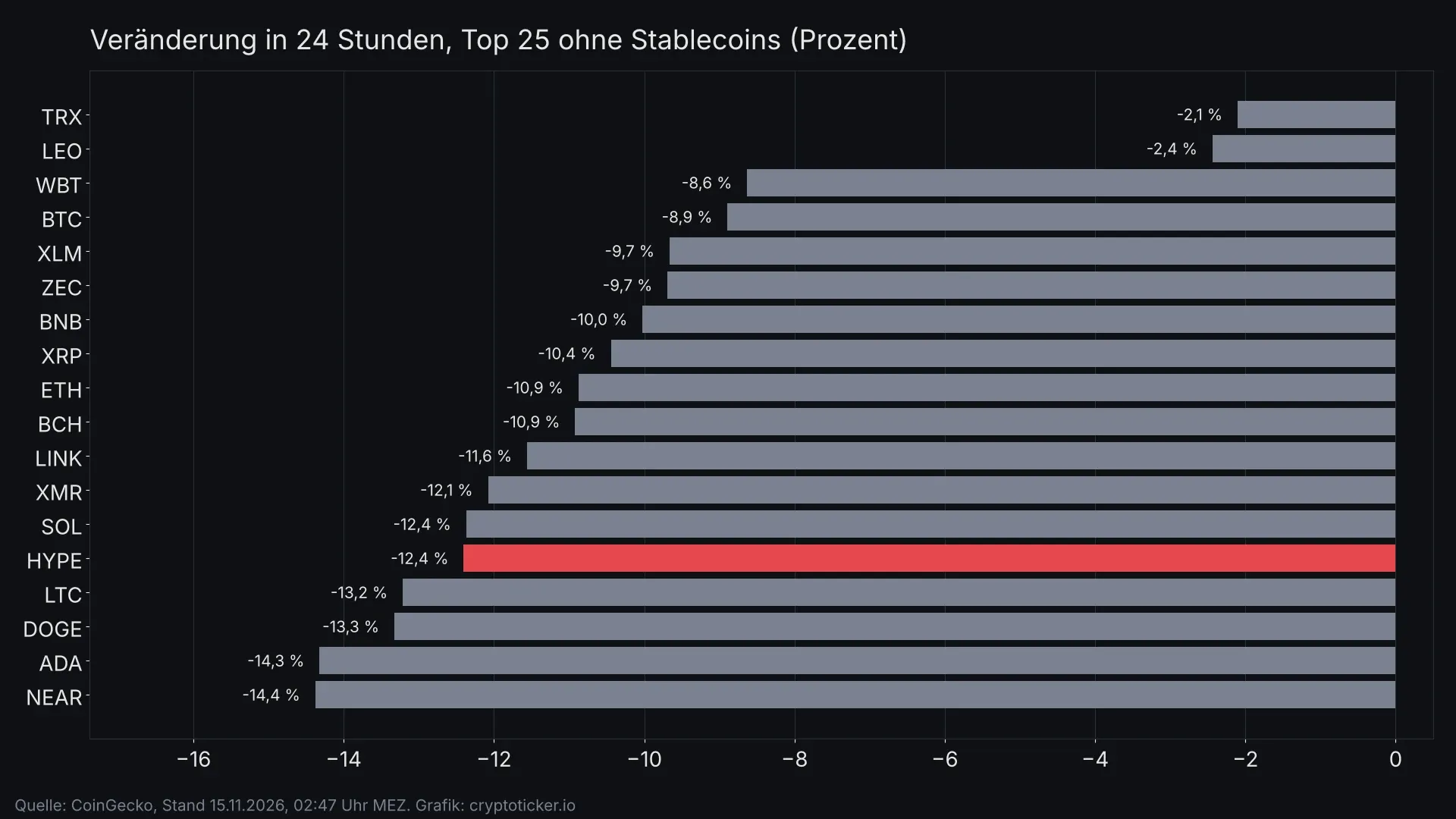
Hyperliquid loses more than 12 percent, placing it in the bottom third of the large coins; bitcoin holds up better.
From outlier to loser: HYPE among the top 25
The chart shows the 24-hour change in the 25 largest cryptocurrencies excluding stablecoins, as of the night into November 15. Almost every major coin lost double digits. NEAR Protocol and Cardano were hit hardest, with just over 14 percent each, followed by Dogecoin and Litecoin with just over 13 percent. At 12.4 percent, Hyperliquid is level with Solana. Only TRON and the exchange token LEO held their losses below 3 percent.
The change of role is striking. As recently as November 13, cryptoticker.io reported that buybacks and burns were supporting the HYPE price while bitcoin fell below $70,000. Hyperliquid uses trading fees to buy back HYPE on the market continuously. In the first days of the downturn, that mechanism kept the token steadier than the rest of the market. On Friday and Saturday it was no longer enough: HYPE gave up its lead and has been falling with the other altcoins since.
A day earlier, Hyperliquid's quarterly report had already failed to support the price, even though it showed protocol revenue of $190.9 million for the third quarter. Strong business figures offer a project only limited protection when the whole market is selling off.
Open interest and funding: what the futures market shows for HYPE
A liquidation is the forced closure of a leveraged position by the exchange once the posted collateral no longer covers the losses. In a fast decline, these closures feed on each other: every long position that is sold off by force pushes the price lower and triggers the next one. According to Bitcoin.com, the drop on November 14 led to liquidations of around $1 billion across the crypto market within 24 hours. When bitcoin fell below $64,000 in the evening, positions worth more than $691 million were liquidated within an hour, $671 million of them longs, according to TokenPost. Just over 97 percent of the forced closures therefore hit investors who had bet on rising prices.
Open interest and the long/short ratio for HYPE on OKX and Hyperliquid
Open interest is the value of all outstanding futures contracts on an underlying asset. What the metric shows is explained in our piece open interest explained. On OKX, open interest in HYPE fell from $107.4 million to $97.3 million between 2 a.m. CET on November 14 and 2 a.m. CET on November 15, a drop of 9.4 percent. Part of that is purely arithmetical, because the dollar value of the contracts falls with the price. The rest consists of closed positions, whether voluntary or liquidated.
On OKX, there were 2.70 accounts with a long position for every account with a short position at 2 a.m. CET on November 14. On Saturday evening the figure dipped to 2.53 at one point; overnight it was back at 2.64. Just over 72 percent of accounts are therefore still betting on a higher HYPE price. If the price keeps falling, a large number of long positions is at risk.
On Hyperliquid itself, contracts covering 20.5 million HYPE were open overnight, around $1.28 billion at the current price. Turnover in the HYPE contract over 24 hours was $1.30 billion. The funding rate, the regular balancing payment between the long and short sides, was slightly negative. That means shorts are currently paying longs, because the contract is trading just below the index price. Selling pressure therefore also dominates in the futures market, if only slightly. cryptoticker.io compiled this analysis itself on November 15, 2026, based on OKX's public market data over 48 hours and Hyperliquid's contract data.
Leverage on HYPE: how longs, shorts and the liquidation price work
Leverage multiplies the effect of every price move on the capital you put in, in both directions. With 10x leverage, a 10 percent price change moves the position by 100 percent. If the price rises, the stake doubles. If it falls, the stake is gone and the exchange closes the position. With 100x leverage, a move of about 1 percent against you is enough for liquidation; with 20x, it is about 5 percent. Fees and the exchange's safety margin come on top, which is why the actual liquidation price sits slightly closer to the entry.
A worked example using the day's figures: anyone who had opened a 10x long position at the 24-hour high of $71.31 would have been liquidated at around $64.20, well before the low of $60.31. The high and the low were just over 15 percent apart. On paper, a long position with leverage of around 7x or more would not have survived the trip from the high to the low.
A short position works the other way round: it gains when the price falls and is liquidated when it rises. Anyone going short after a drop of more than 12 percent is betting that the decline will continue. A sharp rebound, such as HYPE's gain of almost 19 percent in a single day on August 19, can wipe out a highly leveraged short just as quickly.
Stop-loss and position size when trading Hyperliquid
A stop-loss is an order that closes a position automatically once a set price is reached. It caps the loss before liquidation kicks in. Leveraged traders also size their positions so that a loss down to the stop-loss costs only a small share of the account; 1 to 2 percent is a figure often cited. In fast markets, however, a stop-loss can be filled below the intended price, because there are no buyers between two prices.
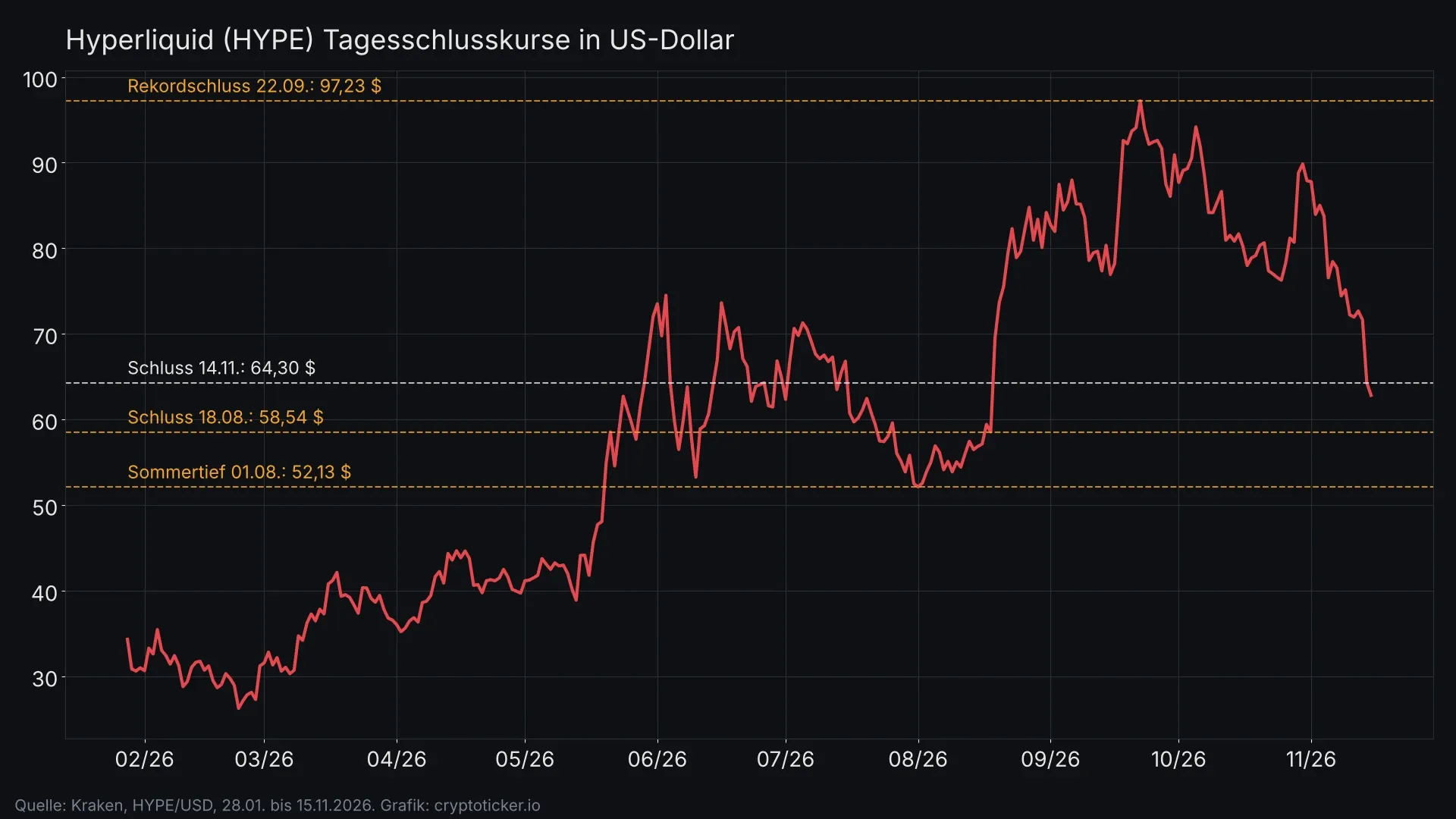
HYPE daily closes on Kraken since January: below the current price lie the levels from August.
Will HYPE fall below $58? The levels from the price history
The chart shows HYPE's daily closes on Kraken since late January 2026. Three levels emerge from it. The first is the close of August 18, 2026, at $58.54, the last daily close below today's level. The following day HYPE jumped to $69.52 and left the summer range. The second level is that summer range itself: between late July and mid-August, HYPE closed between $52 and $58 for weeks. The third is the summer low, the close of August 1 at $52.13.
On the upside, the first level is the November 13 close of $71.65, where the slide began. The record high of around $97 is more than half as much again above the current price. Whether the summer range holds again cannot be predicted. It does, however, show where buyers were willing to step in over the summer.
For context, it helps to look at bitcoin, which sets the pace in the market. How far the largest coin fell in earlier cycles is shown in our analysis how low can bitcoin go. Why the bitcoin price is currently trading below a long-term average is explained in the piece on the 200-week moving average.
Trading Hyperliquid in the EU: MiCA exchanges, perpetuals and CFDs
If you want to buy or sell HYPE, or bet on a price move, there are three routes. The simplest is to buy through a crypto exchange or broker licensed under the EU's crypto regulation, MiCA. MiCA stands for Markets in Crypto-Assets and has governed across the EU since the end of 2024 which providers may trade and hold crypto assets for clients. Kraken, for example, lists HYPE against the US dollar. Which platform charges which fees is shown in our comparison of regulated crypto exchanges.
The second route is futures and perpetuals, which let you trade long and short with leverage. They are offered by centralised exchanges such as OKX and by decentralised venues such as Hyperliquid itself, which are listed in our comparison of perp DEXs. On a decentralised venue you keep your collateral in your own wallet and trade without a customer account with a provider. The third route is CFDs, contracts for difference on the price, such as those that CFD brokers like XTB offer on cryptocurrencies. A CFD only tracks the price; you do not own any coins.
CFDs are complex instruments and come with a high risk of losing money rapidly due to leverage. A high percentage of retail investor accounts lose money when trading CFDs. You should consider whether you understand how CFDs work and whether you can afford to take the high risk of losing your money.
HYPE after the crash: two scenarios between holding and selling
This article cannot and will not make a recommendation. It does help, though, to frame the situation in conditions that can be checked.
In the first scenario, the overall market calms down. Bitcoin stabilises, the wave of liquidations runs its course, and HYPE holds the $58.54 level on a daily closing basis. A recovery towards $71.65, where the price still closed on Friday, would then be possible. In favour of this scenario: through its buybacks, Hyperliquid has ongoing demand for its own token as long as trading continues on the platform.
In the second scenario, the sell-off continues, driven by further ETF outflows or sharper rate expectations ahead of the Fed meeting in December. If HYPE closes below $58.54, the next level lies in the summer range between $52 and $58, with the summer low of $52.13 below it. How investors in the bitcoin market deal with this question is described in our piece should you buy or sell bitcoin. What earlier downturns show is covered in the article on the bitcoin bear market. The conditions under which analysts expect a recovery are set out in the piece on when bitcoin will rise again.
Whatever the scenario, anyone holding HYPE with leverage should compare their own liquidation price with the levels above. Those holding without leverage lose money if prices keep falling, but are not forced out of the position.
Overnight crypto crash: bitcoin, ether and the other losers
Hyperliquid is not alone on this day. Solana also lost just over 12 percent according to CoinGecko, XRP just over 10 percent and Dogecoin just over 13 percent. An overview of the whole day is in our crypto news on the bitcoin slide. We keep updating the latest on the crypto crash today there. The same night's slumps in two other altcoins are covered in our pieces on the Chainlink crash and the Avalanche crash. The longer-term view of the largest coin is in the bitcoin price prediction 2027.
Hyperliquid price: below $58.54 the summer range opens up
- Note the levels. The August 18 closing level of $58.54 decides the next move; below it lies the summer range down to the low of $52.13. Providers that list HYPE are in our comparison of the best crypto exchanges.
- Recalculate your leverage. Leveraged traders should work out their own liquidation price and set a stop-loss. Platforms for futures and CFDs are listed in our comparison of crypto brokers.
- Choose a trading venue. For buying and selling without leverage, MiCA-licensed providers are a suitable choice. Which ones they are is shown in the overview of MiCA-regulated exchanges.
(As of November 15, 2026. This article is not investment advice. Prices and fee structures change; check the terms with the provider before you buy.)