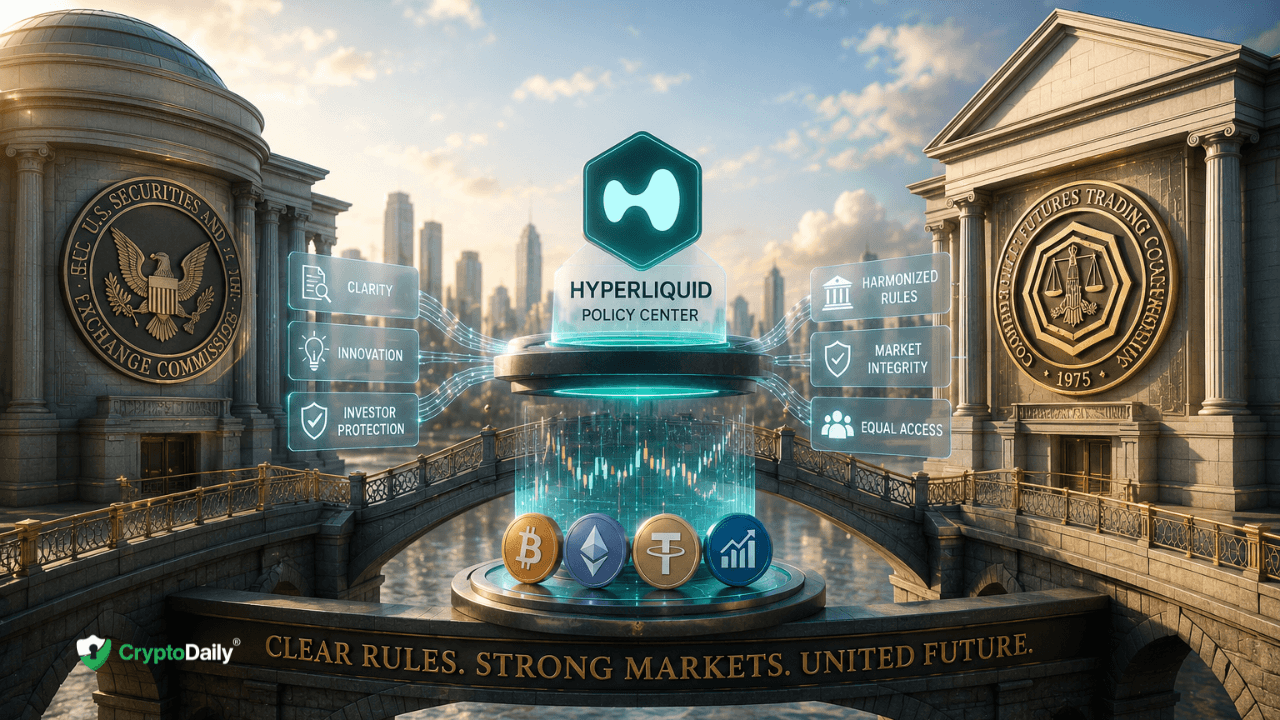
Hyperliquid Policy Center is calling on U.S. regulators to create a clearer and more unified framework for perpetual futures, arguing that the rapidly growing derivatives market is exposing g
Hyperliquid Policy Center is calling on U.S. regulators to create a clearer and more unified framework for perpetual futures, arguing that the rapidly growing derivatives market is exposing gaps between the responsibilities of the Securities and Exchange Commission and the Commodity Futures Trading Commission.
In a comment submitted to the SEC and CFTC, the policy group said perpetual contracts should be classified according to their economic structure rather than simply by the asset they track.
The proposal arrives as perpetual futures begin moving closer to regulated U.S. markets and as Hyperliquid becomes increasingly prominent in both crypto and traditional asset derivatives.
The debate could determine whether platforms offering perpetual contracts tied to cryptocurrencies, stocks, commodities and other assets can operate under a coherent regulatory framework in the United States.
Hyperliquid Wants SEC and CFTC Rules to Align
The central issue is jurisdiction.
The SEC generally oversees securities and security-based derivatives, while the CFTC regulates commodity futures and swaps.
Perpetual contracts can complicate that division.
Unlike traditional futures, perpetual futures have no fixed expiration date. Traders can maintain exposure indefinitely provided margin requirements are met.
Despite that difference, perpetuals share several characteristics with conventional futures contracts.
They are standardized, fungible, allow traders to take leveraged long or short exposure and can generally be closed by entering an offsetting position.
Hyperliquid Policy Center argues that regulators should focus on those economic characteristics when determining how a contract should be treated.
That could help prevent similar products from falling under dramatically different regulatory regimes simply because they reference different underlying assets.
What Are Perpetual Futures?
Perpetual futures are derivatives designed to track the price of an underlying asset without an expiry date.
Traditional futures typically expire on a specified date.
A trader who wants to maintain exposure after that point must close or roll the contract into a later maturity.
Perpetual futures eliminate that process.
Instead, exchanges generally use a funding-rate mechanism to help keep the contract price aligned with the underlying market.
When the perpetual trades above the spot price, long traders may pay funding to short traders.
When it trades below the underlying price, the direction of the payment can reverse.
The structure became extremely popular in cryptocurrency markets because digital assets trade continuously.
A derivative without a fixed expiration date fits naturally into a market operating 24 hours a day, seven days a week.
Why Perpetual Futures Became Dominant in Crypto
Crypto derivatives markets evolved differently from traditional futures markets.
Bitcoin and Ethereum do not stop trading when CME closes.
Neither do decentralized exchanges.
That continuous market structure encouraged the development of instruments that could offer equally continuous exposure.
Perpetuals eventually became one of the dominant forms of leveraged crypto trading.
They concentrate liquidity into a single contract instead of dividing trading volume across several monthly or quarterly expiries.
Traders also avoid repeatedly rolling positions from one futures contract into another.
Those advantages have made perpetual futures especially popular with professional crypto traders.
The challenge is that much of this market developed outside the United States or through decentralized protocols.
U.S. regulators are now deciding how these instruments should fit into existing derivatives law.
SEC and CFTC Are Already Reviewing the Problem
The Hyperliquid proposal did not emerge in isolation.
In June, the SEC and CFTC jointly requested public comment on ways to clarify and harmonize derivatives product definitions.
The agencies specifically acknowledged that evolving financial products and market structures can create uncertainty under regulatory frameworks designed for earlier generations of derivatives.
That consultation gives companies, exchanges and policy groups an opportunity to argue for changes.
Hyperliquid Policy Center is effectively using that process to make the case that perpetual contracts should have a consistent regulatory pathway.
The two agencies are also examining other areas of overlap, including portfolio margining.
The broader direction suggests that SEC-CFTC harmonization has become an active regulatory priority.
Equity Perpetuals Create the Hardest Question
Crypto perpetuals tied to Bitcoin or other commodities are only part of the issue.
Equity perpetuals create an even more complicated jurisdictional problem.
Consider a perpetual contract tracking the price of a publicly traded stock.
The underlying asset is a security regulated by the SEC.
But the contract itself may also resemble a futures product traditionally associated with the CFTC.
Hyperliquid Policy Center argues that qualifying equity perpetuals with the economic characteristics of futures should be eligible for treatment as security futures.
Security futures already exist as a category jointly overseen by the SEC and CFTC.
Under the current framework, certain exchanges registered primarily with one regulator can access the other regime through notice registration.
HPC believes that structure could provide the foundation for a modern perpetual-futures market.
Hyperliquid Says Classification Should Follow Economic Structure
The policy group's central argument is that regulators should not classify a perpetual contract solely according to whether it tracks Bitcoin, oil, gold, a stock index or an individual equity.
Instead, regulators should examine how the product actually works.
That means looking at characteristics such as standardization, fungibility, leverage, settlement and the ability to close positions by entering an offsetting trade.
This approach could make regulation more predictable.
Without a consistent taxonomy, exchanges may face uncertainty over which agency regulates a product and what registrations are required before it can be listed.
That uncertainty can become especially difficult when new financial instruments combine characteristics from several traditional product categories.
Hyperliquid's HIP-3 Markets Are Growing Quickly
The regulatory debate matters because Hyperliquid's markets are no longer small experiments.
According to figures cited by Hyperliquid Policy Center, the platform's HIP-3 perpetual markets have generated more than $480 billion in trading volume since launching roughly ten months ago.
Open interest is around $4 billion.
HIP-3 expanded Hyperliquid beyond conventional crypto perpetuals by enabling markets tied to a wider variety of assets.
Those include cryptocurrencies, commodities, currencies, stock indexes, individual equities and exchange-traded funds.
The platform therefore increasingly resembles an onchain derivatives venue spanning multiple traditional asset classes.
That scale makes regulatory classification much more important.
Hyperliquid Has Processed Trillions in Trading Volume
Hyperliquid's broader derivatives business has also expanded rapidly.
The platform processed nearly $3 trillion in notional trading volume during 2025, according to data cited in the regulatory debate.
More than $1.5 trillion has already been traded during 2026.
That activity helps explain why traditional exchanges and U.S. regulators are paying closer attention to perpetual futures.
What was once primarily an offshore crypto-market product is becoming large enough to compete with established derivatives infrastructure.
The question is whether U.S. markets will integrate perpetuals into the regulated financial system or allow most of the activity to remain offshore and onchain.
Traditional Exchanges Are Pushing Back
The expansion of perpetual contracts has not been universally welcomed.
Traditional derivatives exchanges including CME and ICE have raised concerns about how perpetual markets could affect established trading venues.
One concern is price integrity.
Critics argue that poorly regulated perpetual markets could potentially influence prices used elsewhere in the financial system.
There are also questions around market surveillance, margin requirements, customer protection and the ability of regulators to oversee decentralized or offshore trading infrastructure.
The dispute became more visible this year when CME challenged a CFTC decision connected with the approval of perpetual products in the United States.
That shows how quickly the issue is moving from theoretical policy discussion into commercial competition.
Perpetual Futures Could Reshape U.S. Derivatives Trading
The appeal of perpetual contracts extends beyond crypto.
One of their biggest structural advantages is liquidity concentration.
Traditional futures markets divide trading across different expirations.
For example, traders may simultaneously use March, June, September and December contracts.
Liquidity is therefore spread across a maturity curve.
A perpetual future concentrates activity in one continuously traded instrument.
That could make execution easier for some traders and reduce the operational need to roll positions.
The structure may also support smaller contract sizes and continuous trading.
Those features are particularly attractive as traditional financial markets increasingly explore longer trading hours.
24/7 Markets Create Pressure for New Products
Financial markets are gradually moving beyond the traditional trading day.
Cryptocurrency markets already operate continuously.
Tokenized stocks and blockchain-based securities are pushing equities toward longer trading hours.
Prediction markets and digital derivatives are also challenging conventional market schedules.
Perpetual futures fit naturally into that shift.
Because they have no maturity date, they do not depend on the same expiration and rollover structure as conventional futures.
Hyperliquid Policy Center argues that this makes perpetuals particularly well suited to around-the-clock markets.
That argument may become more important as U.S. exchanges compete with global crypto venues that already operate 24/7.
Regulation Could Bring Perpetuals Onshore
The policy debate is therefore about more than compliance.
It could determine where derivatives trading takes place.
Strict or unclear U.S. rules have historically pushed some crypto derivatives activity toward offshore exchanges.
Clearer regulation could reverse part of that trend.
If the SEC and CFTC agree on how different perpetual contracts should be classified, registered exchanges may have a clearer path to listing them.
That could bring more trading volume, liquidity and market infrastructure back into U.S.-regulated venues.
It could also allow traditional exchanges and crypto-native platforms to compete under more comparable rules.
Hyperliquid Is Moving Closer to the U.S. Regulatory Debate
Hyperliquid itself has become increasingly visible in Washington.
The platform is now part of a much larger discussion about whether decentralized and onchain trading infrastructure can operate within U.S. financial regulation.
President Donald Trump recently said the CFTC was working toward bringing Hyperliquid into the U.S. market in a fully compliant and legal framework.
That statement increased attention around the platform and coincided with a substantial move in the HYPE token.
HYPE gained around 40% following the comments, according to market data cited by The Block.
The price reaction reflects investor expectations that regulatory access to the U.S. market could significantly expand Hyperliquid's addressable user base.
But regulatory integration would also create new compliance obligations.
What Harmonization Would Actually Change
A harmonized SEC-CFTC framework would not necessarily mean lighter regulation.
Instead, its main benefit would be predictability.
Exchanges would know which rules apply.
Regulators would have clearer jurisdiction.
Market participants would have a more consistent understanding of how products are classified.
That could reduce disputes over whether a derivative should be treated as a futures contract, swap, security future or another product category.
For exchanges, regulatory clarity can be almost as important as regulatory leniency.
Building infrastructure around a product is difficult when companies cannot determine which legal framework will apply several years later.
Why This Matters Beyond Hyperliquid
The implications extend well beyond one platform.
If U.S. regulators establish a workable framework for perpetual futures, major centralized exchanges, traditional derivatives venues and decentralized protocols could all use it.
Crypto exchanges could expand regulated leveraged products.
Traditional exchanges could introduce perpetual exposure to equities, commodities or indexes.
DeFi protocols could attempt to connect onchain derivatives with compliant U.S. infrastructure.
The outcome could therefore influence the structure of the broader derivatives industry.
Hyperliquid may be the company pushing the issue most visibly today, but it is unlikely to be the last platform affected.
SEC-CFTC Harmonization Could Become a Major Crypto Policy Theme
Stablecoins dominated much of the first phase of U.S. crypto regulation.
Market structure is increasingly becoming the next major battleground.
Perpetual futures sit directly at the intersection of those debates.
They combine crypto-native market design, derivatives regulation, securities law and 24/7 trading infrastructure.
That makes them precisely the type of product that exposes weaknesses in fragmented regulatory systems.
The SEC and CFTC have already acknowledged the need for greater coordination.
The question is how far that harmonization will go.
What Happens Next?
The agencies are reviewing industry comments as part of their broader derivatives harmonization initiative.
Hyperliquid Policy Center wants regulators to modernize the existing security-futures framework and create classifications based on how perpetual products function economically.
Traditional exchanges are likely to continue pushing for strong surveillance and registration requirements.
Crypto-native platforms will argue that overly restrictive rules could push innovation and liquidity outside the United States.
Finding a balance between those positions will be difficult.
But the scale of perpetual trading means regulators can no longer treat the market as a niche crypto product.
With HIP-3 volume above $480 billion and Hyperliquid's overall trading volumes reaching into the trillions, perpetual futures are already a significant part of global derivatives activity.
The regulatory question is now whether U.S. rules will adapt to that reality.
If the SEC and CFTC succeed in creating a unified framework, perpetual futures could move from being primarily an offshore and onchain crypto instrument into a much larger part of regulated U.S. markets.