On November 6, Hyperscale Data sold every bitcoin it owned. The 211.6 coins brought in about $16.0 million gross, and the company used most of that money to retire a convertible note eleven d

On November 6, Hyperscale Data sold every bitcoin it owned. The 211.6 coins brought in about $16.0 million gross, and the company used most of that money to retire a convertible note eleven days later. On November 18 it raised another $5.0 million in a second convertible note closing and filed its quarterly report with the Securities and Exchange Commission. Inside that filing is a sentence no balance sheet can dress up: it says “these conditions and events raise substantial doubt about the Company’s ability to continue as a going concern.”
Hyperscale Data (NYSE American: GPUS) is not a bitcoin miner anymore, at least not in the way it was two years ago. The Las Vegas-based holding company, which runs its data center business through Sentinum and its other operating assets through Ault Capital Group, describes itself as an artificial intelligence data center company. Its remaining bitcoin treasury is now zero. What it still has is a construction bill at a former mining site in Dowagiac, Michigan, a customer contract whose headline value depends on options nobody has exercised, and a share price of 15.7 cents.
The interesting part is not that a small-cap company is short of cash. It is the sequence in which each funding lever was pulled, and what is left when the last one is switched off.
What the filing actually says
The 10-Q covers the quarter ended September 30, 2026 and was filed two days after the company notified the SEC that it would file late. On that same day, November 16, a Form 8-K published unaudited preliminary figures for the quarter. The balance sheet in the 10-Q is not ambiguous. Cash and cash equivalents stood at $17.3 million, against $27.8 million of restricted cash and $17.5 million of restricted crypto assets that the filing says are not freely available for general operating requirements.
Current assets totalled $103.2 million. Current liabilities totalled $231.2 million: $85.7 million of accounts payable and accrued expenses, $83.7 million of current notes, related-party notes and convertible notes payable, a $38.9 million guarantee liability, a $20.9 million participation liability and $2.0 million of current operating lease obligations. The filing states the result directly: current liabilities exceeded current assets by about $128.1 million.
For the nine months to September 30, the company recorded a net loss of $62.1 million, compared with $35.6 million a year earlier, on revenue of $123.8 million, up 65%. Net loss attributable to common stockholders reached $72.1 million after $9.5 million of preferred dividends. The revenue growth came from crane rental, defense systems and lending activity, not from bitcoin.
What “substantial doubt” does and does not mean
A going-concern paragraph is an accounting disclosure, not a legal finding. Management must assess whether existing cash and available sources of liquidity will cover planned spending for twelve months after the financial statements are issued. When the answer is no, and when management’s own remediation plan is outside its control, the auditor and the filing say so in those words.
What the phrase does not mean is that a company has filed for protection, defaulted, or run out of cash on the day of filing. Hyperscale kept operating: its November 18 8-K declared monthly cash dividends on two series of preferred stock, with a November 30 record date and a December 10 payment date. What the phrase does mean is that the company has told investors, in a signed document, that the money it has is not enough for the plan it has committed to.
The 10-Q names the plan’s moving parts in order: sales of equity securities, debt or other financing, cash from operations, asset sales and monetisation, and “other strategic financing transactions.” Then it adds the detail that matters most for anyone modelling the next two quarters: “The Company has an effective shelf registration statement; however, sales under its at-the-market offering program are currently suspended.”
The Michigan build, itemised
The spending that created the shortfall is a 20-megawatt build-out at the Dowagiac campus, delivered in two phases under a master services agreement with an AI infrastructure customer. The filing sets out the cost and the timing without much room for interpretation.
Item
Amount
Source line in the 10-Q
Total estimated cost to construct, equip and commission 20 MW
$122.1 million
Liquidity and capital resources
Paid through October 31, 2026
$47.3 million
Same
Remaining to be paid, November 2026 to March 2027
$74.8 million
Same
Of which due in November and December 2026
$27.4 million
Same
Of which due in the first quarter of 2027
$47.4 million
Same
Unrestricted cash and equivalents at September 30, 2026
$17.3 million
Balance sheet
Read the last two rows together. Unrestricted cash covers 23% of what is still owed on the build, and the company has to find $27.4 million before the end of December while holding enough working capital for a business that spent $89.4 million on cost of revenue in nine months. The filing notes that the master services agreement provides for one-time customer payments on Phase 1 and Phase 2 fit-out work and for partial prepayment of monthly colocation fees, which it says should “partially offset” the funding requirement. Partial is the operative word.
The delivery dates are equally specific. Phase 1, at 10 MW, has a ready-for-service target of December 2026. Phase 2, the second 10 MW, is targeted for the end of March 2027. The two deadlines sit inside the same window as the $74.8 million of spending, which is why a slip in either one is a financing problem and not just a schedule problem.
Where the last 211.6 bitcoin went
The bitcoin sale is the cleanest number in the whole story. The filing states that on November 6 the company “sold all of its Bitcoin holdings, totaling approximately 211.6 Bitcoin, for gross proceeds of approximately $16.0 million.” Of those coins, 208.4 were pledged as collateral for senior secured convertible promissory notes held by the JGB lenders, meaning most of the treasury was encumbered before it was sold.
Divide the proceeds by the coins and the implied average sale price is $75,614 per bitcoin. Bitcoin traded at $63,486 on Binance at the time of writing, so the liquidation happened about 19% above the current spot price. For a treasury that has been marked down all year, that is a good exit on price and a bad signal on timing: the company sold because it needed the cash, not because the level looked attractive.
The cash then moved almost immediately. On November 16, Hyperscale used a portion of the proceeds to repay the JGB notes in full, including $12.8 million of outstanding principal and a 10% prepayment premium of about $1.3 million. In plain terms, $14.1 million of the $16.0 million went to close one liability, and the prepayment premium was the price of ending the collateral arrangement early.
This is the same pattern visible across the listed-company cohort this year: 14 public companies sold 108,247 bitcoin in 2026, and most of those sales were debt management rather than treasury strategy. Hyperscale’s case is simply the version where the treasury was small enough to be exhausted in one trade.
A $1.2 billion contract, priced per kilowatt-month
The bull case rests on the master services agreement, and the filing gives enough detail to price it. The customer gets an exclusive licence to a designated area of the facility for an initial ten-year term, with two five-year extension options. If both options are exercised, “the total contract value to the Provider is approximately $1.2 billion during the Term, subject to the Provider meeting its obligations under the Agreement.” The agreement also grants a right of first offer on an additional 32 MW of critical AI compute capacity, which would lift total contract value to about $3.0 billion if exercised within the first two years.
Spread the base figure across the full term and the economics become concrete. Twenty years, 20 MW, $1.2 billion works out to about $60 million a year, or roughly $250 per kilowatt-month once the facility is fully delivered. The same $1.2 billion divided by the $122.1 million build cost gives a capital multiple of about 9.8 times gross contract value over two decades, before power, staffing, maintenance and the cost of the financing that bridges the construction period.
That is a workable infrastructure return if everything lands. The catch is the shape of the cash flow. A colocation contract bills monthly per kilowatt delivered, so revenue starts at zero and steps up only when each phase is accepted. The construction bill is due now. Between the two sits the entire liquidity problem, and the $1.2 billion figure is contingent on extensions the customer has not yet chosen to exercise.
Three levers were available, and the filing shows the state of each.
Equity, through the at-the-market program. Over the nine months the company sold approximately 110.3 million Class A shares under its 2026 ATM agreement for gross proceeds of about $47.9 million, an average of roughly 43 cents a share. On October 9 it amended the agreement with Spartan Capital to cut the aggregate offering to $100 million, and in April it raised authorised Class A shares from 500 million to 2.5 billion. The program is now suspended, so this lever is currently unavailable at any price.
Convertible debt, at a discount. The November financing came in two closings: a note with about $10.8 million principal for $10.0 million of gross proceeds on November 6, and a note with about $5.4 million principal for $5.0 million on November 18. Both carry an original issue discount of roughly 7.4%, before any conversion feature. A further note of about $10.8 million for $10.0 million can be issued within three months of the second closing, but only if the parties agree and stockholders approve.
Asset sales. The filing lists “potential sales or monetization of investments or other assets” among the remedies. That bucket includes the equity stakes and the lending book inside Ault Capital Group, which the company still expects to spin off to shareholders in 2027 through an exchange of Series F preferred stock for ACG shares.
Layered on top is the preferred dividend. The company paid $9.5 million of preferred dividends in the first nine months and declared another round on November 18: $0.2708333 per share on the 13.00% Series D and $0.20833 per share on the 10.00% Series E. Those are contractual cash obligations that compete with construction invoices in the same quarter.
What breaks first
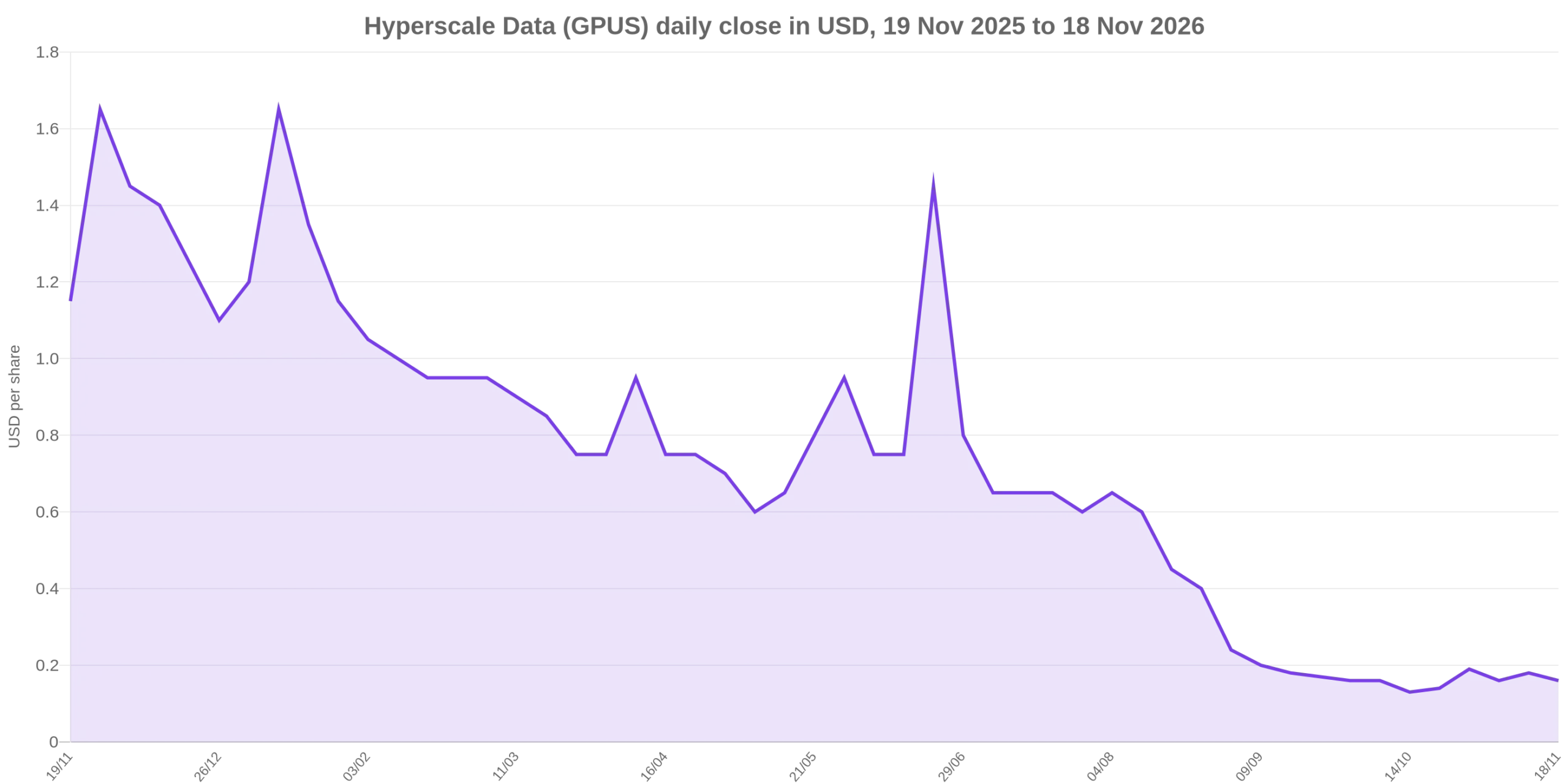
Hyperscale Data’s daily closing price over the past twelve months. Source: Yahoo Finance daily closes, retrieved 19 November 2026.
Dilution is already visible in the share count. Weighted average basic and diluted shares were 158.5 million in the third quarter, against 8.06 million a year earlier, almost twenty times as many. GPUS closed at $0.157 on November 18, up 1.75% on the day, which puts the market value of the whole company at roughly $25 million on that share count, well below the $122.1 million it has committed to spend on one facility. In September, its bitcoin and cash holdings were worth more than its market cap; after November 6 there is no bitcoin left to count.
The second pressure point is legal rather than financial. A purported class action filed on May 26, 2026 in the Western District of Michigan alleges that operations at the Dowagiac data center generate excessive noise and asserts private nuisance, public nuisance and negligence claims. The company has moved to dismiss two of the claims and says it believes the claims are without merit. Fact discovery is scheduled to close on February 19, 2027 and the class certification motion is due June 11, 2027. A facility being converted for AI tenants while neighbours litigate over noise is a permitting and community-relations risk that sits outside the financing plan.
Third is the sequence itself. Cash on hand is $17.3 million. The December construction tranche is $27.4 million. The convertible note programme can add $10.0 million more, but only with stockholder approval and mutual agreement, and the ATM is suspended. That leaves asset sales and whatever the shelf registration can support as the live options between now and year-end.
The dates that matter
Four dates frame the next two quarters. Phase 1 at 10 MW is targeted for December 2026, the same month $27.4 million of construction spending falls due. Phase 2 at 10 MW is targeted for the end of March 2027, alongside the remaining $47.4 million. The preferred dividend pays on December 10. A stockholder vote would be needed before any additional $10.8 million note can be issued.
Hyperscale’s own description of the plan is that management “intends to address the Company’s liquidity requirements through a combination of capital-raising activities.” The 10-Q does not say which combination it expects to close first, and it does not quantify how much of the $74.8 million is already contracted. Until it does, the honest reading is that a company which sold its last bitcoin to repay a note now needs to fund a data center build with instruments it has not yet secured.
Frequently Asked Questions
What does a going-concern warning mean for a company like Hyperscale Data?
It is an accounting conclusion that existing cash and available liquidity will not cover planned spending for the twelve months after the filing date. It is not a bankruptcy filing, a default or a trading halt, and the company can resolve it by raising capital, cutting spending or completing asset sales. Hyperscale’s filing states the doubt explicitly and lists equity sales, debt, operations, asset monetisation and other financing as remedies.
Does Hyperscale Data still own any bitcoin?
No. The 10-Q says the company sold all of its bitcoin holdings, approximately 211.6 coins, on November 6, 2026 for gross proceeds of about $16.0 million. Of those, 208.4 were pledged as collateral for the JGB convertible notes, and the company used part of the proceeds to repay those notes in full on November 16. It still reports about $1.0 million of unrestricted crypto assets and $17.5 million of restricted crypto assets at September 30.
Is the $1.2 billion AI contract already generating revenue?
Not yet at scale. The master services agreement bills monthly per kilowatt delivered, with Phase 1 at 10 MW targeted for December 2026 and Phase 2 at 10 MW targeted for the end of March 2027. The $1.2 billion figure also assumes the customer exercises both five-year extension options, and it rises to about $3.0 billion only if a right of first offer on an additional 32 MW is exercised.
The post Hyperscale Data Sold Its Last Bitcoin and Now Flags a Cash Shortfall on Its AI Build appeared first on BlockchainReporter.