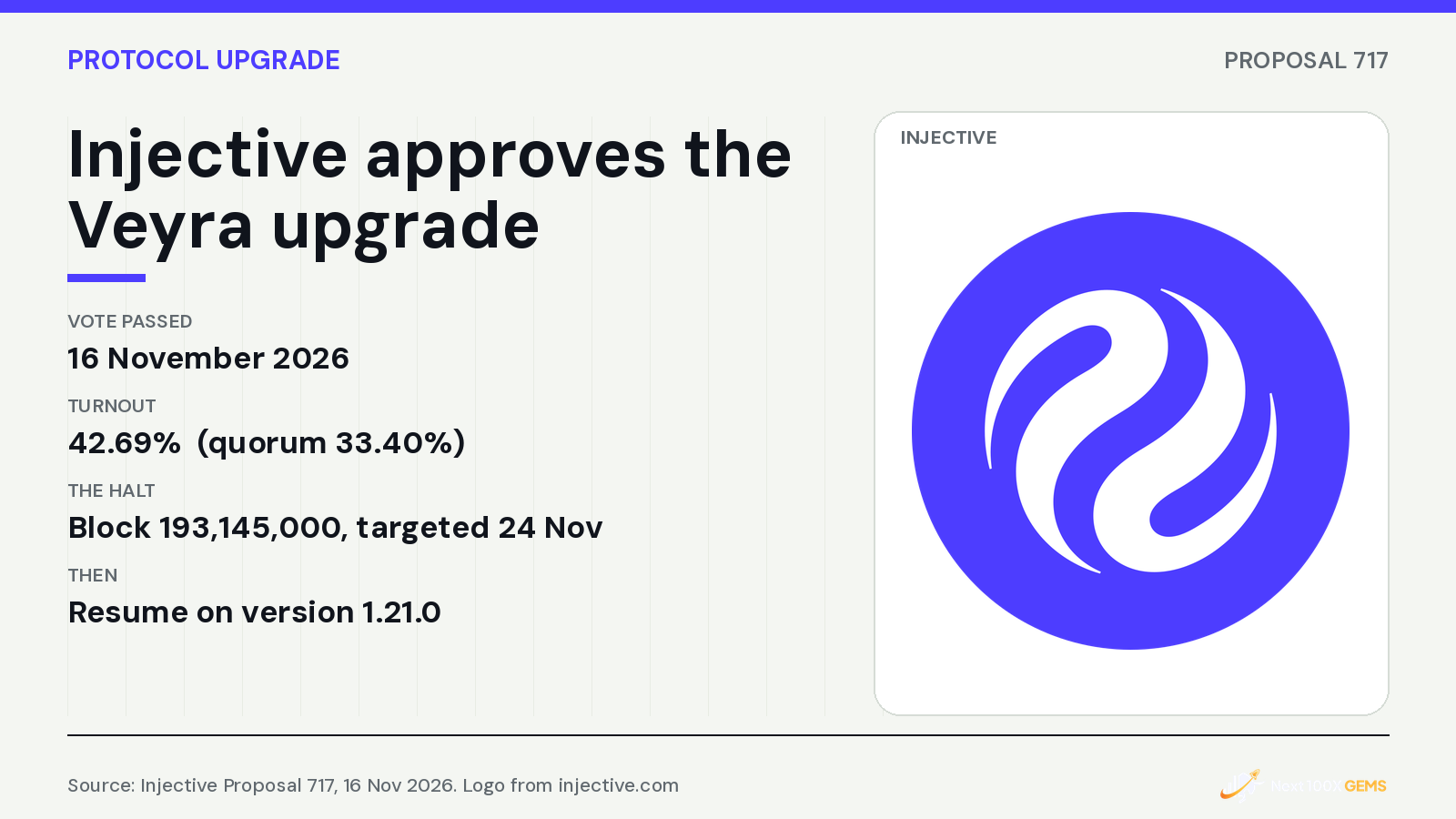
Proposal 717 passed on 16 November. That is not the same thing as Veyra going live. The vote commits the Injective chain to halt at block 193,145,000, a height the proposal targets for 24 Nov
Proposal 717 passed on 16 November. That is not the same thing as Veyra going live. The vote commits the Injective chain to halt at block 193,145,000, a height the proposal targets for 24 November, and to come back on application version 1.21.0. Turnout was 42.69%, above the 33.40% quorum. Of the stake that voted, 67.48% was yes and 32.19% was abstain.
The useful number, for anyone running a node or waiting on a feature, is the block height. The calendar date is an estimate of when that height will arrive.
Voting opened on 12 November and closed on 16 November. The on-chain record, as shown on Valopers, puts 16,236,896 INJ in the yes column, 80,589 INJ against, one INJ as a veto, and 7,745,866 INJ as abstain. That is 24,063,352 INJ in total, or 42.69% turnout against a 33.40% quorum.
The yes share, 67.48%, looks softer than a near-unanimous upgrade until you notice the abstentions. Almost a third of the voted stake chose not to take a side. In this style of governance, those ballots still count toward the turnout figure that cleared the quorum. The no and veto totals were negligible.
The proposer disclosed, in the proposal text, that they are a member of the Injective Labs team. That does not change the tally. It is worth keeping in mind when reading the proposal's own language about institutional rails, tokenized markets and "the world's capital markets." That is the proposer speaking, not a description of software that has already shipped.
A software-upgrade proposal on Injective is a coordinated halt, not an immediate switch. The upgrade message names version v1.21.0 and a halt at height 193,145,000. Injective's chain upgrades page describes the usual sequence: the chain stops at the specified block, validators switch to the new binary, either through Cosmovisor or a manual restart, and consensus resumes once enough of them are back on the expected version.
The 24 November date in the proposal is a target for that height, not a clock time the chain will obey. If blocks arrive faster or slower than expected, the halt moves with the height. Until the chain actually reaches 193,145,000 and comes back on v1.21.0, the approval is a commitment.
For ordinary users, a halt like this is usually a pause, not a migration. Applications and venues that follow the chain stop with it and start again once enough validators are on the new binary. The proposal does not say which exchanges or apps have already said they are ready, and it does not give a duration for the halt. That will be a function of how smoothly the restart goes.
By 17 November, the v1.21.0 mainnet binary was listed on the Injective Foundation's GitHub releases page, with a validator guide on the project's documentation site. The release notes are an operations document: versions, checksums and how to install the binary. They are not a product changelog, and they do not independently spell out the features advertised in the proposal.

The proposal, not a separate technical paper, is the public description of what v1.21.0 is for. It says Veyra expands Injective's MultiVM setup with new Inter-Blockchain Communication capabilities, so assets can move between Injective's Ethereum Virtual Machine environment and the wider interchain ecosystem. It also says the upgrade introduces request-for-quote infrastructure and expands atomic-swap functionality. An RFQ lets a trader ask liquidity providers for a price before a trade is executed. An atomic swap is meant to settle both sides of an exchange together, or not at all.
Those are the concrete claims. The proposal frames them as support for institutional trading, settlement and tokenized assets, and as a step on from Injective Institutional Rail, a service crypto.news dates to 2 November. It also says Veyra builds on an earlier upgrade, Meridian, to prepare the network for CypherOS, a planned privacy platform. That is groundwork, not a privacy launch. The proposal does not publish a list of applications that will go live at the halt, or a test of how the new IBC or RFQ paths behave in production.
None of that is a reason to ignore the upgrade. It is a reason to keep the vote and the marketing copy in separate piles. The chain has been told to stop at a block and restart on a named binary. The rest is what the Labs-affiliated proposer says that binary is for, and it can be checked after 24 November the same way any other upgrade is checked: did the chain halt at the height, and did it resume on v1.21.0.
Sources
Injective Proposal 717, "Injective Veyra Mainnet Upgrade (v1.21.0)", on-chain governance record (vote closed 16 November 2026)
Injective Chain upgrades page (scheduled v1.21.0 at block 193,145,000)
Injective Foundation, injective-core GitHub releases, v1.21.0 mainnet binary (listed by 17 November 2026)
Injective docs, canonical chain upgrade guide for v1.21.0
ChainBrief, "Injective Veyra Upgrade Approved in Proposal 717" (17 November 2026)
crypto news report, "Injective Veyra upgrade heads to governance vote ahead of November 24 launch" (pre-result report)