Ethereum is preparing what many developers call its biggest upgrade since The Merge, the 2022 change that moved the network from proof-of-work to proof-of-stake consensus mechanism. For conte
Ethereum is preparing what many developers call its biggest upgrade since The Merge, the 2022 change that moved the network from proof-of-work to proof-of-stake consensus mechanism.
For context, The Merge was Ethereum's September 2022 switch from crypto mining (proof-of-work) to a system called proof-of-stake, where users lock up ETH to secure the network instead of running power-hungry computers. It cut Ethereum's energy use by more than 99% overnight, one of the largest efficiency gains in the history of computing.
The latest upgrade called Glamsterdam will be activated in the second half of 2026 and aims to make the blockchain itself faster and cheaper. The name blends "Gloas," the consensus-layer component, with "Amsterdam," the execution-layer component, following Ethereum's tradition of pairing a star name with a past Devconnect host city.
Related: 1inch integrates Robinhood Chain as tokenized stock trading goes onchain
What is actually changing
Glamsterdam makes two changes to how Ethereum handles transactions.
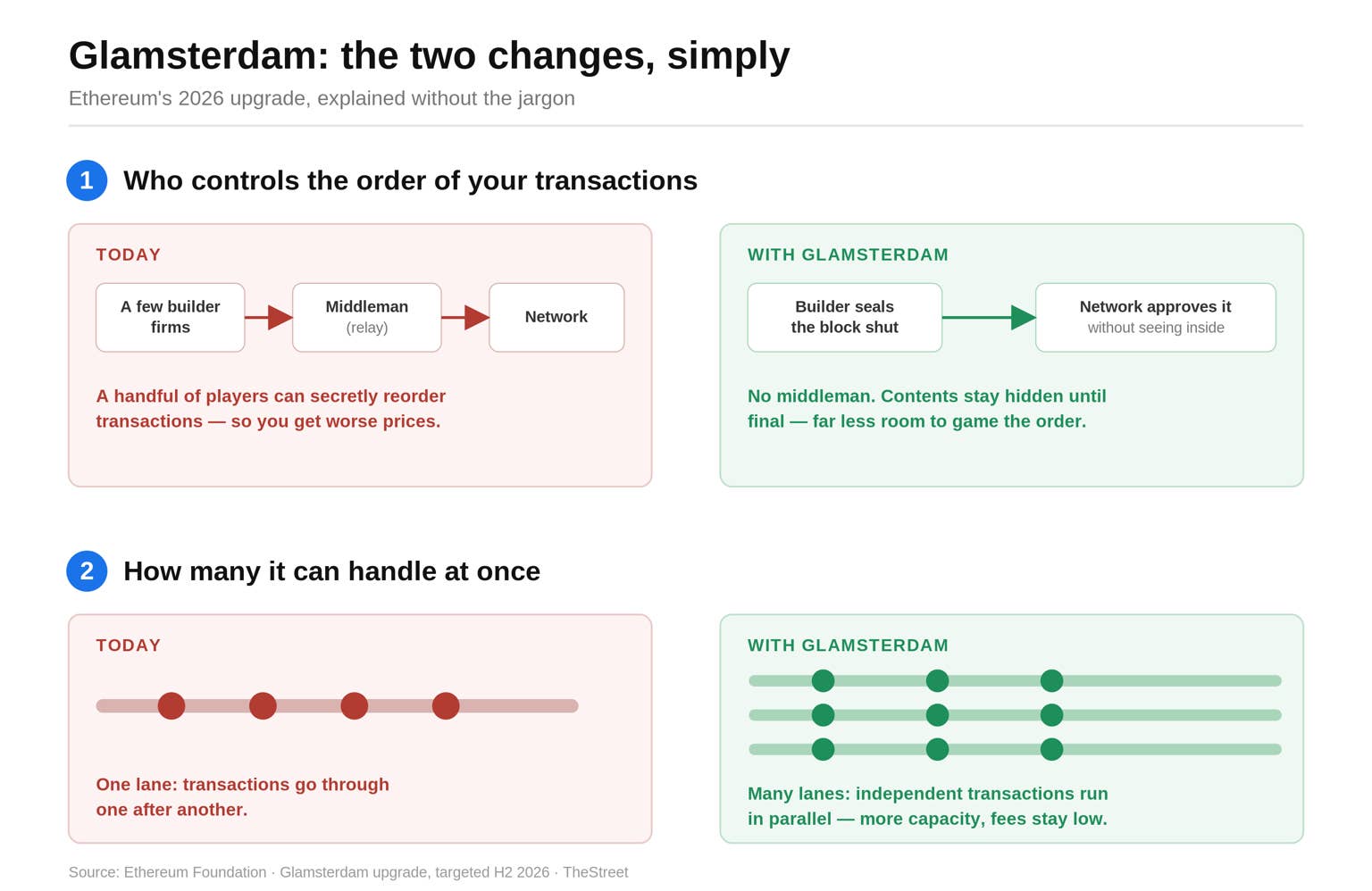
It changes who controls the order. Every few seconds, Ethereum bundles transactions into a "block." Right now, a small group of specialist firms decides what goes into each block and in what order, and they route those blocks to the network through middlemen. That hands a few players the power to reorder transactions in ways that cost ordinary users money.
Glamsterdam builds a fairer process into Ethereum's own rules: whoever approves a block can no longer see or rearrange what's inside it, and the contents stay hidden until the block is final. Fewer middlemen, less room to game the order. This proposal is called enshrined proposer-builder separation, or ePBS (EIP-7732).
How Glamsterdam changes transaction ordering and processing. Graphic: TheStreet / Roundtable.
And it lets Ethereum do more at once. Today the network mostly processes transactions one after another. The upgrade lets it spot transactions that don't affect each other and handle them at the same time —think of it like opening extra checkout lanes instead of forcing everyone through one. More lanes means more transactions per block without pushing fees up. This change is known as Block-Level Access Lists (EIP-7928).
Most Popular on TheStreet Roundtable:
Why this matters for DeFi
For anyone who trades on Ethereum, the ePBS change is the one to watch, because it targets a hidden cost baked into how the network runs today.
"Ethereum's Glamsterdam, viewed by many as Ethereum's most significant upgrade since The Merge, reworks how blocks are built so transactions can run in parallel, raising capacity without sending fees up," said Holly Atkinson, Chief Product and Technology Officer at 1inch, a decentralized trading platform.
The problem ePBS is built to fix sits in plain sight. As Atkinson explains it:
"Most validators don't build their own blocks. They outsource it to a handful of specialized builders through off-protocol, closed-source middleware (relays/MEV-Boost). Those builders see pending transactions and order them to extract value. For an ordinary user this shows up concretely as MEV on token trades, censorship/inclusion risk, and concentration risk."
MEV, short for maximal extractable value, is essentially how insiders skim value from ordinary trades, and it usually reaches users as a worse price when they trade on a decentralized exchange or run a token swap. ePBS, Atkinson said, "shifts control away from a small group of off-chain builders back to the protocol that actually custodies your ETH and tokens," and 1inch "already protects users from MEV impact by default." She called the upgrade "a credible step toward scaling L1 itself, not just via rollups, that reduces reliance on centralized block builders."
1inch is a decentralized trading platform that aggregates liquidity across more than a dozen blockchain networks, helping users find the best price for a swap while keeping custody of their own funds throughout the trade.
Related: 1inch co-founder explains how to fix crypto’s fragmented liquidity problem
An upgrade a frustrated community has been demanding
Glamsterdam arrives at a tense moment for the people who steward Ethereum.
For much of the past year, the Ethereum Foundation, the nonprofit that guides the network's development, has faced sustained criticism that it leaned too heavily on Layer-2 networks while letting the base layer stagnate.
Critics argued that pushing activity and fees onto rollups weakened ETH's own investment case, and that the Foundation put ideology ahead of competitiveness as rival blockchains gained ground. Prominent voices, including researcher Dankrad Feist and journalist Laura Shin, pressed versions of that complaint.
The pressure produced the most significant reorganization in the Foundation's history: a run of high-profile departures that some in the community called a brain drain, a leadership reshuffle, and a slimmed-down mandate. Even Ethereum co-founder Vitalik Buterin publicly questioned whether many of today's Layer-2s still fit the network's model.
Ethereum's price has not reflected much of that ambition. ETH traded around $1,879 on Wednesday morning, up roughly 5% on the day but still down about 40% from a year earlier, when it changed hands near $3,140. It remains far below its all-time high of nearly $5,000, set in August 2025.
Related: JPMorgan cuts earnings forecasts for two major crypto companies