Inside Robinhood Chain’s Revenue Model: What’s in It for Ethereum and Arbitrum? — Source: CoinGape Robinhood Chain has processed over 52 million transactions and surpassed $3 billion in tradi
Inside Robinhood Chain’s Revenue Model: What’s in It for Ethereum and Arbitrum? — Source: CoinGape
- Robinhood Chain has processed over 52 million transactions and surpassed $3 billion in trading volume within weeks of launch.
- Growthepie's on-chain data shows Robinhood retains most of the network's revenue, reigniting debate over Ethereum's Layer-2 economics.
- ARK Invest's Lorenzo Valente argues Ethereum won the infrastructure race, but may not be capturing enough value from settlement fees.
In little more than two weeks, Robinhood Chain has become one of the busiest new Layer-2 networks in crypto.
According to DeFiLlama, the chain has already crossed $256.7 million in TVL, nearly $396 million in stablecoins, and $47 million in tokenized RWAs. Over the past 24 hours, the network has generated $118,500 in transaction fees, $106,200 in chain revenue, and $608,000 in application revenue. It is also processing more than $466 million in DEX trading volume.
But the network’s growth numbers tells only part of the story. The bigger question is where the money is actually flowing. As Robinhood captures application revenue and Arbitrum powers the infrastructure, Ethereum’s share of the economics has become the center of an increasingly heated debate. Here’s how
How much is Ethereum Earning from Robinhood Chain
According to blockchain analytics platform Growthepie, since launch, Robinhood Chain has already generated nearly $1.76 million in cumulative chain revenue.
This places it among the highest-grossing Layer-2 networks in the ecosystem. More strikingly, the dashboard estimates the network retains roughly 98.4% of its revenue while spending only 1.6% on settlement costs. The Robinhood Chain has already flipped Base in terms of 24-hr volume trading.
 Source: Growthepie Economics
Those numbers have reignited a long-running debate over Ethereum’s business model. Is Ethereum capturing enough economic value from the networks it secures?
A Three-Layer Revenue Stack
The debate began when ARK Invest’s Director of Digital Assets Research Lorenzo Valente posted his thesis for Robinhood’s economic stack.
Robinhood Chain illustrates how blockchain economics are evolving. Robinhood owns the customer relationship and captures application revenue.
Arbitrum provides the rollup infrastructure that powers execution. Ethereum supplies the security and settlement layer that underpins the entire system. Each layer performs a different role – and each captures a different share of the value created.
The result is a revenue model that looks increasingly similar to cloud computing. Infrastructure providers, platform operators and application developers each monetize separate parts of the stack.
The model is becoming increasingly common across crypto. Coinbase chose the same path with Base, while Kraken launched Ink and Sony introduced Soneium. Each is opting for a customized Ethereum Layer-2 instead of building a standalone blockchain.
Using early revenue estimates, Valente argued in a X post that Robinhood Chain has generated around $816,000 in revenue since inception, with Arbitrum capturing roughly 10% while Ethereum earned only about $1,500 through settlement fees.
Well his broader point wasn’t about exact numbers which have changed by now, it os about the structure of value capture.
“Robinhood was never going to build on Solana, Sui or any monolithic L1. They want the stack customization. They want to be landlords, not renters.”
For Valente, Ethereum won the infrastructure battle by attracting Robinhood. The question is whether it is charging enough for that privilege.
Bullish for Ethereum – or a Warning Sign?
The minute share of Ethereum in figures have divided Ethereum researchers into two camps.
The bullish interpretation such as Consensys CEO Ethereum Developer Joseph Lubin argues that Ethereum was never designed to maximize transaction-fee revenue. Instead, its value lies in becoming the settlement layer for tokenized assets, stablecoins and financial markets.
He wrote in response to Lavente’s point, “In my opinion, Ethereum L1 revenue fees should stay low to foster growth”. pointing to the hundreds of companies that are set to build on Ethereum in coming years.
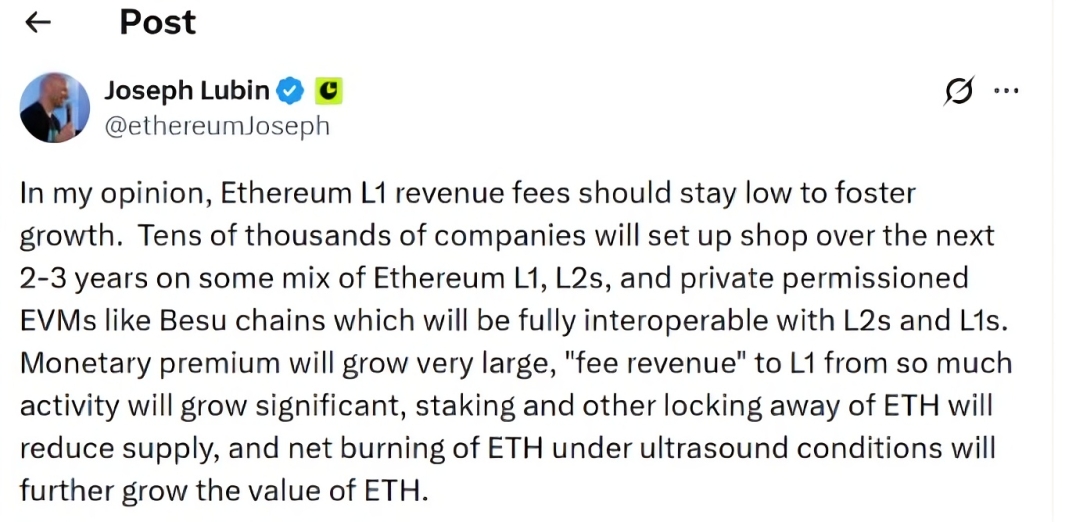
Consensys founder Joseph Lubin on Ethereum’s Low share in Robinhood Chain’s rveneue |
Source: XPostHowever, the opposing view focuses on monetization.
There are few who aruge that if application-specific Layer-2s continue retaining nearly all transaction revenue, Ethereum would collect only a fraction through blob fees and settlement. In this way, the base layer may struggle to translate ecosystem growth into protocol revenue. This is something that formation of new Ethereum organizations liek ETH Ventures are targeting at.
About the author
Inside Robinhood Chain’s Revenue Model: What’s in It for Ethereum and Arbitrum? originally appeared on CoinGape