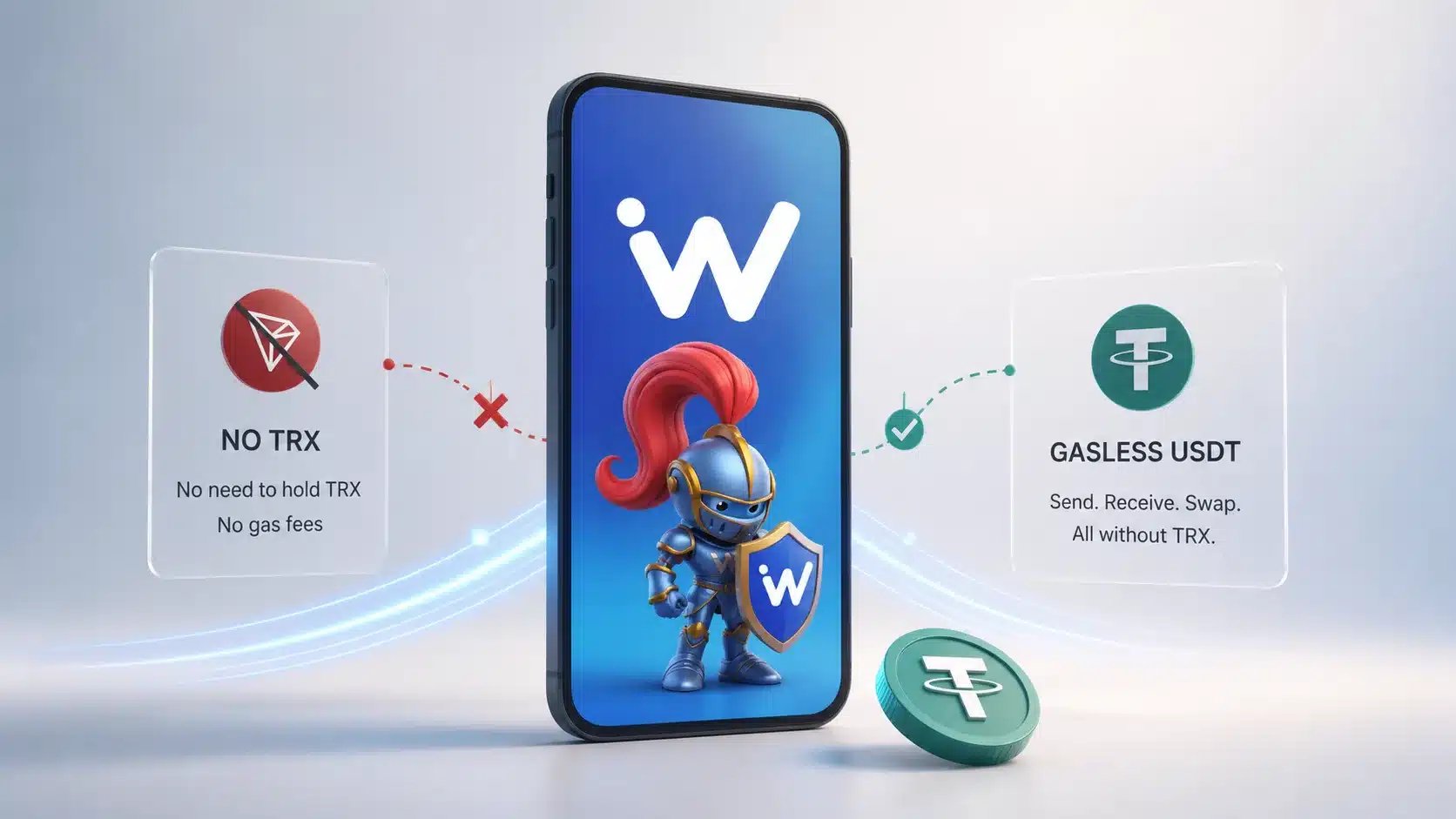
A wallet holding 500 USDT and zero TRX is a locked box. The money is visible, the balance is real, and none of it can move because Tron wants its fee in TRX, and there is no TRX to give. Esca
A wallet holding 500 USDT and zero TRX is a locked box. The money is visible, the balance is real, and none of it can move because Tron wants its fee in TRX, and there is no TRX to give. Escaping that means buying a few dollars of TRX from an exchange that wants your passport first.
That trap has a fix, and the fix is less exotic than the word gasless suggests. IronWallet takes the network fee out of the stablecoin you are already sending, so the second token never has to exist.
What follows is how a gasless USDT wallet manages that, where the mechanism stops, and why it covers some networks and not others.
The Locked Box Nobody Warns Newcomers About
Buy USDT, move it to self-custody, and the wallet looks healthy. One balance, one number, nothing missing. Then comes the first transfer. The network charges its fee in its own coin, so TRC-20 USDT needs TRX, and ERC-20 USDC needs ETH, and a wallet holding only the stablecoin has nothing to pay with.
The result is stuck USDT no TRX, a permanent state until you go and acquire the native token from somewhere. For anyone who bought stablecoins precisely to avoid holding volatile crypto, being forced to buy a volatile token to move them is an unwelcome surprise.
Gasless Means Abstracted, Not Free
Start with the honest part, because the marketing usually skips it. The network always gets paid. Tron validators do not process transfers out of goodwill, and no wallet has repealed that.
What changes is where the payment comes from. Instead of demanding a separate TRX balance, you must source it yourself; the fee is taken out of the stablecoin you are already moving. Send 100 USDT, and slightly less than 100 arrives, with the difference covering the network.
That distinction matters for judging any wallet making this claim. Understanding how gasless transfers work means asking who supplies the native token and when, not whether the network stopped charging.
A wallet promising free transfers with no explanation of that step is describing something it has not built.
Direct Deduction, Step by Step
IronWallet is a non-custodial multi-chain crypto wallet with no KYC, 10,000+ supported assets, gasless stablecoin transfers, and WalletConnect Pay integration. Its approach to fees is direct deduction, and the sequence is short.
- You hold only the stablecoin. No TRX, no ETH, nothing set aside for gas.
- You send USDT or USDC as normal. The wallet does not stop asking for a native balance.
- The fee comes out of the amount you sent. It is deducted from that same stablecoin, in the same transaction.
- The network gets its native token. That settlement happens behind the interface, which is why you never touch it.
The point of the design is that step four is invisible. Anyone who wants to pay gas fees in USDT cares about steps one through three, and the wallet absorbs the rest.
Where It Works and Where It Stops
The scope is where gasless claims usually get vague, so here is the exact coverage.
NetworkToken standardGaslessNamed assetsEthereumERC-20YesUSDT, USDCTronTRC-20YesUSDT, USDCBitcoinNativeNoStandard fees applySolanaSPLNoStandard fees applyBNB ChainBEP-20NoStandard fees applyPolygonERC-20 equivalentNoStandard fees applyBaseERC-20 equivalentNoStandard fees apply
Two networks carry it. The gasless ERC-20 transfers cover Ethereum, and a TRC-20 gasless transfer covers Tron, with USDT and USDC named on both. Everything else in the wallet follows ordinary fee rules, which means Bitcoin needs BTC and Solana needs SOL exactly as they always did.
That narrowness is worth stating plainly. IronWallet gasless is a feature with edges, not a blanket promise, and the two networks it covers happen to be where the overwhelming majority of stablecoin volume already lives.
What Changes Once the Native Token Disappears
The obvious gain is not being stranded. Less obvious is what stops being necessary.
Reallocating assets no longer routes through an exchange. Someone moving USDT between their own addresses, or into a DeFi position, previously had to buy gas first, which meant a centralised venue, an account, and identity verification for a transfer that had nothing to do with any of that.
A wallet that pays gas in stablecoin removes that detour. For cross-chain and DeFi users, the saving is procedural, not financial: fewer steps, fewer accounts, less friction between deciding to move funds and moving them.
Limits, Stated Plainly
A feature explained without its boundaries is an advertisement. These are the boundaries.
- The fee still exists. Your stablecoin balance drops by slightly more than you sent, because the network was paid from it.
- Two networks only. Ethereum and Tron. The other five in the wallet use standard fees.
- Named assets are USDT and USDC. Broader ERC-20 and TRC-20 support exists, though those two are what the documentation names.
- It does not make you anonymous. The transfer is as public as any other on-chain movement.
- It is not a substitute for the on-ramp. Buying the stablecoin in the first place still happens wherever you buy it.
Conclusion
The trick to sending USDT without TRX turns out to be no trick at all. Somebody pays the network; the fee comes out of the stablecoin instead of a token you had to go and find, and the annoying step in the middle disappears.
IronWallet applies that on two networks, Ethereum and Tron, for the two stablecoins most people actually hold. Everywhere else in the wallet, ordinary fee rules apply, and the honest version of the feature says so. That is a small change to how a fee is collected, and a large change to what holding stablecoins feels like. The locked box opens with the key already inside it.
FAQ
Does gasless mean the transfer costs nothing?
No. The network fee is still charged; it just comes out of the stablecoin you are sending instead of a separate TRX or ETH balance. Send 100 USDT, and slightly less arrives, with the difference covering the network. The saving is not the fee itself; it is never having to acquire a second token to pay it.
Why does this only work on Ethereum and Tron?
Those two networks carry the overwhelming majority of stablecoin transfer volume, and the feature covers ERC-20 tokens on Ethereum and TRC-20 tokens on Tron. Other chains in the wallet follow standard rules, so Bitcoin still needs BTC, and Solana still needs SOL. The coverage is a product decision, not a technical limit of every blockchain.
Can I use gasless transfers for any token?
USDT and USDC are the assets named for gasless treatment on both networks. Broader ERC-20 and TRC-20 support exists, but the two named stablecoins are what the coverage explicitly addresses. Anything outside those standards, on any of the other five networks, follows ordinary fee rules.
What happens if the fee is larger than my balance?
The transfer will not complete because the fee has to come from somewhere, and the stablecoin is the only source. Sending your entire balance to the last decimal leaves nothing to deduct from. Leaving a small margin above the amount you intend to send avoids the problem entirely.
Is a gasless wallet safer than a normal one?
Not inherently. Gasless describes fee handling, not security. What it does remove is one trip to an exchange, which means one fewer account holding your identity and one fewer place for that data to leak. That is a privacy gain, not a security one, and the wallet’s custody model matters far more either way.
Disclaimer: This article is provided for informational purposes only. It is not offered or intended to be used as legal, tax, investment, financial, or other advice.
Disclaimer: This content is a sponsored post and is intended for informational purposes only. It was not written by 36crypto, does not reflect the views of 36crypto and is not a financial advice. Please do your research before engaging with the products.
The post Inside the Gasless USDT Wallet: How IronWallet Removes TRX appeared first on 36Crypto.