Institutional investors bought $4.1 billion of U.S. equities in the week ending Sept. 18, even as retail investors continued heading in the opposite direction. The purchases marked institutio
Institutional investors bought $4.1 billion of U.S. equities in the week ending Sept. 18, even as retail investors continued heading in the opposite direction.
The purchases marked institutions’ third buying week in the past four, lifting their four-week average to $2.9 billion, according to Bank of America data cited by The Kobeissi Letter.
Hedge funds bought another $1.2 billion, while retail investors sold $2.2 billion, their eighth consecutive week of selling.
Related: Roundtable 100 analyst reveals Circle’s surprising jump despite beaten-down stock
The split suggests large investors are not embracing risk indiscriminately. Small caps have been hit particularly hard: the Russell 2000 ETF recorded $3.3 billion of outflows, its third-largest weekly withdrawal in nine years.
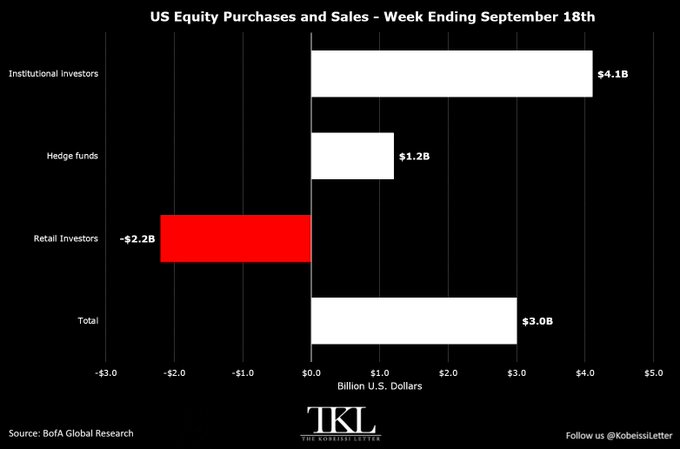
Image shared by The Kobeissi Letter on
X
Higher interest rates and Treasury yields can weigh more heavily on smaller companies, which generally have less access to cheap financing than large, cash-generating businesses.
Instead, institutional capital appears to be concentrating in larger, higher-quality assets viewed as better positioned to withstand expensive financing and still grow earnings.
Bitcoin ETFs suggest selective risk appetite is spreading
A similar pattern has appeared in Bitcoin, where investors continued allocating money through U.S. spot exchange-traded funds even as the cryptocurrency remained volatile.
Bitcoin briefly traded above $87,000 the following week before pulling back, yet U.S. spot Bitcoin ETFs recorded inflows across five consecutive sessions.
Popular on TheStreet Roundtable:
Combined weekly inflows reached about $2.39 billion, their strongest showing in roughly a year, according to SoSoValue.
The funds finished Sept. 25 with another $134.5 million in net inflows, taking cumulative net inflows to about $57.55 billion and total assets to $108.42 billion.
Bloomberg ETF analyst James Seyffart called the products a “smashing success,”noting that Bitcoin ETFs had attracted about $64 billion from launch through their October 2025 peak and were recently only around $6 billion short of returning to that record.
Bitcoin is generally treated as a higher-volatility risk asset, meaning its price can benefit when liquidity improves and investors become more willing to accept risk. But the equity data suggests this is not a broad return to speculation.
Institutions are favoring large-cap equities while small caps struggle, and Bitcoin ETF demand points to capital also reaching assets investors believe can offer strong long-term upside despite elevated rates.
Source: Decible
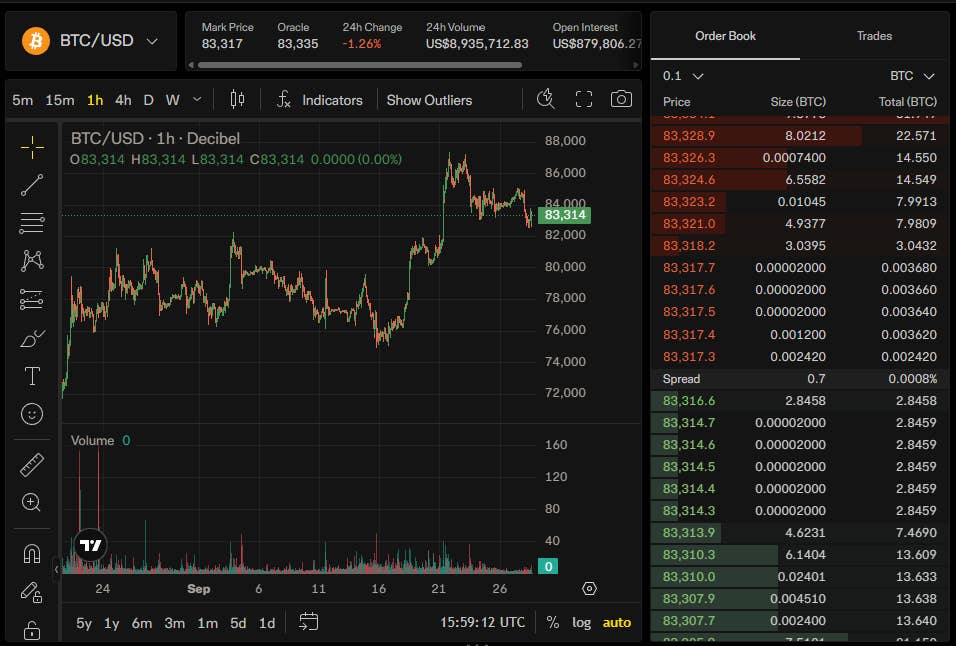
At press time, Bitcoin was trading near $83,314, down about 1.25% on the day, according to Decible data.
Related: Top buyer of U.S. debt caught up in Iran sanctions case