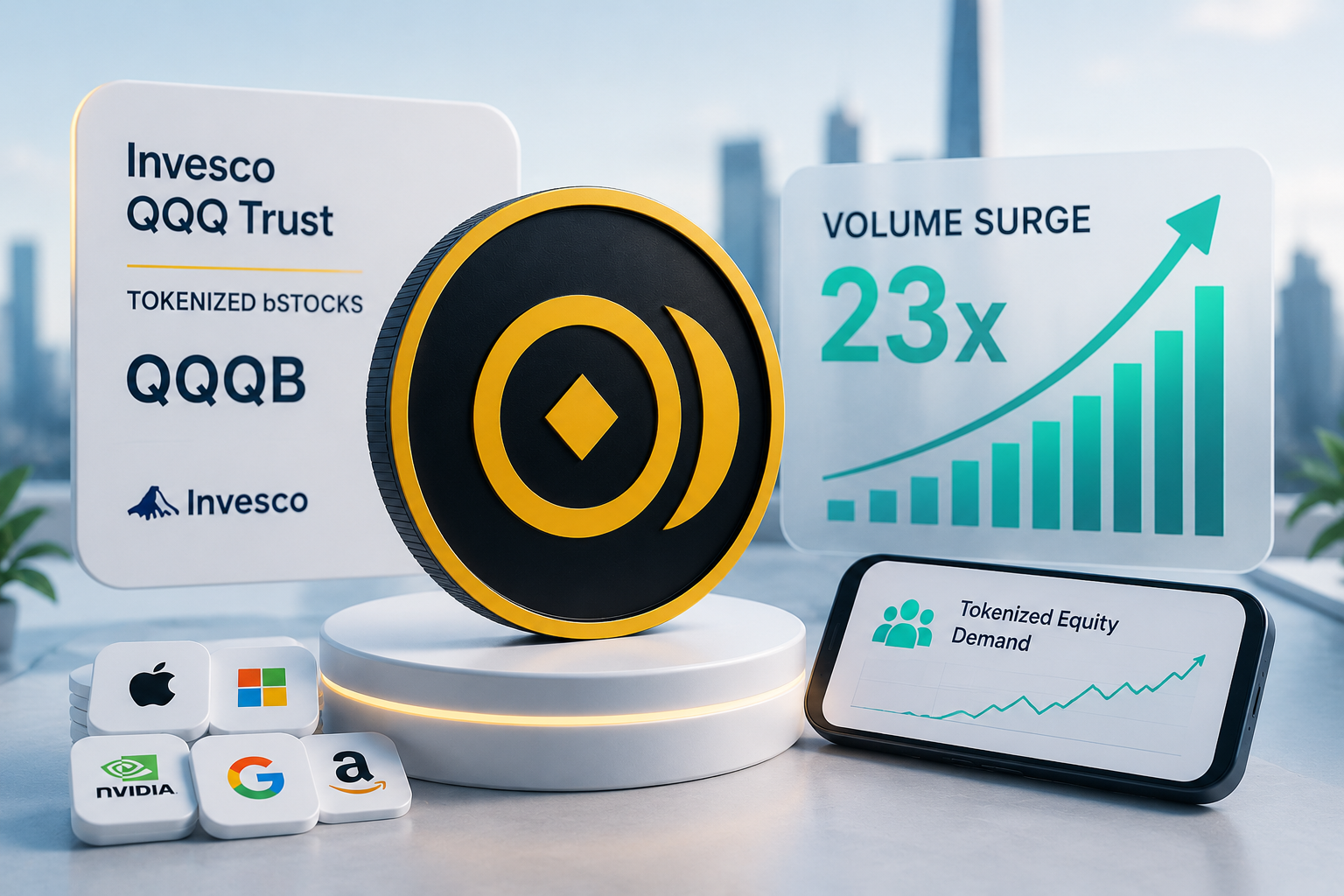
Tokenized stocks have had a defining moment in mid-2026, and QQQB — the tokenized version of the Invesco QQQ Trust available through Binance's bStocks platform — is sitting at the center of i
Tokenized stocks have had a defining moment in mid-2026, and QQQB — the tokenized version of the Invesco QQQ Trust available through Binance's bStocks platform — is sitting at the center of it. Binance expanded its bStocks offering on June 30, adding the Invesco QQQ Trust alongside Microsoft, Meta, Palantir, and Lumentum — all trading as 1:1 tokenized securities against USDT pairs. The bStocks platform, launched on June 11, 2026, surpassed $100 million in assets under management just 15 days after launch, with $458 million in cumulative trading volume and nearly half of all trading occurring outside standard US market hours.
QQQB is currently trading around $724, closely tracking the underlying QQQ ETF price with a market cap of approximately $1.35 million across roughly 1,900 tokens in circulation — a small float that reflects the product's early stage rather than lack of demand.
The 23x Volume Surge That Caught the Market's Attention
The headline number from the past three weeks is a 23x increase in DEX trading volume for bStocks broadly — an extraordinary figure that stands in contrast to the broader tokenized stock category, which has been largely flat over the same period. QQQ has been the single largest driver of that volume, accounting for 38% of bStocks trading activity — more than NVDA at 14% and TSLA at 11% combined.
What's particularly notable is who's driving the volume. Unlike Ondo Finance, where 49% of trading volume comes from transactions above $50,000, bStocks is overwhelmingly retail-driven: 77% of transaction frequency comes from trades under $100, and 92% of cumulative volume sits below $10,000 per transaction. Trading activity spans both Asian and US session time zones, and — critically — remains active even when traditional stock markets are closed.
That last point captures the structural appeal of QQQB for international retail investors. Access to one of the most widely tracked US index ETFs, available to trade at 3am on a Sunday, with no brokerage account, no settlement delays, and no geographic restriction beyond the regulatory carveout for US persons.
How bStocks Actually Works
Each bStock is backed 1:1 by underlying shares held by BTech Holdings Limited under regulated custodial arrangements, providing exposure to price movements, dividends, and corporate actions of the underlying stock, though holders do not possess direct ownership of the shares.
The tokens are structured as certificates representing financial instruments approved under the Abu Dhabi Global Market framework — a regulatory structure that gives the product compliance credibility while keeping it accessible to non-US global investors. Eligible non-US users can integrate bStocks into DeFi protocols or self-custody them via Trust Wallet.
That DeFi integration capability is where QQQB's longer-term utility case becomes interesting. A tokenized QQQ position that can serve as collateral in a lending protocol or be deployed in a yield strategy is a fundamentally different instrument than a traditional ETF share sitting in a brokerage account.
The Competitive Pressure Arriving From All Sides
Robinhood announced on July 1 at a London event its own tokenized stock offering — Stock Tokens allowing eligible users in more than 120 countries to trade tokenized US stocks around the clock through decentralized exchanges, with the ability to deploy tokenized shares into lending pools or use them as collateral across DeFi protocols.
That announcement puts Binance's bStocks program in direct competition with one of the most recognizable retail financial brands in the world — and signals that the tokenized equity category is transitioning from experimental infrastructure into a product category that major platforms are willing to commit engineering and distribution resources toward.
For QQQB specifically, the competitive dynamic actually expands the market more than it threatens Binance's position. Every new tokenized equity platform that launches validates the category and attracts users who then discover that bStocks already exists with $100 million in AUM and established liquidity.
The question for the next few months is whether volume holds or normalizes after the initial excitement of the SpaceX IPO narrative fades. QQQB's 38% share of bStocks trading volume suggests the market is rotating from pre-IPO speculation into index and mega-cap exposure — a more durable demand profile than IPO-driven attention.