Aerodrome Finance trades at around $0.63 on 4 November 2026. That puts AERO 47.3 per cent below its 12-month high of $1.19, set on 11 November 2025, and 124 per cent above its 12-month low of
Aerodrome Finance trades at around $0.63 on 4 November 2026. That puts AERO 47.3 per cent below its 12-month high of $1.19, set on 11 November 2025, and 124 per cent above its 12-month low of $0.28, reached on 12 February 2026. Over 30 days the token has lost 26 per cent; over 90 days it is still up 51 per cent. Is Aerodrome Finance a good buy at current prices, or would you be stepping into a correction that has further to run?
cryptoticker.io compiled the price data itself on 4 November 2026 from the daily closing prices published by CoinMarketCap, and calculated the moving averages and the RSI from that series. For a longer-term view with scenarios into next year, see our Aerodrome Finance price prediction.
Aerodrome Finance price analysis: where AERO stands now
At $0.63, the price sits just above the 200-day moving average, which we calculate as an exponential average of $0.586. The gap is a little under 7 per cent. The 50-day moving average, at $0.717, is about 14.5 per cent above the current price. AERO is therefore wedged between the two lines that analysts most often use as trend filters.
Three levels follow from this. The first support is the zone around the 200-day average at $0.59. Below that lies the September low: on 3 September 2026 AERO closed at $0.46, and from there the price climbed to $0.94 by 12 October, a gain of more than 100 per cent in under six weeks. On the upside, the 50-day average near $0.72 is the first resistance, followed by the October high.
With a market capitalisation of $1.06bn, Aerodrome Finance ranks 60th among crypto assets. That is large enough for reasonable liquidity on the main trading venues, yet small enough for individual market phases to move the price far more sharply than they move Bitcoin or Ethereum.
Has the Aerodrome Finance downtrend been broken or only interrupted?
The broad downtrend began at the 12-month high of $1.19 in November 2025. By the February 2026 low, AERO had lost 76.5 per cent. The price then turned higher and reached $0.94 in October, more than three times the February low. Since that October high Aerodrome has given back about 34 per cent, and over twelve months it is down 30 per cent.
Formally, the broad downtrend is therefore intact: the price is still almost half below the high, and the October peak stayed well short of $1. Within that frame, however, a pattern of rising lows has formed. The February low was $0.28, the early-August low $0.40 and the September low $0.46. As long as AERO holds above $0.46, the decline since October is a correction within a recovery. A daily close below that level would break the pattern, and the downtrend would turn out to have been merely interrupted.
What the RSI and moving averages mean for an Aerodrome entry
The 14-day Relative Strength Index stands at 34.5. A reading of 30 is generally treated as the threshold of oversold territory. AERO has cooled considerably, but it is not yet in the zone where rebounds become statistically more frequent. An RSI at this level suggests selling pressure is easing rather than signalling a buy.
The moving averages paint a mixed picture. The 50-day average of $0.717 is still above the 200-day average of $0.586, so the medium-term trend continues to point upwards. In the short term, though, AERO trades below its 50-day average, which means the correction since October is not over. Two signals matter for an entry: a daily close above $0.72 would end the correction, while several daily closes below $0.586 would open the way towards the September low.
Aerodrome Finance trading volume: what it reveals about demand
Over the past 24 hours AERO changed hands for $52.7mn. Relative to market capitalisation, that is a turnover of about 5 per cent in a single day. Over the past 30 days, daily volume averaged $61.0mn; in the 90 days before that it averaged $52.9mn.
The figures can be read as follows. More was traded during the correction since mid-October than in late summer. Part of that is profit-taking after the strong rally, part is buyers using lower prices. The fact that current daily volume is below the 30-day average suggests that selling pressure is fading. A genuine bottom usually shows only when the price rises again on increasing volume, and that has not happened yet.
Sentiment in the wider market offers little support. CoinMarketCap's Fear and Greed Index stands at 36, in the "fear" range. In such phases smaller assets like AERO tend to fall harder than Bitcoin, although they often recover faster once sentiment turns.
Which structural factors favour Aerodrome Finance
Its role on Base. Aerodrome is a decentralised exchange on Base, the Ethereum layer-2 blockchain operated by Coinbase, and one of the largest trading venues there. Anyone swapping tokens or providing liquidity on Base often ends up at Aerodrome, either directly or via aggregators. The value of the token is therefore closely tied to activity on Base.
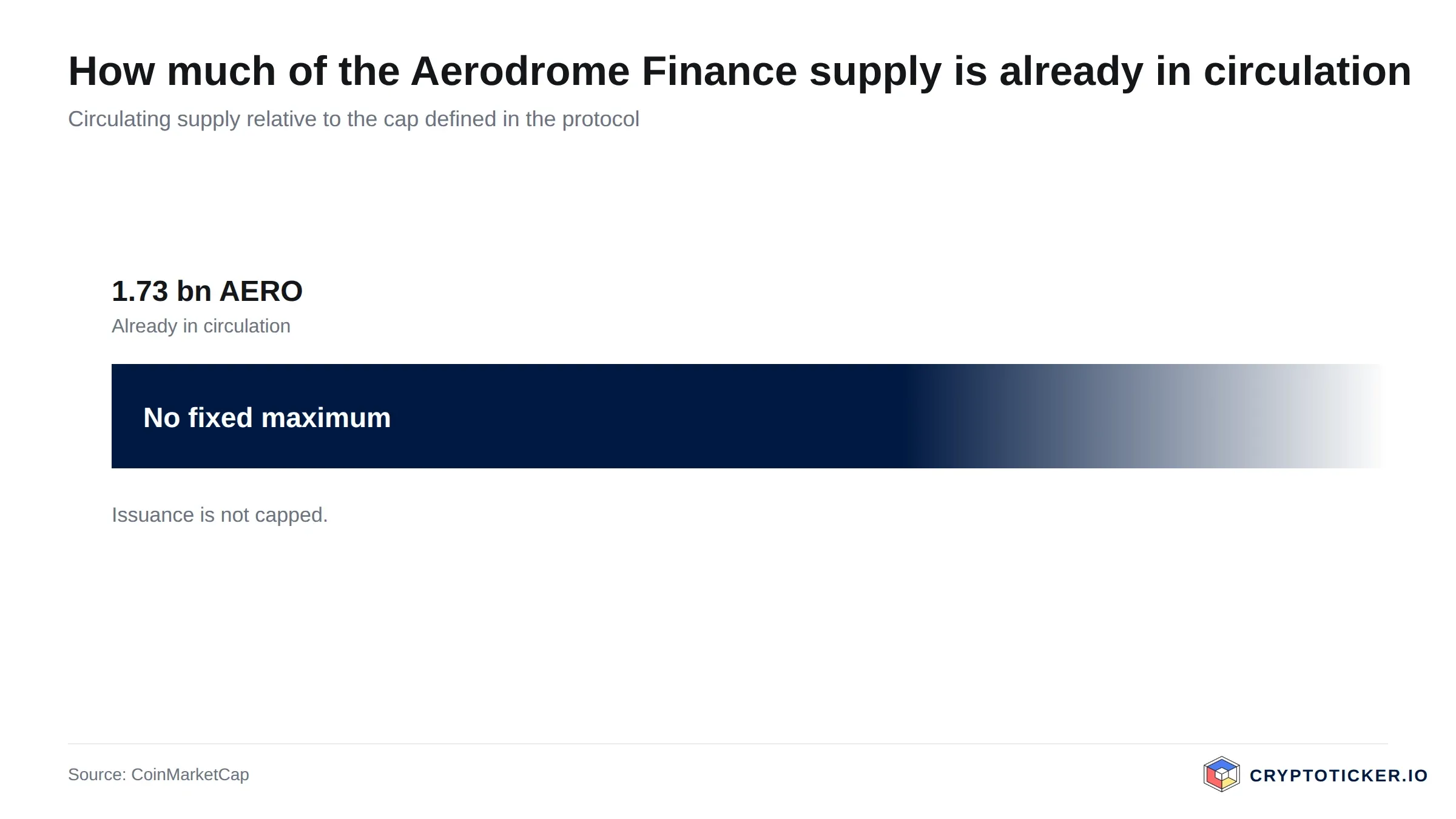
Aerodrome Finance supply structure according to CoinMarketCap data
The token mechanics. AERO follows the so-called ve(3,3) model. Holders who lock AERO for up to four years receive veAERO and with it voting rights. Each week they use those votes to decide which liquidity pools receive newly issued AERO as rewards. In return, the trading fees and additional incentives from those pools flow to the voters, while liquidity providers are paid in AERO. The project explains the details on its website.
The supply. According to CoinMarketCap, about 1.70bn AERO are in circulation, with a total supply of 2.13bn tokens. There is no fixed cap; new tokens are issued continuously as rewards. How much dilution that causes depends on how much AERO is locked as veAERO at the same time.
Regulation. The EU's Markets in Crypto-Assets Regulation, MiCA, has applied in full since the end of 2024. It targets providers of crypto services such as exchanges and custodians, not a decentralised protocol itself. For buyers in Europe this means that if you buy AERO on a licensed platform, that platform's obligations apply. The European Securities and Markets Authority, ESMA, lists licensed providers in its register.
Three reasons to buy Aerodrome Finance at current prices
First, the position at the 200-day average. At $0.63, AERO trades less than 7 per cent above its 200-day average of $0.586. Buying near this level lets you define your risk tightly, because a break would become visible quickly. The RSI of 34.5 also shows that much of the selling pressure has already been absorbed.
Second, the rising lows. From the February low of $0.28 to the September low of $0.46, the floor has risen by about two-thirds. Over 90 days AERO is still up 51 per cent, and the correction since October has not yet damaged that structure.
Third, the fee-driven model. At Aerodrome, trading fees go to veAERO holders. If trading on Base grows, so do the returns on locked tokens. That gives AERO an economic link to actual usage that many other tokens lack.
Three reasons against buying Aerodrome Finance at current prices
First, the short-term downtrend. AERO has lost about 34 per cent since its October high of $0.94, almost 10 per cent of that in the past seven days. The price is below the 50-day average of $0.717. If the zone around $0.586 gives way, the next clear support is the September low of $0.46, roughly 26 per cent lower.
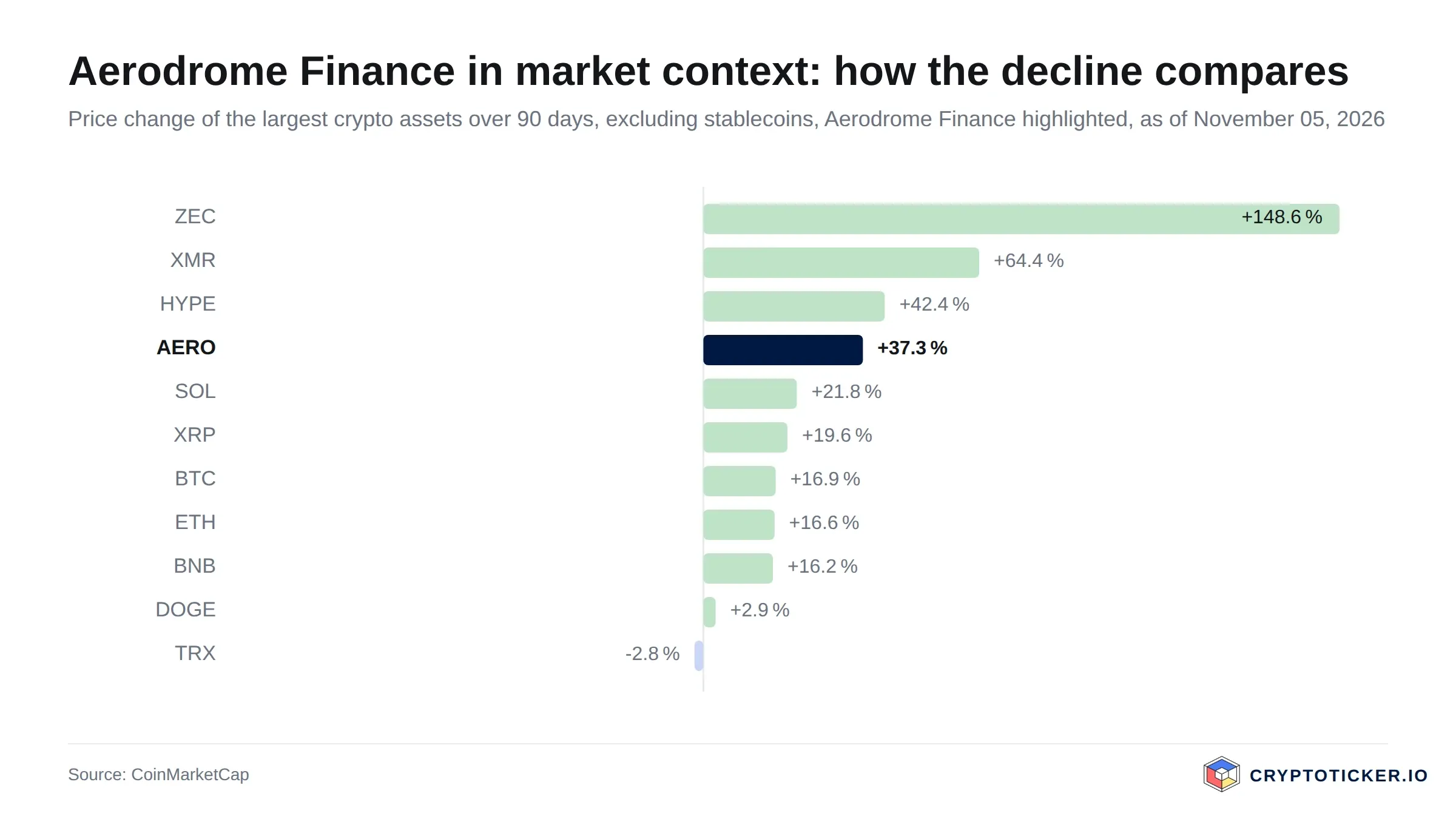
Aerodrome Finance compared with the other large crypto assets over 90 days
Second, ongoing dilution. AERO has no supply cap. Every week new tokens are added as rewards for liquidity providers, and many recipients sell them, which keeps a steady supply flowing into the market. Demand has to absorb that pressure before the price can rise sustainably.
Third, dependence on a single blockchain. Aerodrome's business stands or falls with Base. If trading migrates to other layer-2 networks or to rival exchanges within Base, fees fall and with them the incentive to lock AERO. On top of that comes the cautious mood in the wider market, with a Fear and Greed reading of 36, which has traditionally hit smaller tokens hardest.
How to buy Aerodrome Finance at current prices
There are two routes. The simpler one runs through a centralised crypto exchange that lists AERO; the provider's coin list shows whether the token is available. Our crypto exchange comparison sets out fees, spreads and listings side by side. If a MiCA licence matters to you, the comparison of regulated crypto exchanges shows suitable platforms, and our Kraken reviews describe how one large exchange performs in day-to-day use.
The second route goes directly on-chain: you buy ether on an exchange, send it to your own wallet on the Base network and swap it for AERO on Aerodrome. Network fees on Base are usually low, but you carry full responsibility for addresses, keys and token approvals. If you lock AERO as veAERO, your capital is tied up for the chosen period of up to four years.
For larger amounts, a hardware wallet that supports Ethereum and Base is the safer form of custody. Our hardware wallet comparison shows which devices qualify. Whichever route you take, add up the full cost: trading fee, spread, withdrawal fee and, where relevant, network fees.
Is Aerodrome Finance a good buy at current prices, then?
In the short term the decision lies between $0.586 and $0.72. If the 200-day average holds and AERO reclaims its 50-day average on a daily close, the correction since October would be over, and the October high of $0.94 would come back into view. If instead the price closes several days below $0.586, a return to the September low of $0.46 becomes the more likely scenario. Should that level fail too, the case for a recovery with rising lows is refuted.
In the long term the answer depends less on the chart than on Base. If trading on the layer-2 blockchain keeps growing and Aerodrome remains a central venue there, fees for veAERO holders can offset the continuous issuance of new tokens. If Aerodrome loses market share or volume shrinks for months, dilution will dominate. The long-term case is refuted if trading volume falls durably below its late-summer level while the price stays below $0.46. This is an assessment in scenarios, not a recommendation to buy.
Buying Aerodrome Finance: The key points for your decision
- Keep the three levels in view: $0.586 as the 200-day average, $0.72 as the 50-day average and $0.46 as the September low. The longer-term scenarios are in our Aerodrome Finance price prediction.
- Before buying, check which exchange lists AERO and what trading there costs. The exchange comparison puts fees and listings side by side.
- Settle custody before you buy, especially if you plan to hold AERO directly on Base. Suitable devices are in the hardware wallet comparison.
Disclosure: Some of the providers mentioned in this article work with us through affiliate programmes. This has no influence on the price analysis or the assessment of the chart; the price data come from a public market data source and can be verified there.
(As of 4 November 2026. This article is not investment advice. Prices, fees and terms change; check them with the provider before every purchase. Crypto assets are subject to high price volatility, and a total loss is possible.)