Curve DAO is trading at around $0.176 per CRV on Wednesday morning, 25 November. That leaves the token roughly 60 percent below its twelve-month high of $0.441, the daily close of 27 November
Curve DAO is trading at around $0.176 per CRV on Wednesday morning, 25 November. That leaves the token roughly 60 percent below its twelve-month high of $0.441, the daily close of 27 November 2025, and about 1.5 percent below its twelve-month low of $0.179, the daily close of Sunday, 22 November. Within 30 days the governance token of the decentralised exchange Curve has lost almost half of its value. Is Curve DAO a good buy at current prices, or is the sell-off still in full swing?
cryptoticker.io evaluated the price data for this analysis itself on 25 November 2026, based on the daily closing prices published by CoinMarketCap. Moving averages, RSI and the distances to the high and low are our own calculations from that series.
Curve DAO price analysis: where the CRV price stands now
At $0.176, the price sits roughly 39 percent below the 200-day moving average, which runs at $0.289. The 50-day moving average stands at $0.269, about 35 percent above the current price. Both lines are close together and form a broad band between $0.27 and $0.29. That band is the first major hurdle for any recovery, and it is a long way off.
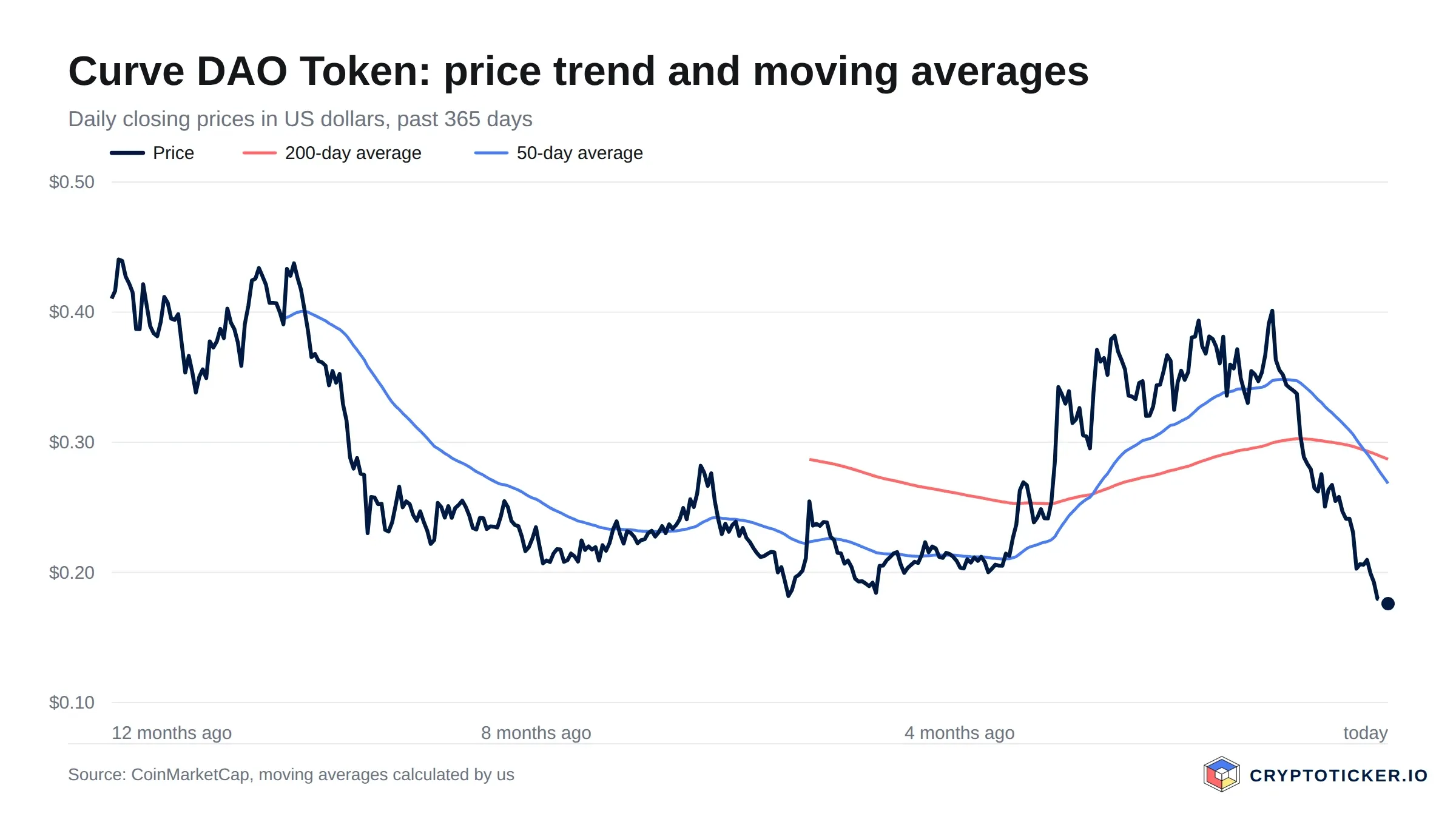
Curve DAO Token price and moving averages, calculated by us from CoinMarketCap daily closing prices
On the downside, the picture is delicate. The zone around $0.18 has already supported CRV twice this year: on 6 June 2026 the price turned higher at $0.182, and on 1 July 2026 at $0.184. The second floor launched the summer rally that carried the token to $0.401 by 22 October. Since last weekend this double floor has been undercut. The daily close of $0.179 on Sunday was the lowest in twelve months, and on Wednesday morning the price is trading slightly below even that. If the zone is not reclaimed on a weekly basis, there is no other level in the twelve-month window where buyers have previously stepped in.
The current zone between $0.175 and $0.185 is therefore the acid test. Above it lies an intermediate level at around $0.205, where the price moved sideways for several days in mid-November before taking the next step down.
Is the Curve DAO downtrend broken or merely interrupted?
There is no sign of a broken downtrend. Since the high of 22 October, CRV has fallen almost without a counter-move: $0.289 at the end of October was followed by $0.247 on 11 November, $0.203 on 15 November and finally the new yearly low. Each interim high was lower than the one before, a textbook pattern of lower highs and lower lows.
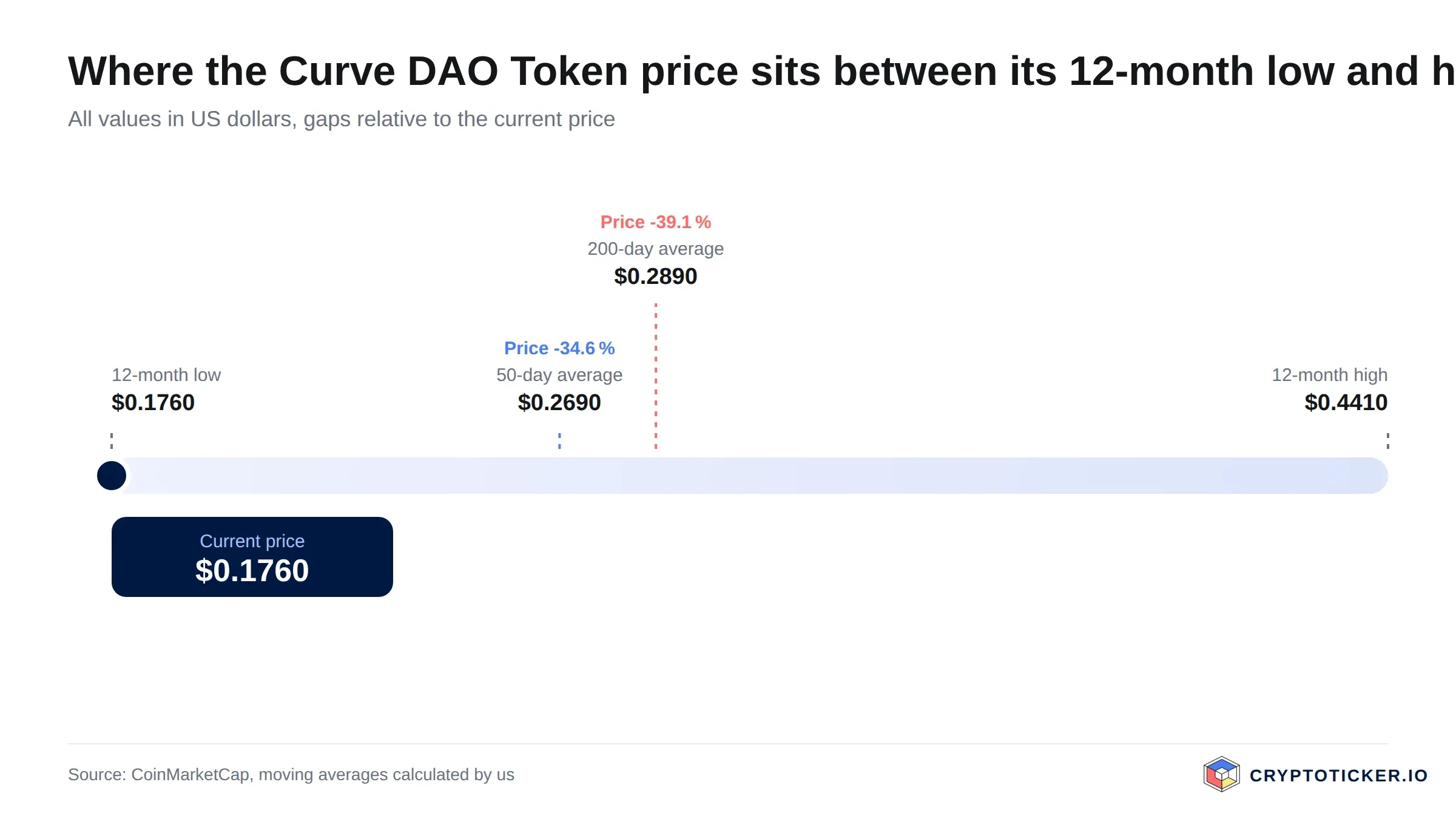
The Curve DAO Token price relative to its 12-month low, high and both moving averages
Over 90 days the token is down around 45 percent, over twelve months around 57 percent. The summer rally was therefore only an interruption of a longer downtrend that began in January 2026 at $0.438. A first signal of a turnaround would be a daily close above $0.205; a more reliable one would only come with a return above the 50-day moving average. Until then, any recovery should be read as a counter-move within the downtrend.
What the RSI and moving averages mean for a CRV entry
The 14-day Relative Strength Index stands at around 22 points, well below the threshold of 30 at which an asset is considered oversold. Readings like this often precede a short technical rebound because sellers become exhausted. On their own they are not a buy signal: in strong downtrends the RSI can stay in oversold territory for weeks while the price keeps sliding.
The moving averages paint a clear picture. The 50-day line has crossed the 200-day line from above, which chart analysts call a death cross. Both lines are falling. For an entry this means that anyone buying now is buying against the trend and betting on a bottom that the chart has not yet confirmed. At the same time, a gap of around 39 percent to the 200-day line is historically wide, which limits the downside potential but does not rule it out.
What CRV trading volume reveals about demand
Trading volume over 24 hours stood at around $25 million on Wednesday morning. That is below the 30-day average of around $34 million and well below the 90-day average of around $54 million. Interest in the token has clearly faded since the autumn rally.
The days with the heaviest losses stand out. On 15 November, when CRV dropped below $0.21, volume rose to around $45 million, and on 22 November, the day of the new yearly low, to around $47 million. Higher volume on down days points to genuine selling pressure rather than mere thinning of trade. The only small bright spot: the slight gain on Monday came on noticeably lower volume, so there was no fresh wave of selling that day either. Whether demand returns will only become clear in the coming days.
The environment is no help. The CoinMarketCap Fear and Greed Index stands at 8 points, deep in extreme fear territory. In such phases, smaller assets like CRV, with a market capitalisation of around $279 million and rank 97, are usually hit harder than Bitcoin or Ether.
Which structural factors speak for Curve DAO
Curve is one of the oldest decentralised exchanges in the DeFi sector and specialises in swapping assets of similar value, meaning stablecoins and closely related tokens such as different versions of Ether. At its core is the StableSwap algorithm, which allows very small price deviations for such pairs. How it works is set out in the technical documentation of Curve.
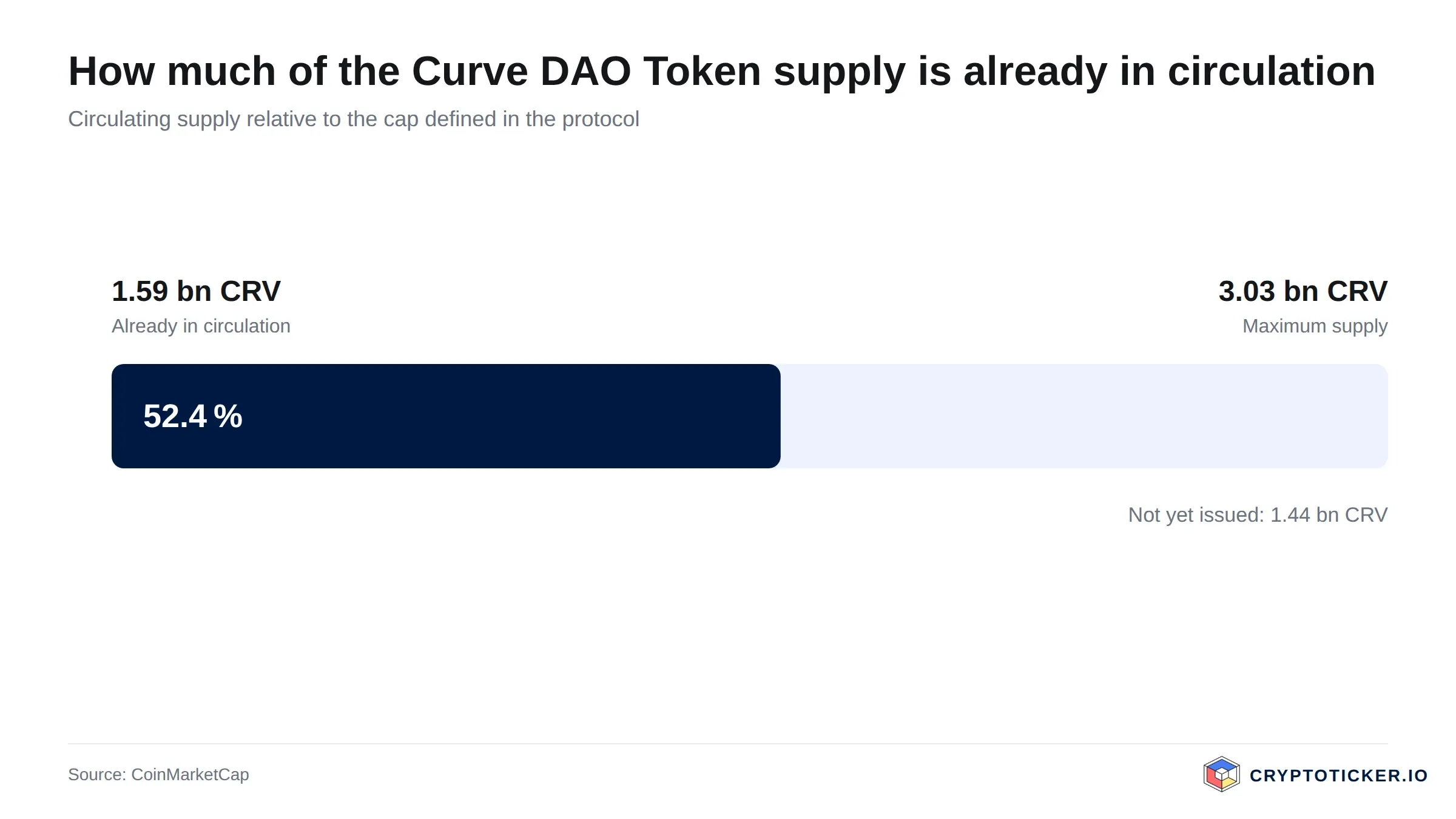
Curve DAO Token supply structure according to CoinMarketCap data
The CRV token governs this system. Anyone who locks CRV for up to four years receives veCRV and with it voting rights over how new tokens are distributed across the individual liquidity pools, plus a share of the trading fees. This mechanism has made Curve a centre of power in DeFi for years, because other protocols compete for those votes. Locked tokens are also unavailable to the market, which reduces the freely tradable supply.
On supply mechanics: around 1.59 billion CRV are in circulation, against a cap of 3.03 billion. About 52 percent of the maximum supply has therefore been issued. New tokens are created according to a fixed schedule whose annual issuance rate falls by around 16 percent every year. Inflation is declining, but it remains noticeable.
Usage is also expanding beyond Ethereum. With its own stablecoin crvUSD and the lending market Llamalend, Curve has broadened its offering, and at the end of October the protocol launched StableSwap natively on Stellar, its first own deployment outside the EVM world. On the regulatory side, the European MiCA regulation, on which the ESMA provides information, creates clearer rules for stablecoins, and an exchange built for exactly these tokens could benefit in the medium term. That is an assumption, not a certainty.
What speaks for buying Curve DAO at the current price
- Price at a proven zone: Around $0.18, CRV turned higher twice in June and July 2026. Anyone buying here has a clear level against which the thesis can be tested.
- Deeply oversold: An RSI of around 22, a gap of roughly 39 percent to the 200-day line and a loss of almost half in 30 days are readings after which technical rebounds frequently set in.
- Established protocol with real usage: Curve earns fees, distributes them to locked tokens and is expanding with crvUSD, Llamalend and new blockchains. A valuation of around $279 million is low compared with earlier years.
What speaks against buying Curve DAO at the current price
- Intact downtrend: Lower highs, a death cross and a fresh twelve-month low mean that the market has not yet found a floor. Anyone buying too early may have to sit through further losses.
- Dilution from new tokens: Almost half of the maximum supply has not yet been issued. Ongoing issuance creates persistent selling pressure whenever liquidity providers sell their rewards straight away.
- Technical risks in DeFi: Curve has already seen attacks on individual pools, most prominently the exploit of July 2023. On top of that comes the dependence on stablecoins, whose regulation continues to change.
Ways to buy Curve DAO: costs, custody and providers
CRV is tradable on many major crypto exchanges, including providers that accept euro deposits. For investors in the European Union, a provider licensed under MiCA is the obvious route. Costs include not only trading fees but also the spread between the buy and sell price, which can be wider for smaller assets such as CRV. How established providers differ in fees, range and usability is covered in our reviews of Bitpanda and Kraken.
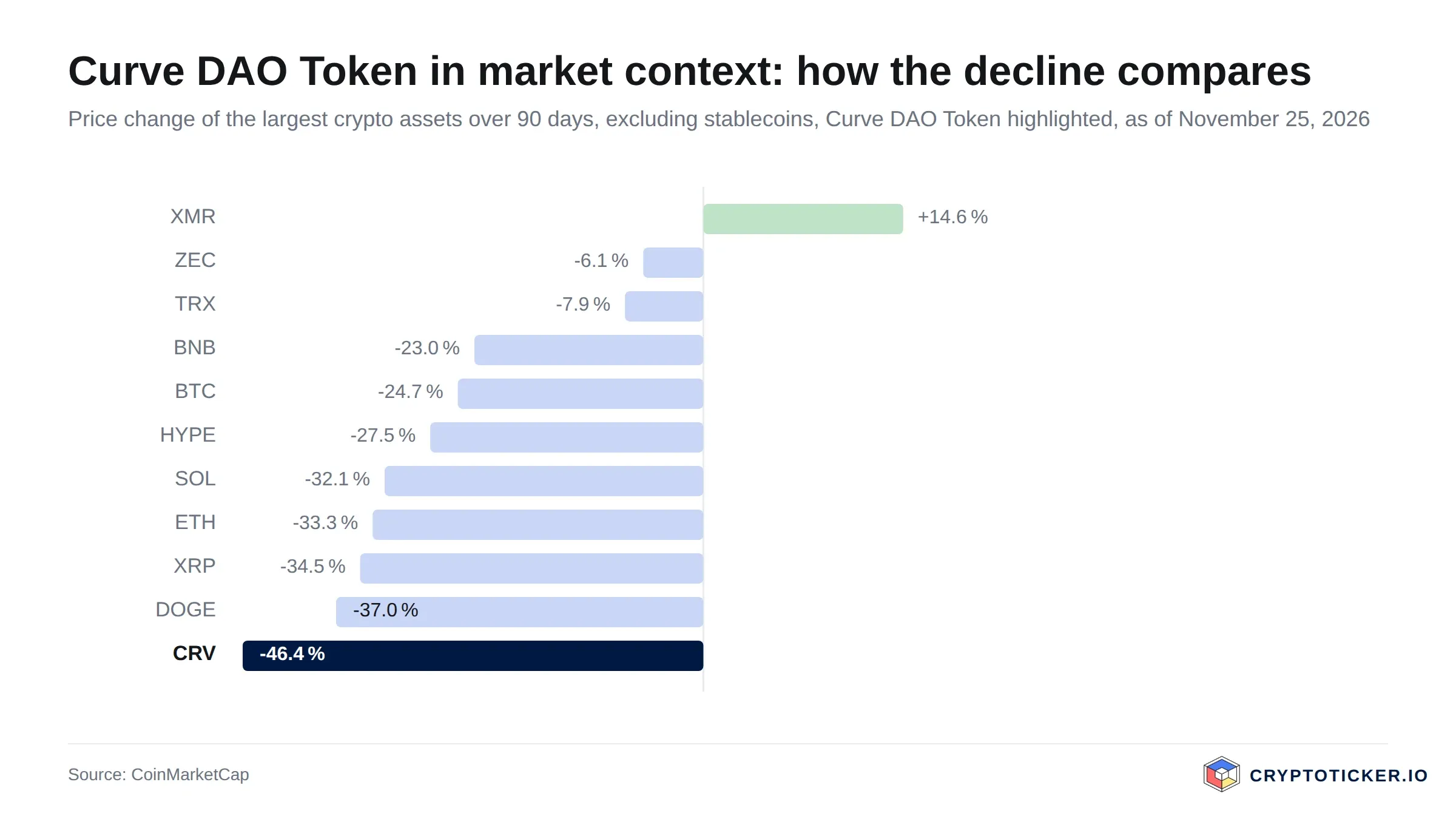
Curve DAO Token compared with the other large crypto assets over 90 days
There are two ways to hold the token. Anyone holding CRV purely as a price position can leave it on the exchange and benefit from simple handling. Anyone who wants to lock it and take part in votes needs their own wallet, because the veCRV lock runs directly through the protocol on Ethereum. Network fees apply, and locked tokens are unavailable until the end of the chosen period. For larger amounts, our hardware wallet comparison is worth a look.
So is Curve DAO a good buy at current prices?
In the short term, the situation cuts both ways. The price is sitting at a zone that held twice this year, and the indicators show a deeply oversold market. A technical rebound towards $0.205 would come as no surprise in this environment. At the same time, the double floor has been undercut, sentiment is in extreme fear and volume on down days points to further selling pressure. A scenario with a drop well below $0.17 is therefore just as plausible. The rebound thesis would be refuted if CRV closes a week below $0.175.
In the long term, the answer depends on whether Curve can defend its role as the central exchange for stablecoins. The valuation is low, the issuance of new tokens declines year after year and the protocol is growing onto new blockchains. Anyone who believes in this scenario could consider building a position gradually in tranches rather than betting everything on a single price. A first sign of a trend reversal would be a return above the 50-day moving average at $0.269. If, on the other hand, the price stays below the 200-day line for months while usage falls, the long-term thesis would be weakened. Possible price targets and scenarios for the coming years can be found in our Curve DAO price prediction.
Buying Curve DAO: Your next three steps
- Set a loss limit before buying, for example a weekly close below $0.175, and weigh the scenarios with our Curve DAO price prediction.
- Buy through a provider with an EU licence; which exchanges meet the MiCA requirements is shown in our comparison of regulated exchanges.
- Put CRV into its DeFi context: how another major protocol token is doing is covered in our analysis Is Aave a Good Buy at Current Prices?
Disclosure: Some of the providers mentioned in this article work with us through affiliate programmes. This has no influence on the price analysis or the assessment of the chart situation; the price data comes from a public market data source and can be verified there.
(As of: 25 November 2026. This article is not investment advice. Prices, fees and terms change; check them with the provider before every purchase. Crypto assets are subject to high price volatility, and a total loss is possible.)