Ethereum Classic trades at about 7.51 dollars, roughly 57.8 percent below its twelve-month high of 17.80 dollars from 8 November 2025. At the same time ETC sits around 23.6 percent above its
Ethereum Classic trades at about 7.51 dollars, roughly 57.8 percent below its twelve-month high of 17.80 dollars from 8 November 2025. At the same time ETC sits around 23.6 percent above its twelve-month low of 6.08 dollars, which it marked on 19 August 2026. That span frames the question this article answers: is Ethereum Classic a good buy at current prices?
CryptoTicker calculated the moving averages, the relative strength index and the twelve-month range shown here itself, from the daily closing prices published by CoinMarketCap. The market capitalisation stands near 1.19 billion dollars, which puts ETC at rank 56 among all crypto assets as of 27 October 2026.
Ethereum Classic price analysis: where ETC stands and which levels matter
The current price of 7.51 dollars places Ethereum Classic between two reference points that have shaped its chart all year. The 200-day exponential moving average runs at 7.80 dollars, the 50-day exponential moving average at 8.30 dollars. ETC trades below both. The 50-day line sits above the 200-day line, which is the remnant of the rally that lifted the coin off its August low, but the gap between the two has been narrowing since late September.
Three zones matter for anyone weighing an entry. The first is the twelve-month low at 6.08 dollars, the floor the market tested in August and has not revisited since. The second is the 200-day mark at 7.80 dollars, barely 4 percent above the current quote. The third is the 50-day mark at 8.30 dollars, about 11 percent higher. Reclaiming 7.80 dollars would be the first technical signal that the autumn slide has stopped; failing to hold the current level opens the path back towards the summer floor.
The short-term picture is quiet rather than dramatic. ETC lost 0.5 percent over the past 24 hours and 3.0 percent over seven days. The damage sits in the monthly window: minus 21.1 percent over 30 days. Over 90 days the coin is still up 12.1 percent, and over twelve months it is down 55.0 percent.
Is the Ethereum Classic downtrend broken or only interrupted?
The honest answer is that it is interrupted, not broken. A broken downtrend needs two things that Ethereum Classic does not currently show: a price above the 200-day average and a sequence of higher lows that holds through a correction. ETC produced the second between August and late September, when it climbed from 6.08 dollars towards the 9-dollar region. It then gave most of that back.
What the August low did establish is a reference the market has respected for more than two months. The 23.6 percent cushion above it is the single most useful number in this analysis, because it quantifies how much room the price has before the question changes from "is this a good entry" to "is the floor gone". Until ETC closes a week above 7.80 dollars, the rally from August reads as a counter-move inside a longer decline that began at 17.80 dollars.
The twelve-month loss of 55.0 percent is worth holding in view. A coin can be cheap relative to its own history and still be in a structural downtrend. Both are true here.
What RSI and moving averages mean for an Ethereum Classic entry
The 14-day relative strength index stands at 36.5. That is in the lower third of the scale without being oversold, which conventionally starts at 30. For a buyer this is an awkward reading. It says selling pressure dominates but has not yet reached the exhaustion point that often precedes a bounce. Entries at an RSI near 30 have historically offered better risk on this coin than entries in the mid-thirties.
The two moving averages tell a more cautious story than the RSI. Price below both lines, with the 50-day line still above the 200-day, describes a market that rallied and is now handing the gains back. If the 50-day average crosses below the 200-day average in the coming weeks, the technical picture turns negative in the way most trend-following models read it. The distance between the two is currently 0.50 dollars, around 6 percent, so that crossing is a matter of weeks rather than months if the price stays where it is.
For holders, that means the chart offers no confirmation yet. Anyone buying at 7.51 dollars is buying before the trend turns, with the risk that the August low gets tested again first.
What Ethereum Classic trading volume reveals about demand
Turnover over the past 24 hours came to about 34.2 million dollars. The 30-day average sits at 46.4 million dollars and the 90-day average at 46.3 million. Current volume therefore runs roughly a quarter below the recent norm.
Thin volume during a decline suggests the drop is driven by an absence of buyers rather than a rush of sellers. The flip side is that a market this quiet rarely produces a sharp recovery on its own.
Relative to its market capitalisation of 1.19 billion dollars, daily turnover of 34.2 million amounts to a little under 3 percent. That is adequate liquidity for retail-sized orders on any major venue and thin enough that larger positions move the price. The wider mood is neutral rather than fearful: the Fear and Greed Index reads 43 on a scale of 100.
Structural factors that speak for Ethereum Classic
Three structural features distinguish ETC from most assets in its size bracket.
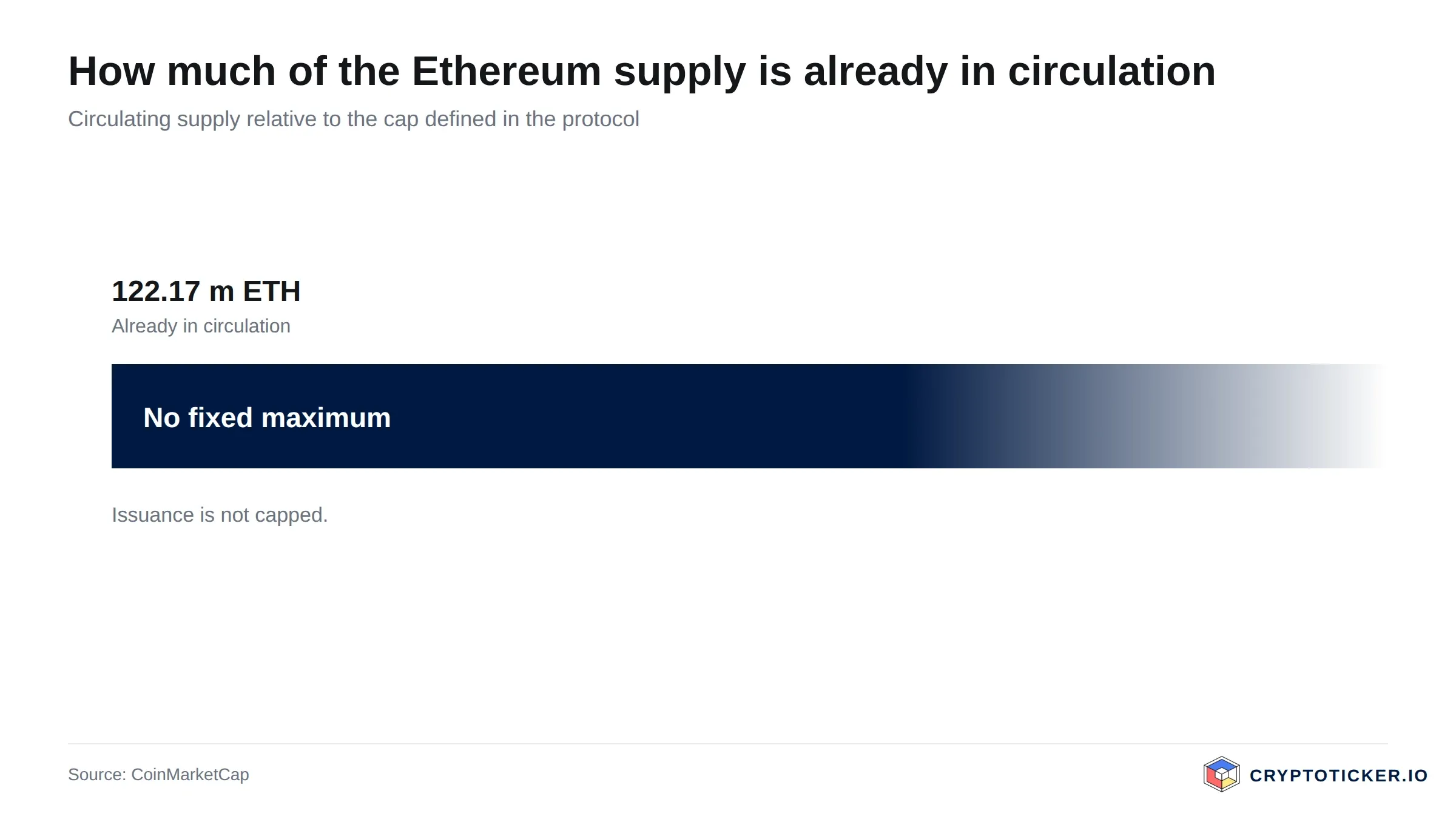
Ethereum supply structure according to CoinMarketCap data
The first is a hard supply cap. Ethereum Classic limits issuance to 210.7 million coins, and 158.83 million are in circulation, about 75 percent of the maximum. Issuance falls by 20 percent every 5 million blocks under the schedule set out in ECIP-1017, the protocol document that fixed the monetary policy. New supply arriving on the market shrinks on a published timetable, which is the opposite of the open-ended issuance most proof-of-stake networks run.
The second is that Ethereum Classic remained a proof-of-work blockchain when Ethereum moved to proof-of-stake in 2022. For miners with written-off equipment and cheap power, ETC is one of the few remaining places to point it. That gives the network a constituency with a direct economic interest in its survival, documented on the project's own site.
The third is compatibility. ETC runs the Ethereum Virtual Machine, so contracts and tooling built for Ethereum work with modest changes. Whether that matters depends on developers choosing to use it, and the activity figures have not supported a strong claim here for some time.
What speaks for buying Ethereum Classic at current prices
The valuation has compressed. At 7.51 dollars ETC trades 57.8 percent below its twelve-month high. An investor buying today pays less than half what a buyer paid in November 2025 for the same share of a network whose code and supply schedule have not changed.
The August floor has held. Since 19 August 2026 the price has stayed above 6.08 dollars through a 21.1 percent monthly decline. A level that survives that kind of pressure is a more useful reference than one drawn on a chart, and it gives a position a defined point at which the thesis fails.
The supply schedule is fixed and public. Unlike networks that can adjust issuance through governance, Ethereum Classic's emission curve is set in protocol. For an investor with a multi-year horizon, knowing the maximum future supply removes one variable from the calculation.
What speaks against buying Ethereum Classic at current prices
The trend is still down. Price sits below both the 50-day and the 200-day average, and the twelve-month loss of 55.0 percent shows ETC has lagged the market consistently, not briefly. Buying here means betting against the prevailing direction.
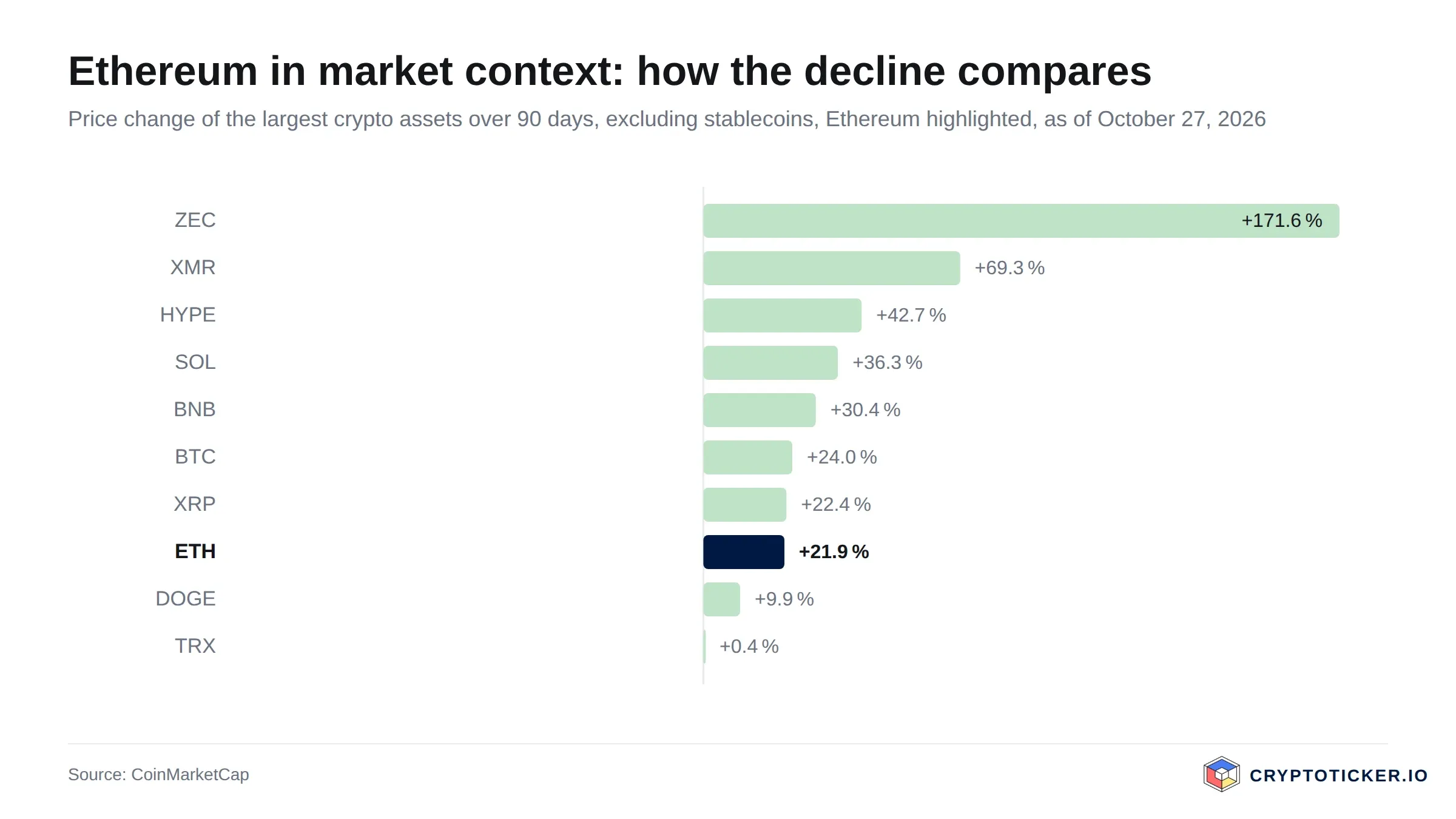
Ethereum compared with the other large crypto assets over 90 days
Demand is weak. Turnover 25 percent below the 30-day average, with an RSI of 36.5 that has not reached oversold, describes a market losing interest rather than one building a base. Quiet markets can stay quiet for a long time.
The investment case rests on continuity rather than growth. The strongest arguments for ETC concern what it has preserved: proof-of-work, a capped supply, an unaltered chain. Those are reasons it should continue to exist. They are not, by themselves, reasons its price should rise, and there is no scheduled event in view that would change the demand picture.
How to buy Ethereum Classic at current prices: costs, custody, providers
ETC is listed on every large exchange, so the decision is about fees, regulation and where the coins end up afterwards.
On fees, the spread usually costs more than the headline commission. Spot trading fees at the large venues sit between 0.1 and 0.5 percent, but a market order in a coin turning over 34.2 million dollars a day can slip further; a limit order avoids most of it. Our crypto exchange comparison sets the current fee structures side by side.
On regulation, European buyers should check whether a venue holds a MiCA authorisation in an EU member state. That determines which rules govern the custody of your coins and what happens if the operator fails. The overview of regulated exchanges lists which providers hold which permissions, and our Kraken review goes through one of the larger venues in detail.
On custody, a position you intend to hold for years does not belong on an exchange. Moving ETC to a hardware wallet removes counterparty risk, at the cost of being responsible for your own backup. The devices and their trade-offs are covered in our hardware wallet comparison. Note that no English-language Ethereum Classic forecast page is currently available on CryptoTicker; the figures in this article are the most recent data we hold.
So is Ethereum Classic a good buy at current prices?
The answer differs by horizon.
Short term, the setup is unattractive. Price below both moving averages, an RSI of 36.5 that is weak without being washed out, and turnover a quarter below average leave no technical trigger to act on. A buyer here needs the 200-day mark at 7.80 dollars to be reclaimed, and nothing in the current data suggests that is imminent. If the 50-day average crosses below the 200-day in the coming weeks, the near-term case weakens further.
Long term, the picture is more balanced. A capped supply of 210.7 million, a fixed emission schedule and a functioning proof-of-work chain give ETC a defined profile at 57.8 percent below its twelve-month high. For an investor measuring in years rather than months, that discount is the argument, and the August low at 6.08 dollars provides a clear level at which to conclude the argument has failed.
The assumption behind the long-term case is that proof-of-work with a hard cap retains a constituency. That assumption is refuted if the price closes below 6.08 dollars on sustained volume, or if hashrate migrates away from the network for a longer period. Either would remove the distinguishing feature the case rests on.
Buying Ethereum Classic: The key points for your decision
- Decide your horizon before your size. The short-term chart and the long-term supply argument point in opposite directions, so a position needs to belong to one of them. Fees and order types for either are set out in our crypto exchange comparison.
- Write down 6.08 dollars. The August low is the level at which the structural case stops working. A position without that number is a position without an exit, and the regulated exchange overview shows which venues offer the order types to enforce it.
- Move long-term holdings off the exchange. Coins held for years carry counterparty risk every day they sit on a trading venue. The hardware wallet comparison covers the devices and what each backup method demands of you.
Disclosure: Some of the providers mentioned in this article work with us through affiliate programmes. This has no influence on the price analysis or on the assessment of the chart situation; the price data comes from a public market data source and can be verified there.
(Status: 27 October 2026. This article is not investment advice. Prices, fees and conditions change; check them with the provider before every purchase. Crypto assets are subject to high price volatility, and a total loss is possible.)