Choosing between Kaspa and Solana could be a confusing decision to make. Both projects promise fast transactions and scalable blockchain infrastructure, although they take very different path
Choosing between Kaspa and Solana could be a confusing decision to make. Both projects promise fast transactions and scalable blockchain infrastructure, although they take very different paths to get there. Solana already powers thousands of decentralized applications and attracts billions of dollars in ecosystem activity. Kaspa, on the other hand, is still building its ecosystem around a unique BlockDAG architecture that many supporters believe could reshape Proof of Work.
That difference makes the comparison especially interesting for anyone investing with a 5 year outlook. Short term price swings often hide the bigger picture. A longer time horizon allows investors to focus on technology, adoption, developer activity, and the likelihood that each network continues growing through the next crypto cycle.
Why Kaspa and Solana Appeal to Different Types of Investors
Kaspa and Solana both aim to solve the blockchain trilemma of speed, security, and decentralization. Their methods could not be more different.
Solana relies on Proof of Stake and an extremely fast execution environment that supports decentralized finance, NFTs, gaming, payments, and tokenization. The network has already established itself as one of the busiest smart contract platforms in crypto.
Kaspa takes inspiration from Bitcoin. Instead of replacing Proof of Work, it modernizes it through BlockDAG technology. Multiple blocks can be processed simultaneously instead of waiting for one block after another. That allows KAS to deliver much faster confirmation times without abandoning the security model that has protected Bitcoin for years.
The comparison often comes down to a simple question. Is it better to own an established network with proven adoption, or an emerging network that may have much more room to grow?
Kaspa and Solana Solve Different Problems
Kaspa was designed to improve Bitcoin’s biggest limitation, which is transaction speed. Its GHOSTDAG consensus organizes blocks into a directed graph instead of a traditional chain. Every valid block contributes to network security instead of becoming an orphan block.
That design gives Kaspa several advantages:
- Fast transaction confirmations
- Proof of Work security
- Fair token distribution
- High scalability through BlockDAG architecture
Solana focuses on a completely different objective. The network aims to become infrastructure for mainstream decentralized applications.
Developers benefit from low transaction costs, high throughput, and an ecosystem that already supports thousands of live applications. Payments, decentralized exchanges, gaming platforms, and tokenized real world assets already operate across the network.
Both technologies solve genuine problems. Kaspa focuses on the network layer. Solana concentrates on application performance.
Solana Has a Clear Lead in Ecosystem Growth
Technology alone rarely determines which blockchain becomes successful. Adoption usually matters just as much.
This remains Solana’s biggest advantage today.
The network supports thousands of developers, billions of dollars in decentralized finance, deep stablecoin liquidity, and millions of active wallets. Institutional interest has also continued to expand through products such as spot Solana ETFs and tokenization initiatives.
Kaspa is still much earlier in its development cycle.
Smart contracts are gradually becoming part of the roadmap, developer tools continue improving, and community growth remains healthy. Even so, the KAS ecosystem cannot currently compete with Solana’s mature infrastructure.
That does not automatically make Kaspa the weaker investment. Early stage projects sometimes deliver stronger percentage returns because they start from a much smaller base.
Kaspa May Offer More Upside if Adoption Accelerates
One factor often discussed by analysts is market capitalization.
Solana already commands a valuation worth tens of billions of dollars. That success demonstrates strong confidence in the network, although it also means much larger amounts of capital are needed to move the SOL price substantially higher.
Kaspa operates from a much lower valuation.
If new developers build applications, smart contracts attract users, and major exchange support expands further, the percentage upside for KAS could exceed that of many larger cryptocurrencies.
That opportunity comes with greater uncertainty.
Kaspa still needs to prove that its technology can support a thriving ecosystem rather than simply impressive engineering.
Future Development Could Decide Which Network Wins
Both projects have important milestones ahead. Kaspa continues working toward broader smart contract functionality through upgrades such as Toccata. Developer tools are expanding, and more than 95% of the total KAS supply is already circulating. That sharply reduces future inflation compared with many newer cryptocurrencies.
Solana continues improving network reliability through upgrades including Firedancer and Alpenglow. Those developments aim to strengthen validator performance and improve resilience during periods of heavy activity.
Superior technology does not always produce the strongest investment returns.
Crypto history shows that developer adoption, liquidity, institutional participation, and user activity frequently matter just as much as technical design.
Read Also: This Analyst Has a Viral XRP Price Target for 2027
Growth Catalysts Could Shape the Next Five Years
Kaspa and Solana have different catalysts that could influence their performance through 2031.
Kaspa’s biggest opportunities include:
- Smart contract expansion
- Additional tier 1 exchange listings
- Continued developer growth
- Lower token inflation as emissions decline
Solana’s growth drivers include:
- Institutional investment products
- Expansion of real world asset tokenization
- Consumer payment applications
- Continued growth across DeFi and stablecoins
Each network already has a clear direction. Solana is expanding an established ecosystem. Kaspa is attempting to build one from the ground up.
Kaspa Carries Higher Risk Than Solana
Higher potential returns usually come with higher risk. Kaspa still faces several important challenges. Smart contract adoption remains unproven, decentralized applications are limited, and competition from established Layer 1 networks remains intense.
Solana’s risks look different. Its valuation already prices in considerable success. Future gains require sustained adoption, continued institutional demand, and reliable network performance. Previous outages also remain part of the discussion whenever investors evaluate SOL.
Neither project is risk free. Each simply carries a different type of risk profile.
ChatGPT’s 5 Year Outlook for Kaspa and Solana
Looking only at today’s prices does not tell the full story. Both Kaspa and Solana remain well below their previous highs, although they reached this point for different reasons.
Kaspa Price Outlook
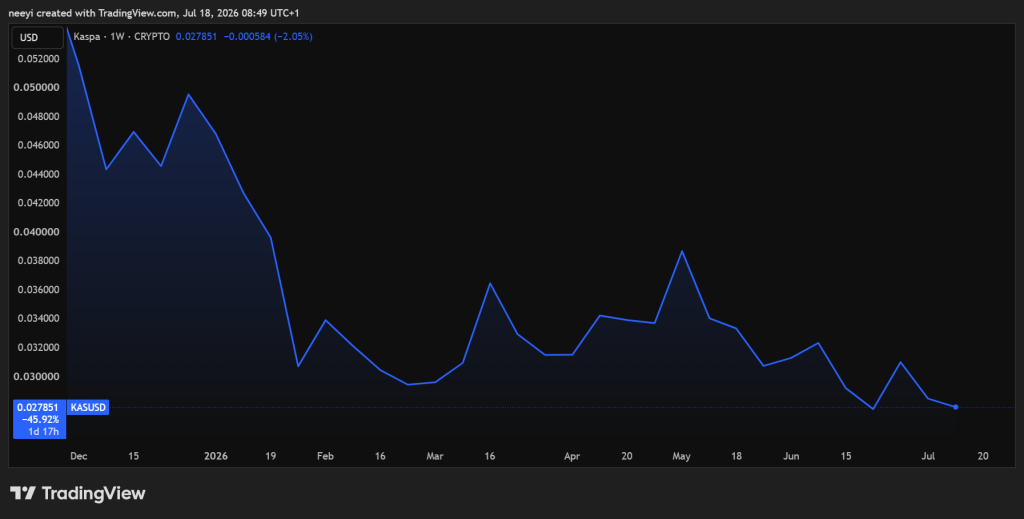
KAS price currently trades around $0.028, leaving it roughly 86% below its all time high of $0.2075 reached in July 2024.
The decline began after speculative demand faded following that record high. KAS spent much of the second half of 2024 moving lower as liquidity shifted toward larger cryptocurrencies. Early 2025 brought a brief recovery that carried the token to about $0.152, although that move failed to develop into a sustained uptrend.
KASUSD Price Chart / TradingView.com
Another challenge came from Kaspa’s still developing ecosystem. Limited smart contract activity, fewer tier 1 exchange listings, and a relatively small DeFi presence reduced fresh demand throughout much of 2025. That eventually left KAS trading between $0.048 and $0.050 toward the end of the year.
Market conditions remained difficult during 2026. KAS reached a yearly high of about $0.053 in January before broader weakness pushed the price close to $0.025 in February. Optimism surrounding the Toccata hard fork later helped the token recover above $0.031, although a familiar sell the news reaction followed once the upgrade became active.
Today, Kaspa continues to consolidate between $0.027 and $0.030. That leaves the project at an interesting point where future price performance could depend more on smart contract adoption and ecosystem growth than technical upgrades alone.
Solana Price Outlook
SOL price currently trades near $75, placing it roughly 74% below its local peak near $295 reached in January 2025.
Unlike Kaspa, Solana entered its correction after an exceptionally strong expansion cycle fueled by DeFi growth, meme coins, and institutional interest. Once liquidity tightened across crypto markets, SOL gave back much of those gains during an extended correction.
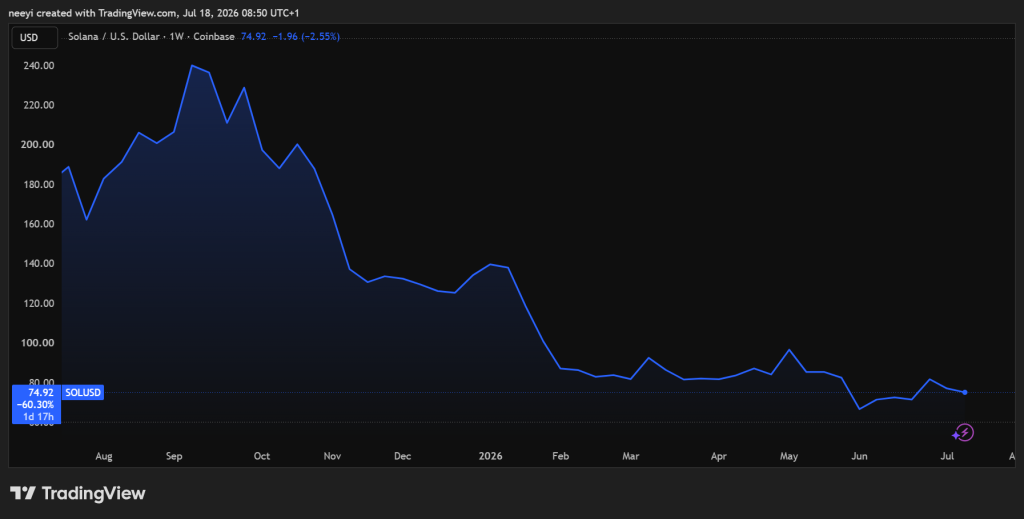
SOLUSD Price Chart / TradingView.com
Price action remained volatile throughout 2025. Solana dropped close to $110 during the first quarter before recovering above $200 later in the year as network activity improved. Another wave of macroeconomic uncertainty eventually pushed SOL back below $100 by December.
The correction continued during 2026. SOL briefly climbed above $105 early in the year before sliding to roughly $74 after several months of persistent selling pressure.
Recent trading has looked more constructive. Solana has stabilized around the $76 to $78 region, which many analysts view as an important long term support area. Continued institutional adoption, expanding tokenization projects, and ongoing network upgrades could help strengthen that foundation over the coming years.
ChatGPT’s Price Scenarios for the Next 5 Years
After reviewing the current state of both projects, we asked ChatGPT to estimate what Kaspa price and SOL price could look like over the next 5 years based on technology, adoption, ecosystem development, tokenomics, and current market valuations.
The following scenarios represent possible outcomes presented by ChatGPT.
ScenarioKaspa (KAS)Solana (SOL)Likely WinnerConservative$0.08 to $0.12$150 to $180Solana for stabilityModerate$0.18 to $0.25$220 to $280Kaspa for returnsBullish$0.35 to $0.50$350 to $450Kaspa by percentage gainExtremely Bullish$0.60 to $0.80$500 to $650Kaspa by a wide margin
Conservative Scenario
This outcome assumes crypto adoption continues steadily without another explosive bull market.
Solana benefits from its established ecosystem, growing institutional participation, and mature developer community. Kaspa also appreciates from current levels, although adoption progresses gradually as its smart contract ecosystem continues developing.
Solana appears stronger under this scenario because its existing infrastructure provides more stability.
Moderate Scenario
This scenario assumes healthy market conditions and successful execution by both projects.
Kaspa launches a thriving smart contract ecosystem, attracts more developers, and secures broader exchange support. Solana continues expanding across payments, DeFi, and real world asset tokenization.
Kaspa becomes the stronger performer because its smaller market capitalization allows much larger percentage gains than SOL.
Bullish Scenario
A broad crypto bull market returns, bringing substantial capital back into Layer 1 networks.
Solana reaches new highs as institutions continue building products around its ecosystem. Kaspa also benefits from renewed speculation, stronger adoption, and increased developer activity.
This becomes the environment where KAS price could outperform SOL price by a comfortable margin. Solana still delivers impressive gains, although its much larger valuation naturally limits its percentage upside.
Extremely Bullish Scenario
This represents the most optimistic outcome over the next 5 years.
Kaspa successfully establishes itself as one of the leading Proof of Work smart contract platforms. BlockDAG technology gains wider acceptance, decentralized applications expand rapidly, and major exchanges continue strengthening support.
Solana also performs exceptionally well as tokenization, payments, and institutional adoption accelerate.
Even under this optimistic outlook, ChatGPT believes Kaspa offers the greater profit potential because moving from a market capitalization below $1 billion to several billion dollars requires far less capital than pushing Solana hundreds of billions of dollars higher.
That difference does not necessarily make Kaspa the better investment for everyone. Investors seeking higher upside may prefer KAS, whereas those who value greater liquidity, a mature ecosystem, and lower execution risk may still find Solana the more comfortable long term holding.
Read Also: Why $1 Could Be a Realistic SEI Price Target in the Coming Bull Run
Which investment looks better for a Five Year Portfolio?
The answer depends more on risk tolerance than technology alone.
Investors seeking an established blockchain with deep liquidity, strong developer activity, and growing institutional support may find Solana the stronger choice.
Those comfortable accepting greater uncertainty in exchange for potentially higher percentage returns may prefer Kaspa. Its BlockDAG architecture, declining token emissions, and early stage ecosystem leave room for substantial growth if adoption follows the technology.
Owning both could even make sense for diversified portfolios. Solana provides exposure to one of crypto’s leading smart contract platforms, while Kaspa offers exposure to a newer Layer 1 that still has much to prove.
FAQs
Does Kaspa coin have a future?Kaspa (KAS) has a promising but highly speculative future. Its long-term viability hinges on whether its unique technology and recent upgrades can attract widespread developer adoption and real-world utility to compete with established networks
Can Kaspa reach $10?Yes, Kaspa (KAS) reaching $10 is theoretically possible but highly ambitious, with most prediction models and market analysts projecting this milestone between 2030 and 2040.
Subscribe to our YouTube channel for daily crypto updates, market insights, and expert analysis.
The post Is Kaspa Better Than Solana for a 5-Year Investment? appeared first on CaptainAltcoin.