In Russia crypto news, the State Duma passed Bill No. 1194918-8 on July 21, 2026, imposing a ₽300,000 (~$3,800) annual purchase cap on non-qualified retail crypto investors, banning peer-to-p
In Russia crypto news, the State Duma passed Bill No. 1194918-8 on July 21, 2026, imposing a ₽300,000 (~$3,800) annual purchase cap on non-qualified retail crypto investors, banning peer-to-peer trading through licensed intermediaries only, and routing all domestic activity through a Bank of Russia-supervised exchange regime effective September 1, 2026.
Anatoly Aksakov, chair of the State Duma Financial Market Committee, stated that the crypto market’s regulation would be fully streamlined by July 27, with implementation rolling out in phases starting on the September 1 effective date.
The law creates Russia’s first comprehensive crypto regulation framework, one that simultaneously tightens domestic retail access to levels that will push many existing participants toward compliance or exit, while carving out an explicit permission structure for cross-border settlements that functions as a state-sanctioned alternative to SWIFT.
The EU’s April 2026 sanctions package, which targeted Russian crypto providers directly and noted Russia’s growing reliance on cryptocurrencies for international transactions, provided the geopolitical backdrop against which the Duma finalized the law’s provisions.
Russia Crypto Retail Investor Framework: The ₽300,000 Annual Cap, Mandatory Risk-Awareness Test, and Whitelisted Asset List That Define Non-Qualified Access
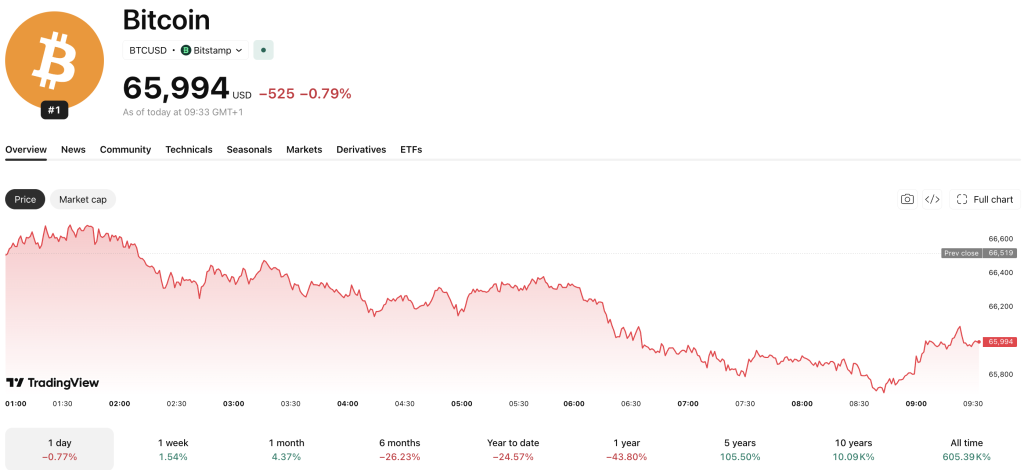 SOURCE: TradingView
Non-qualified investors have a ₽300,000 (~$3,800) annual purchase limit per licensed intermediary, enforced individually at each platform, making multi-platform arbitrage difficult.
They must pass a mandatory risk-awareness test before making purchases, which blocks transactions until it is passed. This aligns with the Bank of Russia’s preference for controlled retail participation.
Cross-border transfers for non-qualified accounts are capped at ₽100,000 per transaction. The asset list is limited to high-market-cap instruments, including Bitcoin, Ethereum, USDT, and USDC, while privacy coins are excluded due to anti-money laundering laws.
A 48-hour cooling-off period applies to some purchases. Qualified investors, with a ~₽3,000,000 purchase ceiling, face no asset restrictions and a ~₽1,000,000 cross-border transfer limit.
Starting September 1, 2026, legally recognized crypto transactions in Russia must occur through licensed digital depositories or authorized platforms, making informal peer-to-peer trading illegal.
The hard ban on P2P trading will take effect on July 1, 2027, giving unlicensed operators about ten months to either obtain registration with the Bank of Russia or shut down.
During this period, banks must refuse transfers linked to suspect unlicensed exchanges, and licensed platforms cannot route payments to unregistered foreign venues.
This prohibition aims to eliminate informal intermediation, forcing traders to either comply with the regulated system or risk operating illegally as the deadline approaches.
Licensed Exchange Framework and Bank of Russia Crypto Oversight
Entities operating as crypto exchanges, brokers, custodians, and similar roles must be licensed by the Bank of Russia after September 1, 2026. This licensing requires meeting capital, anti-money laundering, and transaction reporting standards. Licensed platforms can also act as tax withholding agents, integrating Russia crypto income into Russia’s tax system.
The previous legal grey area under the 2020 Digital Financial Assets law ends with the new regulations. Existing firms can operate without registration until July 1, 2027, but banks must block transfers to unlicensed operators immediately, limiting unlicensed platforms’ access to payment systems sooner than the deadline.
Additionally, the law provides judicial protection for digital currency holders, easing legal barriers for those entering the licensed framework. This approach contrasts with Europe’s MiCA, which imposes more restrictions on retail access while permitting state-directed cross-border transactions.
The author does not hold or have a position in any securities discussed in the article. All prices were quoted at the time of writing.
The post Is Putin Set to Legalize Crypto in Russia? What Next for BTC? appeared first on Tokenist.