Key Takeaways Shares of Walmart have fallen 24% since reporting Q1 2026 results in May, now priced at $103.09 Second-quarter revenue reached $187.94 billion, representing 5.9% annual growth a
Key Takeaways
- Shares of Walmart have fallen 24% since reporting Q1 2026 results in May, now priced at $103.09
- Second-quarter revenue reached $187.94 billion, representing 5.9% annual growth and surpassing forecasts, while EPS hit $0.81 versus the $0.74 consensus
- The company’s Q3 sales forecast of 3% to 3.75% expansion fell short of expectations, causing the steepest single-session decline since 2022
- The price-to-earnings multiple has declined to 37, approaching its five-year historical average, while the dividend yield of 0.95% trails the S&P 500’s 1.04%
- Wall Street maintains a “Moderate Buy” consensus with a $131.88 average target, though multiple analysts have lowered their price objectives recently
Shares of Walmart began Friday’s session at $103.09, representing approximately a 24% decline from the 52-week peak of $135.15. The retreat commenced following the release of Q1 2026 financial results in May, with downward pressure persisting through subsequent months.
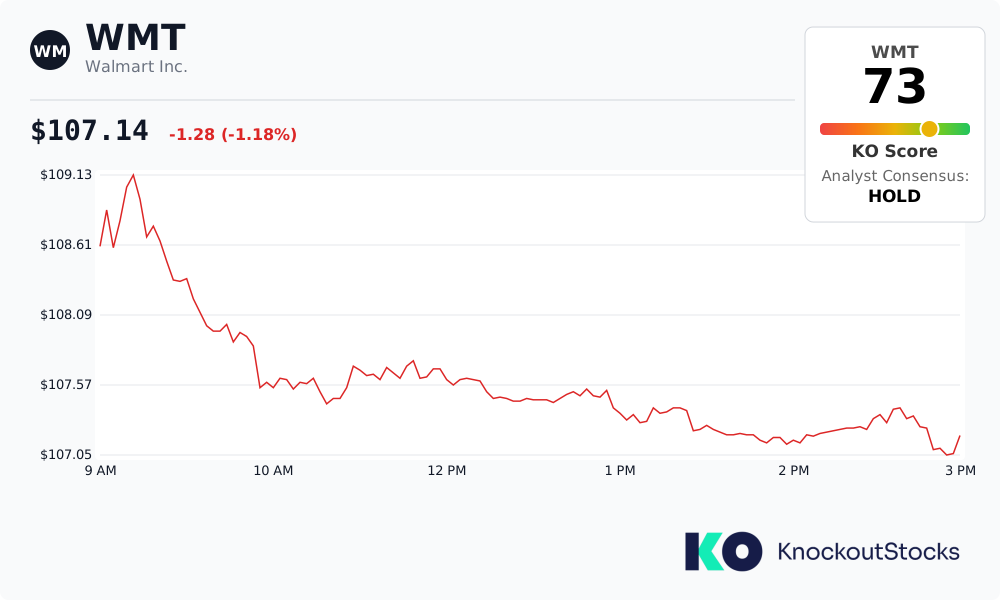 Walmart Inc., WMT
The equity currently trades beneath both its 50-day moving average of $111.90 and its 200-day moving average of $120.45. The company maintains a market capitalization of approximately $820 billion.
Second-quarter performance exceeded expectations. Walmart delivered earnings per share of $0.81, surpassing the analyst consensus of $0.74. Top-line results of $187.94 billion also beat projections of $186.64 billion, marking 5.9% growth compared to the prior year.
The concern centered on forward guidance. Walmart forecasted net sales expansion of only 3% to 3.75% for the third quarter. This outlook fell significantly short of the 6.6% revenue acceleration achieved during the first half of fiscal 2027.
The disappointing forecast sparked the stock’s sharpest one-day decline in two years. Market participants had been willing to pay elevated multiples for superior growth rates, and those growth expectations now appear to be moderating.
Examining Current Valuation Metrics
The price-to-earnings multiple reached 49 earlier in 2024. It has now contracted to 37, bringing it near Walmart’s five-year historical average. However, this doesn’t necessarily indicate the stock is undervalued. The multiple has dipped below 30 on multiple occasions during the past five years.
The current dividend yield of 0.95% falls short of the S&P 500’s 1.04% average, diminishing its attractiveness for yield-seeking portfolios. Walmart has increased its dividend for 53 straight years, achieving Dividend King distinction, yet the yield alone isn’t compelling investors to accumulate shares at current prices.
Net income during the initial two quarters of fiscal 2026 totaled $11.7 billion, reflecting modest 2% year-over-year growth. Fluctuations in the fair value of equity investments negatively impacted this figure.
Institutional Holdings and Price Targets
Institutional investors and hedge funds control 26.76% of outstanding Walmart shares. Pure Financial Advisors established a new stake valued at $8.1 million during Q2. Major holders including State Street, Geode Capital, and Bank of America have either increased existing positions or initiated new ones in recent reporting periods.
Regarding insider transactions, EVP Daniel Danker divested 50,644 shares at $105.35 on August 26th, generating approximately $5.3 million. The transaction occurred under a pre-established Rule 10b5-1 trading plan designed to satisfy tax liabilities related to vested equity compensation.
Wall Street analysts have reduced price objectives lately. JPMorgan lowered its target from $137 to $125 while retaining an “overweight” recommendation. Telsey decreased its target from $140 to $130 while keeping an “outperform” stance. Raymond James and KeyCorp have similarly maintained constructive ratings.
The Street consensus stands at “Moderate Buy” with an average price objective of $131.88. Walmart has issued Q3 2027 EPS guidance ranging from $0.62 to $0.64, alongside full fiscal 2027 guidance of $2.80 to $2.87 per share.
Digital commerce expanded 23% while advertising revenue surged 38% during Q2, demonstrating that the company’s higher-margin business segments continue to deliver strong results.
The post Is Walmart (WMT) Stock a Bargain After Its 24% Decline From Peak Levels? appeared first on Blockonomi.