Janction JCT Volume: Does $220M Show Real Token Demand? Janction JCT trading volume doesn’t automatically mean token demand. Futures contracts, borrowed-money trades, and repeat trading can i
Janction JCT Volume: Does $220M Show Real Token Demand?
Janction JCT trading volume doesn’t automatically mean token demand. Futures contracts, borrowed-money trades, and repeat trading can inflate volume without matching spot buying. Real demand depends more on staking, JCT payments, and verifiable GPU network activity.
Janction JCT is in the spotlight after reports of about $220M in trading volume, a figure that has been hard to pin to one exchange, market type, or time window. In crypto news today, big volume often passes for strong demand.
This article checks that idea against the project’s official documents and alive market data snapshot taken on November 16, 2026.
What Is Janction Crypto, and How Does the GPU Marketplace Work?
Janction is a network that shares computing power for AI work. Owners of spare GPUs (graphics chips that run AI tasks) rent that power to AI users who need it.
The project calls itself a layer 2 network for AI services, which puts it among DePIN AI projects. DePIN means decentralized physical infrastructure networks, which pay people to supply real hardware.
The Janction GPU marketplace matches those providers with AI customers, and the token is one way to pay and take part, not the only way.
Janction JCT Spot vs Futures Volume: What the Data Shows
Trading volume is the total value of all buys and sells in a set time. Spot volume covers real token purchases. Futures volume covers contracts that follow the price without owning the token, often with borrowed money that boosts both wins and losses.
Amarket snapshot from November 16, 2026 (01:18 UTC+8, combined across 30+ exchanges) shows the gap.
Metric
Snapshot
Futures volume
$283.56M
Spot volume
$5.02M
Futures-to-spot ratio
about 56.5x
Open interest
$65.60M
Funding rate
0.0734%
Liquidations
$1.18M, 68% longs
Futures volume ran about 56 times spot volume. Open interest, the total value of open futures contracts, sat at $65.60M, and the funding rate, a fee longs pay shorts, was above the usual baseline. In the same 24 hours, long positions took most of the $1.18M in liquidations, which are forced closures of leveraged trades. That mix points to leveraged betting, not broad buying.
Price tells a similar story. JCT hit a record $0.01804 on November 8, and it sits 86.4% below that high, down about 79% over seven days. No single-day figure here matches the $220M headline, so it stays unverified.
Real token demand means people need JCT for a reason and keep holding it. Trading demand only means people want to swap it today. So who’s still holding the token once the traders move on?
How Does Janction Token Utility Create Real Demand?
The Janction token utility covers four areas, according to theofficial utility page.
GPU staking and bidding: providers lock JCT to earn veJCT, a non-transferable credential for bidding, matching, and priority.
Payments: users can pay in stablecoins or JCT, and JCT payments may bring credits or fee cuts set by governance.
Governance: veJCT holders vote on marketplace settings, grants, and budgets.
Contributions: governance may reward infrastructure work, data checks, or technical help.
The stablecoin option changes the math. More computing use doesn’t force more JCT buying, since users can skip the token, and the docs say so openly. JCT staking may be the stronger demand source, but the reviewed documents don’t publish the staked total.
What Does Janction Tokenomics Say About Supply Pressure?
Total supply is 50 billion JCT, with about 90% on Ethereum and 10% on BNB Chain, per theofficial tokenomics page. The project says 22.99% circulated at launch.
Allocation
Share
Release schedule
Ecosystem
34.29%
30% at launch, 1-year cliff, 2-year vesting
Team
21.34%
18-month cliff, 3-year vesting
Foundation
18%
1-year cliff, 2-year vesting
Investors
10%
1-year cliff, 18-month linear
Airdrop
5.70%
100% at launch
Liquidity
4%
100% at launch
Advisors
3.67%
1-year cliff, 2-year linear
Community incentive
3%
100% at launch
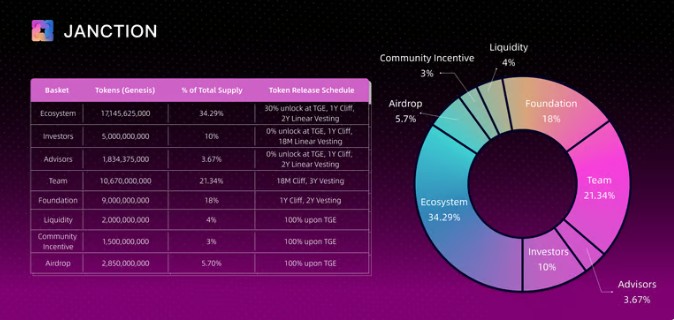
Cliffs matter here. A cliff is a waiting period before tokens start to unlock, and vesting is the schedule that releases them afterward. Investor, advisor, and foundation cliffs each last one year, and trading began on November 10, 2025, so first-year cliffs end around now. Scheduled unlocks don’t guarantee selling, though.
JCT circulating supply needs care. The project’s launch figure works out to about 11.5 billion JCT, while the live snapshot shows 10.34 billion, or 20.7% of supply. Trackers count differently, and unlocked tokens aren’t always circulating or ready to sell. Figures depend on the provider, so timestamps matter.
Market cap counts circulating tokens only, while fully diluted valuation counts all 50 billion, so the snapshot’s $24.85M and $122.65M show how much remains locked.
Does Janction Have Real GPU Marketplace Adoption?
Public documents don’t list active GPU providers, completed jobs, paying customers, marketplace revenue, or JCT-settled payments. Without them, nobody can measure adoption yet.
What Does the Janction Roadmap Show So Far?
Theroadmap page is an interactive board focused on transparency and feedback milestones, so it gives no dated targets. Instead, the steps below follow what anyone can verify.
Launch: trading began November 10, 2025.
Marketplace: published counts of GPU providers, jobs, and customers.
Staking: disclosed JCT staking totals and veJCT participation.
Governance: live votes on grants, budgets, and marketplace settings.
Supply: dated unlock updates as first-year cliffs end.
Expert Take: Which Signals Matter More Than Volume?
A stronger signal would be GPU marketplace revenue paid in JCT, since that ties computing demand straight to token buying. The main worry is that stablecoin payments can weaken that tie. On current evidence, the $220M headline is a trading signal first and a demand signal second.
Risks deserve equal attention. Leverage can flip prices fast, and AI scams often follow trending AI crypto tokens through fake airdrops and cloned sites. Readers following India crypto news should check every link against the official site and thecontract addresses in the docs before connecting a wallet.
Method note: project claims come from Janction’s documents, market figures come from one dated snapshot, and the two stay separate. Snapshot numbers change by the minute.
Conclusion: Janction JCT Volume Is One Piece of the Story
Janction JCT runs a GPU marketplace for AI work, and its token covers staking, payments, governance, and contribution rewards. What stands out is a 50 billion supply and a futures market far larger than the spot.
Less clear is how much real usage will flow through JCT instead of stablecoins. Next checks: staking totals, marketplace revenue, and confirmedunlock dates.
Disclaimer
This article is for informational purposes only and isn’t financial advice. Crypto is volatile, and losses can be total. Readers should research independently and ask a licensed adviser.