Policy1 min read
Kraken parent Payward plans first CFTC-regulated markets on Hyperliquid
Payward, Kraken’s parent company, plans to deploy CFTC-regulated perpetual futures markets on Hyperliquid through Bitnomial. Read the full story on Altcoin Buz
Asset manager Janus Henderson and tokenization platform Centrifuge have launched JQQQ, a blockchain-based fund designed to provide eligible investors exposure to the Nasdaq-100 Index through
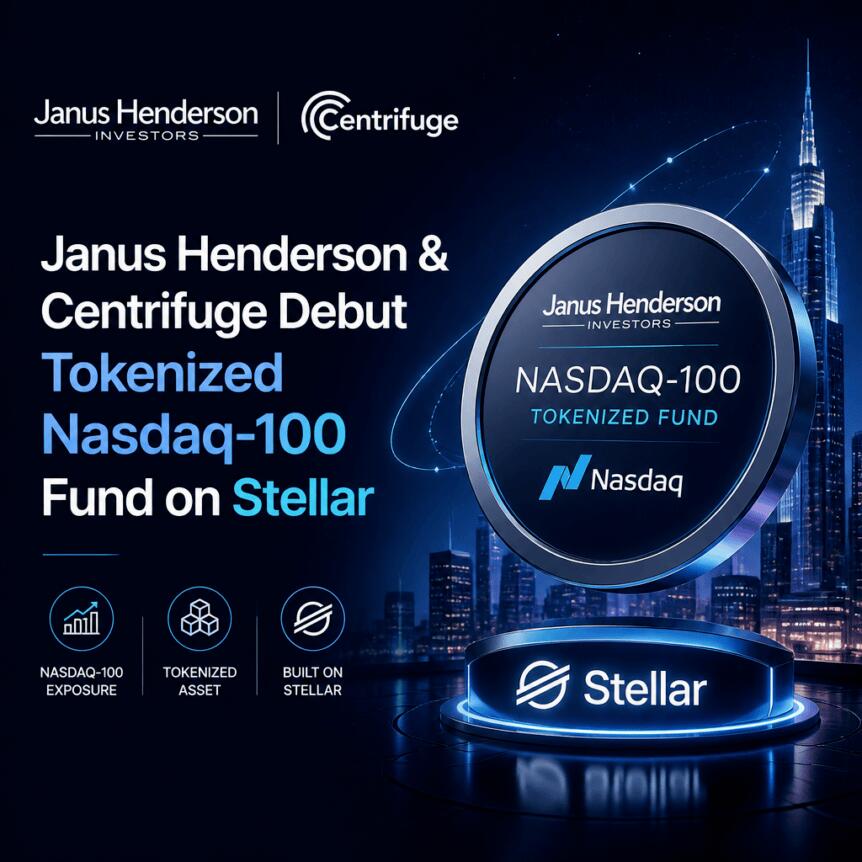
Asset manager Janus Henderson and tokenization platform Centrifuge have launched JQQQ, a blockchain-based fund designed to provide eligible investors exposure to the Nasdaq-100 Index through the Stellar network. The fund, announced on Tuesday, is aimed at professional investors outside the United States, according to reporting by the Wall Street Journal.
Janus Henderson said the vehicle is built using Centrifuge’s tokenization infrastructure and structured to track the Nasdaq-100 under a licensing agreement with Nasdaq. The launch extends the firm’s existing onchain offerings, which have previously focused on US Treasurys and structured credit, into an equity-index wrapper.
The Janus Henderson announcement frames JQQQ as part of a broader push to broaden institutional onchain investment strategies. The asset manager said its institutional onchain strategies now total more than $1 billion, building on earlier work in tokenized debt products such as US Treasurys and structured credit.
JQQQ is set up as a segregated portfolio within a British Virgin Islands investment company. Rather than offering direct participation in individual Nasdaq-100 constituents, the fund provides indirect exposure to the benchmark index. That distinction may matter for investors assessing what they are actually holding and how index tracking is operationalized in a tokenized structure.
Regulatory and eligibility boundaries are also explicit. The fund is described as aimed at eligible professional investors outside the United States, with the Wall Street Journal reporting a $100,000 minimum investment.
Nasdaq’s involvement is central to why a tokenized Nasdaq-100 wrapper is possible. In April, Nasdaq said it would expand licensing for the Nasdaq-100 Index to additional asset managers, naming companies including BlackRock and State Street. The company also said it would maintain its longstanding relationship with Invesco, which runs the large-cap Invesco QQQ Trust exchange-traded fund (with a market capitalization referenced in the original announcement).
That licensing expansion helps explain the direction of travel for the category: once index rights are distributed more widely, issuers can design products that translate benchmark exposure into tokenized formats. For market participants, it also suggests that future tokenized index offerings may increasingly depend on formal licensing rather than purely on-chain engineering.
JQQQ also adds another high-profile use case to Stellar’s growing role in institutional tokenization. According to RWA.xyz, Stellar ranks fourth among blockchains by distributed real-world asset value, with approximately $3.8 billion in tokenized assets, behind Ethereum, BNB Chain, and Solana.
The Stellar network has hosted tokenized assets from major issuers, including Spiko, Franklin Templeton, and Ondo. In parallel, other tokenization players have announced plans to extend private credit and broader asset classes onto Stellar. For example, Cointelegraph previously reported that Tradable announced plans to bring up to $1 billion in private credit assets to Stellar, with $500 million expected at launch.
Institutional plumbing is also developing through traditional market infrastructure. Cointelegraph previously reported that the Depository Trust & Clearing Corporation (DTCC) said in May it would connect its tokenization service to Stellar. The DTCC said tokenized assets are expected to become available in the first half of 2027, potentially including US Treasurys, major index ETFs, and Russell 1000 stocks. While that is a separate timeline from JQQQ, the broader implication is that Stellar is positioning itself as a settlement and distribution layer for financial-market tokenization.
Even with growing product availability, investors evaluating tokenized funds like JQQQ may want to focus on how index tracking is implemented and how risks are managed—especially since the fund is structured for indirect exposure rather than direct stock ownership.
Eligibility will be another practical consideration. The reported $100,000 minimum and the focus on eligible professional investors outside the US mean the initial user base may be narrower than retail-facing products. That could also shape liquidity and distribution dynamics in the early stages.
Finally, Stellar’s institutional footprint is expanding even as its native asset remains under scrutiny. CoinGecko data cited in the original report shows XLM down roughly 16% year to date, trading near $0.17 on Tuesday. That divergence—between growing tokenized asset activity and weaker native token performance—has become a familiar theme in real-world asset tokenization and is worth monitoring as more regulated products come online.
With JQQQ now launched on Stellar under Nasdaq licensing, the next signal to watch is whether more asset managers pursue similar tokenized index products—particularly as Nasdaq’s broader licensing framework expands and traditional market infrastructure like DTCC’s integration moves closer to activation.
This article was originally published as Janus Henderson & Centrifuge Debut Tokenized Nasdaq-100 Fund on Stellar on Crypto Breaking News – your trusted source for crypto news, Bitcoin news, and blockchain updates.