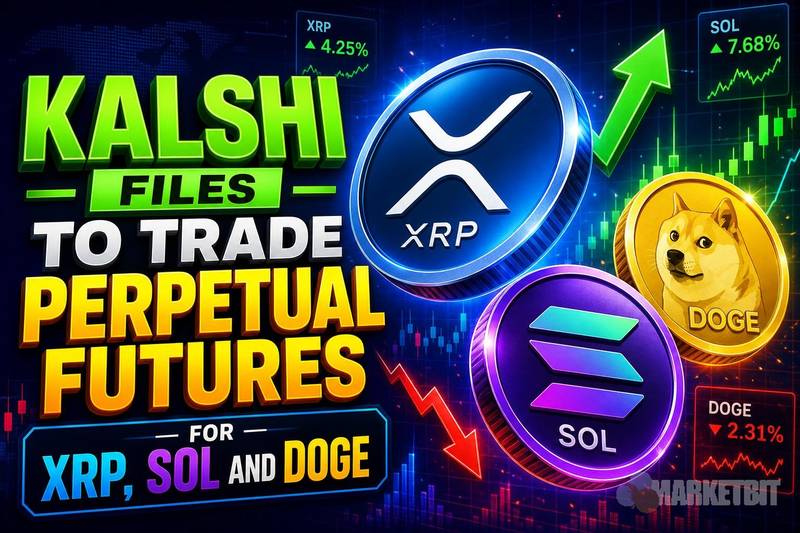
Kalshi has filed to list perpetual futures contracts tied to XRP, Solana (SOL), and Dogecoin (DOGE), expanding the regulated prediction market platform's push into crypto derivatives beyond i
Kalshi has filed to list perpetual futures contracts tied to XRP, Solana (SOL), and Dogecoin (DOGE), expanding the regulated prediction market platform's push into crypto derivatives beyond its initial offerings.
The filings, submitted to the Commodity Futures Trading Commission, cover perpetual futures for all three altcoins. Documentation for the proposed contracts appears in CFTC product filings published through the agency's trading organization products portal.
Kalshi previously announced its entry into perpetual futures trading for U.S. customers, positioning itself as a regulated domestic alternative to offshore crypto exchanges that have long dominated the derivatives market.
What the Filing Covers
The filing names three specific assets: XRP, SOL, and DOGE. Each would be offered as a perpetual futures contract, a product structure that tracks an underlying asset's price without a fixed expiration date.
This is a filing, not a confirmed product launch. The contracts would need to clear CFTC review before going live on the platform. Separate filings for individual contract terms have also been submitted to the agency.
For traders tracking broader altcoin market conditions, recent price analysis of XRP and DOGE suggests subdued momentum across major tokens heading into June.
How Perpetual Futures Fit Kalshi's Strategy
Perpetual futures are the most traded crypto derivative product globally. Unlike standard futures, they have no settlement date, allowing traders to hold positions indefinitely while paying or receiving periodic funding rates.
Kalshi's move to offer these products onshore is a market-structure development. Most perpetual futures volume currently flows through offshore venues that operate outside U.S. regulatory oversight. A CFTC-regulated listing would give domestic traders direct access without the legal ambiguity of using foreign platforms.
The filing also signals that Kalshi sees demand beyond prediction markets, the category that originally defined the platform. Crypto perpetual futures represent a significant expansion in product complexity and trading volume potential, a shift that investors like Kevin O'Leary have suggested will increasingly matter as institutional interest in crypto products grows.
Why XRP, Solana, and Dogecoin
The choice of XRP, SOL, and DOGE reflects a focus on liquid, high-recognition altcoins with large retail trading bases. All three consistently rank among the top tokens by trading volume and social media engagement.
Each asset carries a distinct market profile. XRP is tied to cross-border payments infrastructure and has been at the center of major U.S. regulatory proceedings. Solana has become a leading smart contract platform with deep DeFi activity. Dogecoin, originally a meme token, maintains one of the most active retail communities in crypto.
Selecting these three rather than smaller or more niche tokens suggests Kalshi is prioritizing assets where existing trader demand and liquidity can support a new derivatives venue. This approach mirrors how traditional exchanges typically launch futures products, starting with the most liquid underlying assets before expanding the lineup.
What traders will watch next is whether the CFTC approves the contracts and on what timeline. The CFTC's industry filings page will reflect any updates to the review status. The broader question is whether a regulated U.S. perpetual futures market, something that has remained largely theoretical until now, can attract meaningful volume away from offshore competitors. How that plays out could reshape how risk-adjusted returns compare between traditional and crypto markets.
Disclaimer: This article is for informational purposes only and does not constitute financial or investment advice. Cryptocurrency and digital asset markets carry significant risk. Always do your own research before making decisions.
Read original article on marketbit.net