Kalshi has pledged to supply $1 million and data about the prediction markets it hosted during US midterm elections for up to 50 research projects looking to produce studies based on the data
Kalshi has pledged to supply $1 million and data about the prediction markets it hosted during US midterm elections for up to 50 research projects looking to produce studies based on the dataset.
The offer from the leading prediction market platform comes after CEO Tarek Mansour took a victory lap about the accuracy of the odds it supplied as America went to the polls.
Kalshi also faces potential uncertainty from the Democrat-led Congress that emerged from the elections, with fresh CFTC scrutiny adding to the pressure from the roughly 20 state attorneys general that have the company in their sights.
Kalshi offers $1 million to researchers
The $1 million grant program announced by Kalshi is open to researchers. Interested applicants can send their pitches in for consideration by quote-tweeting their ideas to this post announcing the program and applying through the website.
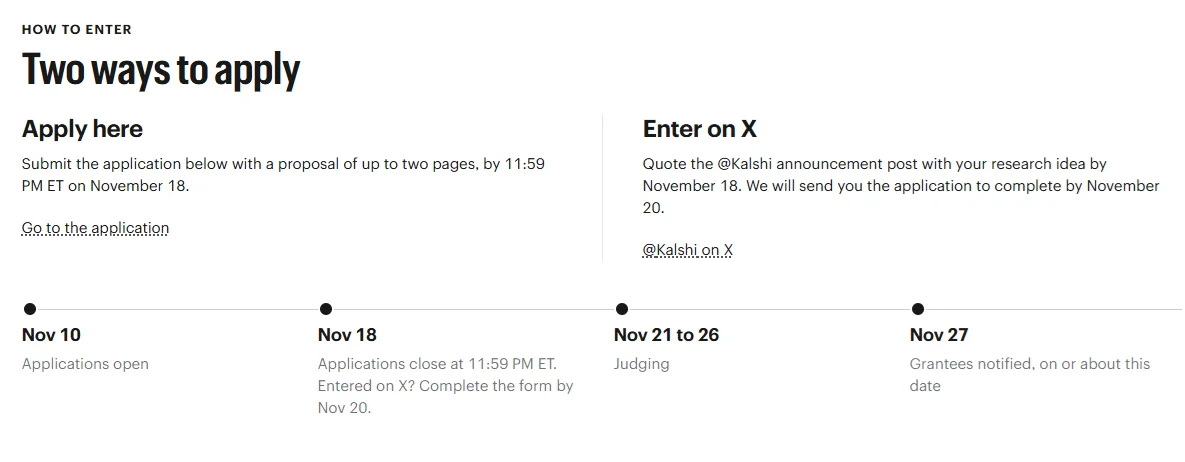
How to apply to Kalshi’s $1 million research grant program. Source: Kalshi
Successful applicants will have access to any public platform data they need for their research project.
Kalshi Research, the unit running this program, was launched almost one year ago, in December 2025, to build a route to connect academics with its internal trading records and to host a prediction market conference. The prediction market operator compared the research arm to similar units at leading AI labs, Anthropic and OpenAI.
When it launched last year, the platform claimed to have onboarded scholars from schools such as Harvard, Stanford, the University of Chicago and Yale.
Data from the research arm over the last year have reflected the scale of the platform’s growth and success. One research paper reviewing the 2026 midterms reported directional accuracy reaching 98.2% by the time polls closed, improving on its 93.8% score from three months earlier. Brier scores also went from 0.040 to 0.016 over the same period. The lower the score, the better the grade on the Brier measure of forecast error.
The study said Kalshi matched or beat polling averages at every point where polls existed.
Kalshi has been riding high since the midterms
Kalshi put up strong numbers during the November midterms, with trading volume topping $2.5 billion on the 2026 markets, nearly double the $1.3 billion from the 2024 round.
CEO Tarek Mansour was also bullish on X, declaring that “The power to decide what America sees changed hands,” pointing to the platform’s record of calling winners in about 98% of the races it listed.
Co-founder Luana Lopes Lara dubbed Kalshi as “the future of news.” The platform reported that listed favorites emerged as winners in 479 of the first 487 decided contests.
Notably, rival prediction market platform Polymarket had a slight edge in accuracy over Kalshi’s House and Senate odds, per a RotoWire breakdown.
What does a Democratic Congress and potential CFTC action mean?
As Kalshi and Polymarket rightly forecast, Democrats took both the House and Senate on November 3, and several of the party’s lawmakers are not big fans of prediction markets as they currently operate.
Senator Jeff Merkley and Representative Maxine Waters have criticized the platforms for letting people bet on elections, war and terrorism. CNBC has counted nearly 30 prediction market bills introduced since 2025, most from Democrats, according to Cryptopolitan’s reporting.
The pressure is not strictly partisan. Senator Elizabeth Warren, a Democrat, and Senator John Curtis, a Republican, sent the platforms joint letters before the vote asking how they guard against insider trading.
State courts are already a battlefield. Arkansas Attorney General Tim Griffin sued Kalshi on November 4, a day after the election, calling it a “pocket-sized bookie” operating without a gaming license. That suit pushed the number of states challenging Kalshi to roughly 20, with Utah charging co-founders Mansour and Lopes Lara with 13 felonies in late October.
Then there is the regulator Kalshi has leaned on for cover. Politico reported on November 10 that the Commodity Futures Trading Commission privately warned Kalshi it could face charges over how it self-certified dozens of new contracts, a fast-track filing process the agency flagged twice this year.
Kalshi spokesperson Elisabeth Diana described the matter as a procedural error involving a handful of contracts, many of which never went live.
A settlement there could force exchanges into slower, contract-by-contract filings, the speed much of the sector’s growth depends on.
The smartest crypto minds already read our newsletter. Want in? Join them.