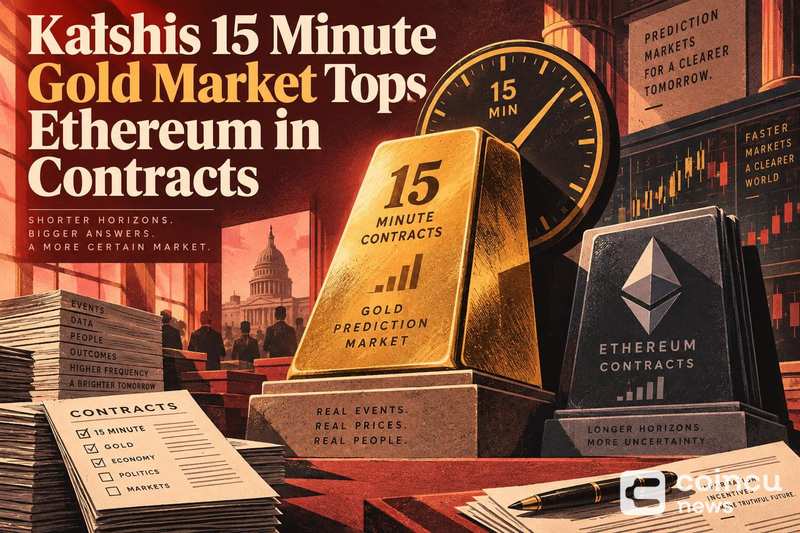
Kalshi's 15-minute gold market has surpassed Ethereum in total contract count, while fees generated on the platform approached $5 million in September, according to reports circulating among
Kalshi's 15-minute gold market has surpassed Ethereum in total contract count, while fees generated on the platform approached $5 million in September, according to reports circulating among prediction market observers, a milestone that signals accelerating retail demand for ultra-short-duration commodity contracts outside traditional crypto venues.
Kalshi's 15-minute gold market overtakes Ethereum in contract count
The crossover, as reported, positions Kalshi's gold product ahead of its Ethereum perpetual market in raw contract count, a metric that measures the number of discrete positions opened rather than notional dollar volume or open interest. Contract count is a distinct signal from trading volume: a single large-notional Ethereum trade can represent one contract, while a surge in 15-minute gold binary outcomes generates a new contract with every expiry cycle. For related coverage, see CFTC Chair Selig Urges Tokenization and 24/7 Market Readiness.
That distinction matters when interpreting the milestone. A higher contract count in the gold market does not necessarily imply higher revenue per contract or greater capital at risk; it reflects the frequency at which participants are placing and settling positions, driven by the 15-minute window that resets dozens of times per trading session.
September fees near $5 million show the market's monetization potential
Fees approaching $5 million in September, if confirmed, would represent a meaningful revenue signal for a prediction market platform that has sought CFTC approval to expand into U.S. stock perpetual contracts, underscoring that short-duration commodity markets can generate platform income competitive with longer-duration crypto derivatives. The "near $5 million" framing should be read as an approximation; the precise figure has not been independently verified as of the time of writing.
Fees in prediction markets typically reflect the platform's take on each settled contract rather than trader profit or loss. With 15-minute gold contracts resetting continuously, even a modest per-contract fee compounds rapidly across thousands of daily settlements, which is the mechanical reason short-expiry formats can produce outsized fee totals relative to their notional size.
Why 15-minute gold contracts are attracting attention
Short-expiry binary contracts on gold price direction appeal to participants who want event-based exposure without overnight holding risk, a format structurally distinct from spot gold, futures, or crypto derivatives. Each 15-minute window functions as a self-contained outcome: participants take a directional position on whether gold will close the interval higher or lower, and the contract settles automatically at expiry.
The rapid cadence also means losses and gains accumulate quickly. A participant who enters multiple sequential contracts across a trading session faces compounded risk that differs materially from a single longer-duration position, a consideration relevant to any assessment of the product's accessibility to retail traders.
Analysts tracking Kalshi's overall activity have previously noted anomalies in how the platform reports transaction statistics, as a reported gap between book volume and on-screen transaction data raised questions about how contract counts and fee figures should be interpreted. That context applies here: the contract-count crossover and the September fee figure should be treated as reported data points pending fuller disclosure from the platform.
How Kalshi's 15-minute gold market works
Contract window and settlement
Each contract resolves on a binary outcome tied to gold price direction over a fixed 15-minute interval. Settlement is automatic at expiry, removing the need for participants to actively close positions, which lowers the friction cost per trade and supports the high contract-count totals being reported.
What contract count measures
Contract count is a frequency metric, not a value metric. It counts how many individual contracts were opened and settled, regardless of size. In a market where each 15-minute cycle generates new contracts, the count will structurally outpace markets with longer durations and fewer resets per day, which is the primary reason the gold market can lead Ethereum in this specific metric while potentially trailing it in other measures.
Fees and participant risk
Platform fees are deducted at settlement and represent revenue to Kalshi rather than profit to participants. Regulatory scrutiny of prediction market platforms has intensified, with ESMA warning that platforms including Kalshi may operate without required EU licenses, a compliance backdrop that institutional participants weighing the platform's fee-generating trajectory should factor into their assessment.
FAQ: Kalshi gold contracts, fees, and the Ethereum comparison
What is Kalshi's 15-minute gold market? It is a prediction market product that allows participants to take directional positions on gold price movement within 15-minute windows, with automatic settlement at each expiry.
What does surpassing Ethereum in contract count mean? It means the gold market generated more individually settled contracts than Kalshi's Ethereum market over the measured period, reflecting the frequency advantage of a 15-minute cycle versus longer-duration crypto contracts. It does not indicate that the gold market is larger by notional volume or revenue.
How close to $5 million were September fees? The figure is reported as "near $5 million" for September; the exact amount has not been independently confirmed. Readers should treat this as an approximate reported figure.
Are contract count and fees the same as profit? No. Contract count measures activity frequency, and fees measure platform revenue. Neither figure indicates participant profit, which depends on individual trade outcomes and is not reported in aggregate by the platform.
The next concrete signal to watch is whether Kalshi publishes formal September activity disclosures or whether the CFTC review of its proposed stock perpetual contracts produces conditions that affect how the platform reports contract and fee data going forward.
Additional source references: source document 1, source document 2.
Disclaimer: This article is for informational purposes only and does not constitute financial or investment advice. Cryptocurrency and digital asset markets carry significant risk. Always do your own research before making decisions.
The post Kalshi's 15-Minute Gold Market Tops Ethereum in Contracts was initially published on Coincu.